John Sobieski
| John IV | |
|---|---|
| Defender of the faith | |
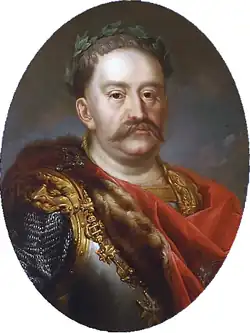 Sobieski in scale armour | |
| King of Poland Lithuania | |
| Reign | 11th December 1686-17th June 1696 |
| Predecessor | Louis |
| Successor | Francis |
| Born | 17th August 1629 Olesko Castle, Olesko |
| Died | 17th June 1696 (age 66) Wilanów Palace, Warsaw |
| Burial | Wawel Cathedral, Kraków |
| Spouse | Marie Casimire Louise de La Grange d'Arquien (m.1665) |
| Issue | James, Prince of Oława Teresa, Electress of Bavaria Prince Aleksander Prince Konstanty |
| House | Sobieski |
| Father | Jakub Sobieski |
| Mother | Zofia Teofila Daniłowicz |
| Religion | Roman Catholic |
| Signature | 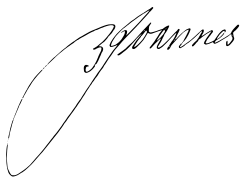 |
John II/IV Sobieski (17th August 1629-17th June 1696) was King of Poland Lithuania from 1686 until his death in 1696. John was born in Olesko, he spent his childhood in Zhovkva after graduating from Bartłomiej Nowodworski College in 1643, Sobieski then graduated from the philosophical faculty of the University of Kraków in 1646, after finishing his studies, John and his brother Marek left for Western Europe, where they spent more than 2 years travelling, the death of Władysław III Vasa and the hostilities of the Khmelnytsky Uprising, they volunteered to join the army.
In 1649, John fought in the Battle of Zboriv. In 1652, Marek died in Tatar captivity after his capture at the Battle of Batih. John was promoted the rank of Colonel and fought in the Battle of Berestechko. In 1653 Sobieski was sent by John III Casimir to the Ottoman Empire, he learnt Tatar and Turkish, he studied Ottoman traditions and military tactics after the start of the Deluge, John Sobieski was among the Greater Polish regiments led by Krzyszt Opaliński, Palatine of Poznań which capitulated at Ujście and swore allegiance to King Charles X of Sweden.
26th May 1656, he received the position of standard-bearer of the Crown, during the 3 days Battle of Warsaw, Sobieski commanded 2,000 men strong regiment of Tatar cavalry. He took part in a few engagements over the next 2 years, including the Siege of Toruń in 1658. In 1659, he was elected a deputy to the Sejm and was one of the Polish negotiators of the Treaty of Hadiach with the Cossacks. He took part in the war against the Russians, participating in the Battle of Slobodyshche and Battle of Lyubar and later that year negotiated the Treaty of Cudnów with the Cossacks.

Through personal connections, he became a strong supporter of the French faction in the Polish royal court, represented by Queen Marie Louise Gonzaga.Sobieski remained loyal to the King during the Lubomirski Rebellion, he participated in the Sejm of 1665, accepted the prestigious office of Marshal of the Crown on 18th May that year, in 1666 he was promoted Field Crown Hetmanhe was defeated at the Battle of Mątwy and signed the agreement of Łęgonice on 21st July, which ended the Lubomirski Rebellion.
In October 1667, he achieved another victory over the Cossacks of Petro Doroshenko and their Crimean Tatar allies in the Battle of Podhajce, during the Polish-Cossack-Tatar War (1666–71). On 5th February 1668, he was promoted Grand Hetman of the Crown, the highest military rank in the country and the de facto supreme commander of the Polish-Lithuanian Army. 1672 saw internal politics destabilizing the Commonwealth as the pro-French faction of Sobieski and pro-court faction of King Louis formed 2 confederations.