Jean Jaurès
Jean Jaurès | |
|---|---|
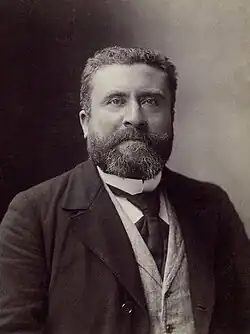 Jaurès in 1898 (photograph by Nadar) | |
| Member of the French Chamber of Deputies for the Tarn | |
| In office 1902–1914 | |
| Member of the French Chamber of Deputies for the Tarn | |
| In office 1893–1898 | |
| Member of the French Chamber of Deputies for the Tarn | |
| In office 1885–1889 | |
| Personal details | |
| Born | 3 September 1859 Castres, France |
| Died | 31 July 1914 (aged 54) Paris, France |
| Resting place | Panthéon, Paris |
| Political party | SFIO (1905–1914) |
| Spouse(s) | Louise Bois (married 1886) |
| Children | 2 |
| Alma mater | École normale supérieure |
| Occupation | Politician, philosopher, journalist, historian |
Jean Jaurès (3 September 1859 – 31 July 1914) was a French politician, philosopher, journalist and historian. He was one of the most important leaders of French socialism.
Jaurès entered the French parliament in 1885, at the age of 26. A great miners’ strike in the town of Carmaux made him a socialist in 1892. In 1898, he fought to prove that Captain Alfred Dreyfus, a Jewish officer accused of treason (helping the enemy), was innocent. In 1904, he started the newspaper L’Humanité. In 1905, he helped unite the French socialists in one party, the SFIO. In his last years, he fought against the danger of a great European war. A young French nationalist shot and killed him in Paris on 31 July 1914, three days before Germany declared war on France.
Jaurès is one of the most honored people in French history. In 1924, his body was moved to the Panthéon, the famous building in Paris where France keeps its great men and women. Thousands of streets, squares and schools in France carry his name.
He also left important written works. The main ones are a thesis in philosophy, De la réalité du monde sensible (printed in 1891, defended in 1892); a great history of the French Revolution, the Histoire socialiste de la Révolution française (1901–1904); and the book L’Armée nouvelle (1911). He also wrote several thousand newspaper articles.
Early years and studies (1859–1881)
A childhood in the Tarn
Jean Jaurès was born in Castres, a small town in the Tarn, in the south of France. His family was middle-class but not rich. His father, Jules Jaurès (1819–1882), had failed in business. He made his living from a small farm, La Fédial, near the town. His mother, Adélaïde Barbaza (1822–1906), was a very religious Catholic. She watched closely over the education of her two sons. The younger son, Louis (1860–1937), later became an admiral (a chief of the navy) and a deputy.
Jean grew up between the town and the countryside. All his life, he kept a deep love for the south of France, for the Occitan language, and for the world of the peasants (small farmers). He never forgot their problems when he became a politician.
In 1869, Jaurès entered the school of Castres with a scholarship (money given to a good student). He was a brilliant pupil. In 1876, a school inspector, Félix Deltour, saw that he had great abilities. He sent the boy to Paris, to the Sainte-Barbe school, to prepare the entrance examination of the École normale supérieure. This is a famous French school that trains teachers and scholars.
The same year, at sixteen, Jaurès gave his first public speech, a welcome to the prefect (the chief officer of the area). In 1878, he won the first prize of a national competition for the best speech in French. Then he came first in the entrance examination of the École normale supérieure. The philosopher Henri Bergson entered the school the same year.
Student of philosophy
At the École normale supérieure, Jaurès chose philosophy. He liked this subject because it tries to understand the world as a whole. In 1881, he came third in the agrégation of philosophy, a very hard examination for future teachers, behind Paul Lesbazeilles and Bergson.[1] The Republic and its free schools had opened this road to him. For this reason, he was thankful to the Republic all his life. For him, the Republic was a promise: knowledge could free the poor.
Teacher and young deputy (1881–1889)
Teaching philosophy
In the autumn of 1881, Jaurès became a teacher at the lycée (secondary school) of Albi. He chose to stay near his family: his father was very sick and died in May 1882. His teaching was a great success. He spoke without notes and treated his students as equals.
At the start of 1883, he began teaching courses at the University of Toulouse. He gave his first lecture there on 15 January. At the end of the same year, with the help of the rector Perroud, he became a lecturer there. He also gave lessons in morals at a girls’ school. In these courses, he slowly built his own philosophy of history. For Jaurès, philosophy and politics did not fight each other. They needed each other.
The youngest deputy of France
The republicans of the Tarn asked Jaurès to be a candidate in the elections of 1885. On 4 October, he was elected with a little more than half of the votes.[2] At 26, he was the youngest deputy of France. A deputy is a member of the Chamber of Deputies, the French parliament. He sat with the moderate republicans, not with the socialists.
In March 1886, after a miners’ strike at Decazeville, he did not vote with the socialist deputies. But he worked on social questions from the start. In 1886, he proposed a law on funds to help sick workers and pay for their old age. In 1887, he wrote the report on the law that created safety delegates (workers chosen to watch over safety) in the mines. His first speech, in October 1886, was about schools.
On 29 June 1886, Jaurès married Louise Bois, the daughter of a merchant of Albi. They had two children: Madeleine (1889–1951) and Louis (1898–1918). Louis was killed in the First World War, four years after his father. Through his wife, Jaurès could use the country house of Bessoulet, near Albi, where he spent almost every summer.
In January 1887, he wrote his first article in La Dépêche, the great republican newspaper of Toulouse. He wrote there until 1914, more than a thousand articles in all. In these years he also fought against General Boulanger, a popular soldier who was a danger for the Republic.
The elections of September 1889 used a new system, with one deputy for each small district. Jaurès was a candidate in the first district of Castres. The conservatives were strong there. Their chief was Baron René Reille, the head of the Reille-Solages group, which owned the mines of Carmaux. Jaurès won a majority in the town of Castres itself. But he lost in the countryside. The conservative Léon Abrial beat him with 9,632 votes against 8,776.[3]
In the same elections, Baron Reille kept his seat, and his son-in-law, the Marquis de Solages, a director of the mining company, won the district of Carmaux. Jaurès went back to the university and to philosophy.
Becoming a socialist (1889–1893)
Doctor of philosophy and city politician
Back in Toulouse, Jaurès finished his two theses. He defended them at the start of 1892. The main thesis, De la réalité du monde sensible (On the reality of the world we can feel), says that the world around us is real and forms a living whole. The second thesis, written in Latin, looks for the roots of socialism in German philosophy, from Luther to Hegel.[4]
So Jaurès first found socialism through philosophy. The fights of the workers made him an active fighter for socialism later.
In 1890, Jaurès was elected to the city council of Toulouse. He became a deputy mayor in charge of public schools. In his articles in La Dépêche, he watched the growth of the workers’ movement. He thought about the first May Day (1 May, the new day of the workers) and about the soldiers who shot strikers at Fourmies in 1891.
Step by step, he moved toward socialist ideas. Lucien Herr, the librarian of the École normale supérieure, helped him in this direction. He also had long talks with the socialist chief Jules Guesde. One meeting in Toulouse, in March 1892, became famous. But historians say his change was slow and gradual, not the result of one night.[5]
Carmaux, the school of social struggle
The mining town of Carmaux brought Jaurès and the workers’ movement together. In the city elections of 1 May 1892, the socialist list won. On 15 May, Jean-Baptiste Calvignac became mayor. Calvignac was a metal worker of the mining company and the secretary of the miners’ trade union. A trade union is a group that defends the workers.
The company refused to give him free time for his work as mayor. On 2 August, it dismissed him (took away his job). For the miners, this was an attack on universal suffrage, the right of all adult men to vote. In the middle of August, the strike became general. It lasted almost three months. The government sent soldiers into the town.
In La Dépêche, Jaurès took the side of the miners. His argument was simple and strong. If a worker cannot be a mayor without losing his job, then paid work and the rights of the citizen cannot live together. In that case, the whole social order is wrong. The strike became a national affair.
On 30 October 1892, arbitrators (outside judges chosen to end the conflict) gave their decision. Calvignac got his job back. Most strikers were taken back, except a few men found guilty of violence. In the middle of October, the Marquis de Solages, now without political support, had resigned as deputy.[6]
A by-election (a special election for one empty seat) followed in January 1893. After long discussions, the socialists of Carmaux chose Jaurès as their candidate. He accepted the program of Jules Guesde’s workers’ party, which had good ideas for the farmers.
In the second round, he won with about 52% of the votes. In the general elections of August 1893, he was re-elected in the first round with 59.3%.[7] The republican professor had become the socialist deputy of the miners, and also of many peasants.
Socialist deputy (1893–1898)
About fifty socialist deputies entered the Chamber in 1893. Jaurès quickly became one of its most listened-to speakers. He defended the public freedoms against the hard laws voted after bomb attacks by anarchists. He spoke for the peasants, the teachers and the workers.
In 1895, he had a famous public debate with Paul Lafargue about history: do ideas move history, or only economic forces? Jaurès answered: both. He wanted to join the ideas of Karl Marx with the moral ideal of the French Revolution.
The Tarn remained his home ground. In 1895, the glass workers of Carmaux went on strike against their employer, Eugène Rességuier. They lost. Jaurès gave them a new kind of answer: a cooperative, a factory owned by the workers themselves. The Verrerie ouvrière (workers’ glassworks) of Albi opened in October 1896, paid by gifts from all over France. It became a symbol of the French cooperative movement.[8]
At the same time, the local men of power attacked the socialist town of Carmaux. The courts removed Calvignac from office and took away his political rights for five years.
Jaurès was also one of the best experts on the problems of the farmers. In a speech of July 1897, he explained that socialism was not the enemy of the small farmer. It was his defense against money-lenders and middlemen (traders who stand between farmers and buyers). This care for the countryside explains part of his strong election results.
On 15 March 1897, in a great speech on the Ottoman Empire, he denounced the massacres of the Armenians. He accused the European powers, France among them, of letting whole peoples die for money and for good relations between states. It was one of the first great protests of this kind in the French parliament.[9]
The Dreyfus affair (1897–1899)
From doubt to commitment
In December 1894, a military court found Captain Alfred Dreyfus guilty of treason. Like almost everyone, Jaurès first believed that Dreyfus was guilty. He even protested in the Chamber: a simple soldier, he said, would have been shot for less.
His change came in January 1898, after Émile Zola published his famous open letter “J’accuse…!”. Jaurès then denounced the illegal trial of 1894 at the tribune (the speaker’s platform) of the Chamber. On 22 January, a royalist deputy (a supporter of the kings), the Count de Bernis, hit him as he came down from the tribune. On 12 February, Jaurès was a witness at Zola’s trial. The defenders of Dreyfus praised his exact knowledge of the case.
This fight made him almost alone among the socialists. Most of them, behind Guesde, saw the affair as a quarrel inside the middle class. Their public statement of 24 July 1898 said that the workers had nothing to do in this battle.
The fight also cost Jaurès his seat. On 8 May 1898, all his enemies united behind the Marquis de Solages. Jaurès lost at Carmaux with 45% of the votes, although the socialists were growing in the whole country.[10] In July, the university of Paris also refused him a course. He had lost his seat, his hope of a post as professor, and much support in his own camp. Only his pen and his voice remained.
Les Preuves (The Proofs)
Jaurès became an editor and co-director of La Petite République, the main socialist newspaper of Paris. On 7 July 1898, the new war minister, Cavaignac, read documents in the Chamber. He said they proved the guilt of Dreyfus. The friends of Dreyfus felt beaten.
Jaurès saw a chance instead: the documents were forgeries (false papers), and the case was now open again before the whole country. Léon Blum later compared his action to Zola’s “J’accuse…!”.[11]
Jaurès gave his summer to the work. From 10 August 1898, La Petite République published his study, later printed as a book: Les Preuves (The Proofs). He showed three things. The trial of 1894 was illegal, because secret papers were shown only to the judges. The famous bordereau (the written list at the start of the case) was the work of another officer, Esterhazy. And the papers read by Cavaignac were forged.
Events proved him right very fast. On 30 August, Colonel Henry confessed that he had forged the main paper. He killed himself the next day. On 26 September, the government asked the highest court to review the trial of 1894.[12]
For Jaurès, defending one innocent man was a socialist duty. Socialism fights for humanity; it cannot look away when humanity is crushed in a single person. Justice and law are not “middle-class” values; they protect the weak first.
In 1899, he followed the second trial of Dreyfus at Rennes for his newspaper. The judges found the innocent man guilty again, and the president pardoned him. Jaurès did not stop. With the Dreyfus family, he worked until the full rehabilitation (the official statement of innocence) of 12 July 1906. His great speech of April 1903 in the Chamber had started this last step.[13]
Defending the Republic (1899–1904)
The Millerand question
In June 1899, at the worst moment of the nationalist crisis, Waldeck-Rousseau formed a government of “republican defense”: its goal was to protect the Republic against its enemies. A socialist, Alexandre Millerand, became a minister in it, next to General de Galliffet, an old enemy of the workers. It was the first time a socialist entered a “middle-class” government. The socialists were deeply divided about it.
Jaurès defended the choice: when the Republic is in danger, the workers must save it, because the Republic makes all future progress possible. In December 1899, a general congress of the socialist groups met in Paris, at the salle Japy. It voted two opposite texts. One said that a socialist must never enter a government of this kind. The other accepted it in special cases, under the control of the party.[14]
In November 1900, at Lille, Jaurès and Guesde debated “the two methods” before thousands of party members: winning reforms step by step, or simply waiting for the revolution. The split followed. Guesde and his allies formed one party (1901); Jaurès and his friends another (1902).
For Jaurès, the results justified the risk. As minister, Millerand shortened the working day, opened the labor council to workers’ delegates, and prepared workers’ pensions. Waldeck-Rousseau pushed the employers of Le Creusot to negotiate during the big strikes.[15] Above all, the Republic was saved from the nationalist attack.
In the left-wing bloc
Re-elected at Carmaux in April 1902, Jaurès became a pillar of the left-wing majority that supported the government of Émile Combes. In January 1903, the deputies elected him vice-president of the Chamber. He put his talent at the service of the secular school (the public school without religion) and of the control of religious orders (religious groups like monks and nuns).
On 30 July 1903, at the prize ceremony of the lycée of Albi, he gave his “Speech to the youth”. It contains one of his most famous sentences: “Courage is to look for the truth and to tell it”.[16]
These years were also years of writing. Jaurès directed the Histoire socialiste (1789–1900), a history written by many authors, in thirteen volumes (1901–1908). He himself wrote the volumes on the French Revolution, the story of the war of 1870–1871, and the conclusion. The book was based on long research in archives. It told the Revolution through economic and social life, and gave a voice to the common people. It had a lasting influence on historians.[17]
Jaurès played a leading part on the road to the separation of the churches and the state. In May 1904, L’Humanité, his new newspaper, printed a secret note of protest sent by the Pope to the European governments against the visit of President Loubet to Rome. The scandal broke the relations between France and the Vatican.[18] Separation became certain.
With Aristide Briand, Jaurès supported a liberal separation, which respected freedom of belief. He helped pass article 4, in April 1905, which made the law workable and peaceful.[19] The Chamber passed the law on 3 July. The Senate gave its final approval on 6 December. The law was officially published on 9 December 1905.
L’Humanité and socialist unity (1904–1905)
A new newspaper
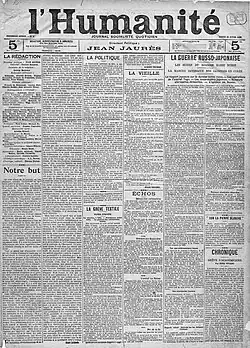
The first issue of L’Humanité appeared on 18 April 1904, with Jaurès as director. Lucien Herr found the name. Friends and citizens who wanted social progress, among them the philosopher Lucien Lévy-Bruhl, gave the starting money, about 850,000 francs.[20] In his first editorial (the article giving the views of the paper), “Notre but” (Our goal), Jaurès wrote that the paper would give free minds full and exact information, so that they could judge the world themselves. He explained the title: humanity “does not yet exist, or hardly exists”, and the socialists work to make it real.[21]
People joked that it was “the newspaper of the seventeen agrégés”, because so many of its writers were scholars. The first issue sold 130,000 copies. Then sales fell badly. From 1907, the paper became stable, around 60,000 to 70,000 copies, and it grew again before the war.[22] Jaurès wrote an article in it almost every day until his death.
From Amsterdam to the salle du Globe
In August 1904, the congress of the Socialist International met in Amsterdam. For hours, Jaurès defended the French policy of republican defense before August Bebel and Karl Kautsky, the German leaders. The Republic, he said, was won by the people; it deserved to be saved. The majority voted against him.
The congress adopted the text of Dresden. It said again that socialists must not enter such governments, and it asked the French socialists to unite in one party of class struggle (the open fight between workers and owners).[23] Jaurès accepted the decision. For him, unity now came first.
At the start of 1905, he broke with the left-wing bloc. His old reformist friends, Millerand, Briand and Viviani, refused the discipline of the new party and stayed out. The delegates of the rival parties met in Paris, at the salle du Globe, from 23 April 1905. They founded the Parti socialiste, Section française de l’Internationale ouvrière (SFIO), proclaimed on 25 April.[24]
Jaurès obtained freedom for the local groups of the party (the federations) and a small central organization. At first, the strictest groups kept him out of the leadership. Their paper, Le Socialiste, became the official newspaper of the party, not L’Humanité. This did not last.
Through his speeches, his paper and his work in the congresses, Jaurès slowly became the real leader of the united party. The congress of Toulouse, in 1908, confirmed it: his great speech on reform and revolution won over almost all the party members.[25]
These were also years of hard personal fights. In December 1904, after a quarrel with the nationalist Paul Déroulède, Jaurès fought a pistol duel with him near the Spanish border. Nobody was hit.
At the start of 1905, he led a campaign in L’Humanité for the first Russian revolution. In May 1905, he debated with Gustave Hervé about the socialist and the fatherland. In July, the German chancellor Bülow forbade a speech he was to give in Berlin. The text, on the friendship of peoples, appeared the same day in L’Humanité and in the German socialist paper Vorwärts.[26]
Leader of the socialists (1906–1911)
In May 1906, Jaurès kept his seat at Carmaux by a small majority. The SFIO now had 51 deputies. In June 1906, he had a famous debate in the Chamber with Georges Clemenceau about radicalism and socialism. Jaurès said: the Republic will be complete only when liberty and equality also rule the economy.
In October 1906, the CGT, the main trade union group, declared itself independent from all parties (the Charter of Amiens). Jaurès chose respect and dialogue, not control. The SFIO accepted this independence at its congress of Limoges, and L’Humanité gave the CGT its own space in the paper.
In the social conflicts of these years, Jaurès always stood with the workers. He supported the revolt of the southern wine-growers in 1907. He protested against the deadly violence used against strikers at Draveil and Villeneuve-Saint-Georges in 1908, and against the arrest of the CGT leaders.
He attacked the government of Briand for breaking the railway strike of 1910. The same year, against Guesde, he made his party support the new law on workers’ and peasants’ pensions.[27] His method stayed the same: win real reforms now, without giving up the full change of society.
Colonial questions took a growing place in his speeches. As a young man, he had accepted the common idea of a French “civilizing mission” (the belief that France brought progress to other peoples). Later, he became one of the strongest critics of colonial conquest. In 1908, he denounced killings by the French army in Morocco, and angry deputies almost stopped him from speaking. He attacked the companies that received giant lands in Africa or controlled the mines of Algeria. In June 1912, he fought the treaty that made Morocco a French protectorate (a country controlled by France).
For him, colonial conquest was unjust to the colonized peoples and dangerous for peace in Europe. But his criticism stayed inside the ideas of his time. He attacked the methods of conquest, not the principle of a French presence overseas. Historians do not call him an anticolonialist in the later sense of the word.
In 1910, he was re-elected with a comfortable majority, and the SFIO rose to 76 deputies.
Inside the party, Jaurès held no official post. But he acted as a tireless mediator (peace-maker) between the different groups of the party. In 1911, the newspaper received a new structure. The party, the unions and the cooperatives entered its board, and Jaurès remained political director. He had become, in the words of the historian Jean-Pierre Rioux, the implicit but uncontested leader of French socialism.[28] From July to October 1911, he made a lecture tour in Brazil, Uruguay and Argentina, a sign that people now listened to him far beyond Europe.
Private life
People who knew Jaurès describe a simple man, careless about his clothes, short and heavy. His power lay in his speech and in his exceptional memory. He was a great reader and lived modestly. Most of his money came from his writing. His family life was divided between Paris and Bessoulet, near Albi, where he spent his summers.
His wife Louise remained a religious Catholic and raised the children in her faith. In July 1901, their daughter Madeleine made her first communion (an important Catholic ceremony). Other socialists attacked Jaurès violently for this. He answered that freedom of belief began in his own home. He would not force his ideas on his family, as others forced their faith.
He himself had left the Catholic religion of his childhood, but he kept thinking about religion as a philosopher. Sad events marked his last years: the death of his mother in 1906, and the birth of a grandson with a severe disability. Several biographers note a part of melancholy (quiet sadness) under his public optimism.[29]
The fight against war (1905–1914)

L’Armée nouvelle (The New Army)
In 1905, the German emperor’s visit to Tangier opened the first crisis over Morocco between France and Germany. From then on, peace stood at the center of Jaurès’s action. He was not against the defense of the country. Against Gustave Hervé, who called for revolt rather than war, he said that the workers have a fatherland, and that the nation, home of democracy, deserves to be defended. But only a defensive war is just.
He put these ideas into a book, L’Armée nouvelle (The New Army). He presented it as a bill (a proposed law) in November 1910 and published it in April 1911. He proposed a citizen army built on the reserves (trained men called back only in case of war), like in Switzerland, with short training, new officers, and a defensive strategy. The welcome was cold, even on the left: the CGT and the Guesdists found the book too military.[30]
The book became useful again in 1913, and the World War later proved several of its ideas right, for example about a long war and the value of reserve soldiers.
From Basel to the three-year law
In the Socialist International, Jaurès worked to turn words into firm promises. At the congress of Stuttgart, in 1907, he and Édouard Vaillant made the congress ask the workers of all countries to use every means to stop war.
In November 1912, while war burned in the Balkans, an extraordinary congress met at Basel, in Switzerland. The Protestant church lent its cathedral. From its pulpit (the speaker’s place in a church), Jaurès gave a famous appeal for peace, built on Schiller’s poem “The Song of the Bell”.[31] But the congress decided no precise common action, and Jaurès worried more and more about the German party.
In France, the year 1913 was filled by the fight against the new army law. The government wanted to raise military service from two years to three, because Germany was making its army much bigger. Jaurès saw in it a heavy and useless burden, which avoided the real reform of the army.
He answered with the plan of L’Armée nouvelle, spoke again and again in the Chamber, and held meetings all over the country. On 25 May 1913, at Le Pré-Saint-Gervais, near Paris, he spoke before about 150,000 people. A national petition collected 700,000 signatures.[32] The law passed anyway, on 19 July 1913.
The nationalist press now attacked Jaurès with very great violence. It called him the man of Germany and a traitor. In April 1914, the voters answered: Jaurès was re-elected with more than 58% of the votes, and the SFIO won over one hundred seats, its best result ever.[33]
July 1914
On 28 June 1914, the heir to the throne of Austria-Hungary (the next in line to be emperor) was murdered at Sarajevo. Jaurès watched the European crisis grow worse. In the middle of July, the congress of the SFIO voted his idea: an international general strike of the workers, to force the governments to let outside judges settle the conflict.
On 25 July, at Vaise, near Lyon, where he supported the candidate Marius Moutet, he explained that all the great states shared a part of the blame. Europe, he warned, stood at the edge of disaster.[34] On 29 and 30 July, he was in Brussels for an urgent meeting of the International Socialist Bureau.
In Brussels, on the evening of 29 July, he spoke at the Cirque royal before thousands of people. The German socialist Hugo Haase spoke before him against the policy of Austria. Jaurès gave a speech that many witnesses described later with strong emotion. When the leaders signed their common statement, Haase embraced Jaurès. It was the last image of the unity of the International. Its next congress, moved from Vienna to Paris for 9 August, never met.[35]
Back in Paris, on 31 July, Jaurès led a small socialist delegation (a group sent to speak for the party) to the foreign ministry. The under-secretary (a junior minister) Abel Ferry received them. Jaurès pressed the government to do everything to keep the peace.[36] For the next day, he planned a great article on the responsibilities of the crisis. That same morning, L’Humanité had printed his last article, “Sang-froid nécessaire” (Calm is necessary).
The assassination (31 July 1914)
For months, part of the nationalist press had pointed at Jaurès with very great violence, almost calling for his death. In the fever of the last days of July 1914, one man answered these calls.
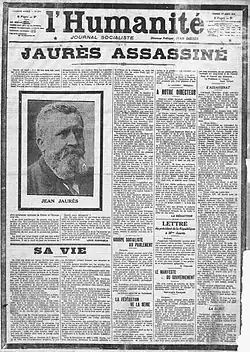
On 31 July 1914, at about 9:40 in the evening, Jaurès had dinner with his co-workers at the Café du Croissant, rue Montmartre, close to his newspaper. He sat with his back to the open window. Only a curtain separated him from the street. Two revolver shots were fired at him from very close. One bullet hit his head. He died within moments.[37]
The killer was arrested at once. His name was Raoul Villain, a nationalist of twenty-eight, a member of the League of the young friends of Alsace-Lorraine and a reader of the nationalist press. Its campaigns had taught him to see Jaurès as the traitor who would hand France to Germany. At the police station, he explained his act by Jaurès’s fight against the three-year law.
The investigation later showed planning: Villain had bought a second gun the day before, had asked questions at the door of L’Humanité, and had already watched the café on the evening of 30 July.[38]
The news caused very strong emotion in the whole country. The government was afraid of riots just before the mobilization (the call of all soldiers to the army). So it honored the dead man.
The workers’ organizations had lost their main voice for peace. They could not stop the war. Strangely, his death even helped the national unity of August 1914, which the French called the “union sacrée”, even though Jaurès had fought for peace. France called up its soldiers on 1 August. Germany declared war on 3 August.
On 4 August, at the funeral in Paris, Vaillant, the union leader Jouhaux and the prime minister Viviani spoke. In the Chamber, its president Paul Deschanel called Jaurès the martyr of his ideas, and all the deputies stood. He was buried on 5 August at Albi.
The trial of Raoul Villain was delayed during the whole war. It opened in March 1919 before the court of the Seine. His lawyers said that Villain was mentally unstable. Some questions were never answered, for example about his money. On 29 March 1919, the jury declared him not guilty. The vote of a jury is secret; the press reported that only one juror had voted against.[39]
The widow of Jaurès even had to pay the costs of the trial. The verdict caused protest far beyond the left. On 6 April 1919, a huge march crossed Paris.[40]
Villain later lived in Spain, on the island of Ibiza. Members of a republican militia (an armed group) killed him there in 1936, at the start of the Spanish civil war.[41]
Memory
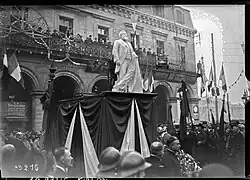
Jaurès became a legend almost at once. On 23 November 1924, under a left-wing government, his body was moved to the Panthéon. Two funeral marches followed it, one official and one communist. The heritage of Jaurès had already become a prize in the fight between socialists and communists, the two parties born from the split of 1920.[42]
L’Humanité, now the paper of the Communist Party, and the SFIO of Léon Blum both claimed to continue his fight. In the 1930s, the “neosocialists” of Marcel Déat also claimed his name, before they moved toward working with the Nazis; Blum had to defend the memory of the founder.[43] In 1936, the Popular Front celebrated its victory in his name.
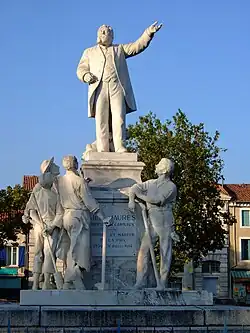
Monuments came early. A society of friends of Jaurès appeared in 1916. The first public monuments rose in 1921. Carmaux opened its monument in 1923, with the writer Anatole France; Castres followed in 1925, Toulouse in 1929.
In 1992, the Fondation Jean-Jaurès was created, with Pierre Mauroy as president. On 21 May 1981, the day he took office, President François Mitterrand laid a rose on the tomb of Jaurès in the Panthéon. Thousands of streets, squares, schools and metro stations carry his name. Today, politicians of almost all parties claim Jaurès, sometimes in ways far from his real ideas, which historians correct.
The scientific study of Jaurès is organized around the Société d’études jaurésiennes, founded in 1959, one hundred years after his birth. Ernest Labrousse led it first, then Madeleine Rebérioux from 1982 to 2005.
The national center and museum Jean-Jaurès opened at Castres in 1988. Since 2000, the publisher Fayard prints a complete scholarly edition (a careful edition made by specialists) of his works. The years 2009 (150 years after his birth) and 2014 (100 years after his death) brought many ceremonies of memory and new research.[44]
His ideas and his works
The philosopher
Jaurès always looked for synthesis, the union of ideas that seem opposed. For him, philosophy and action never stood apart. His thesis describes the world as one living whole. For Jaurès, the world is not dead matter only. Human thought is part of the life of the world, and continues its movement.
From this came his deepest belief: the ideal of justice is not a dream laid over the world from outside. It is a force already at work inside it. So ideas and the economic forces of history do not have to fight each other.
The socialism of the Republic
From Marx, whom he had studied closely, Jaurès took the analysis of class struggle and the weight of the economy. But he refused to make the economy the only cause of history. In his debate of 1895 with Lafargue, he showed that moral ideas, born from the Enlightenment and the French Revolution, have a force of their own in history.[45]
For him, socialism completes the Republic. It extends the power of the citizen to the economy, through the common ownership of the great tools of production, like factories, mines and railways. He gave the road to it a name: “revolutionary evolution”. It means: win majorities in free elections, gather reforms one after the other, and organize the workers, instead of taking power by violence.[46]
This made him a special kind of reformist, who never gave up the goal of a fully changed society. Socialists who followed Marx more strictly said he believed too much in ideas. The revolutionary trade unionists said he believed too much in parliament. Yet in his last ten years, he was the most listened-to leader of French socialism and one of the great voices of the International.
Secularism and religion
Secularism stood at the heart of his action. Secularism is the rule that the state and the churches must be separate. A son of the republican school and a constant friend of the teachers, Jaurès saw it as a guarantee of freedom, not as a weapon against religion. This explains his support for a liberal separation in 1905, and his great speech of January 1910 for the secular school.
He had left the faith of his childhood, but he kept thinking about religion as a philosopher. A long text on religion and socialism, unpublished in his lifetime, shows this lasting question: socialism, he thought, would have to answer the spiritual needs (the needs of the soul) of humanity in another way than the churches.[47]
The nation, the International and the colonies
Some people said: you must choose between your country and the International. Jaurès answered: the two go together. The nation is the historical home where the workers win their rights. The International is the tool that must keep the nations out of war. L’Armée nouvelle says it in a famous sentence: “A little internationalism takes one away from the fatherland; much internationalism brings one back to it. A little patriotism takes one away from the International; much patriotism brings one back to it.”[48]
His position on the colonies shows the same tension: he believed in ideas good for all people, but he criticized rule by force over other peoples. He started from the common belief in a civilizing mission. He ended as a strong critic of the violence of conquest, of the hunt for quick money, and of the dangers of war between the powers. But he never rejected colonization itself as a principle.
The historian
His work as a historian was also important. He wrote the Histoire socialiste de la Révolution française mainly between 1898 and 1903, after long work in archives. Its ambition was new: tell the Revolution through economic and social life, give the people a voice as actors, and measure the early hopes of material equality. The word “socialist” in the title shocked many scholars; even Alphonse Aulard, the first professor of the history of the Revolution, criticized it.
Later historians judged otherwise. Albert Mathiez and then Albert Soboul re-edited the work. It is now seen as the founding book of the social history of the French Revolution. In 1903, on Jaurès’s proposal, the parliament also created a commission to publish the economic documents of the Revolution; it worked for decades.[49]
The orator and the journalist
In the memory of the French, Jaurès keeps a special place among the great speakers of the Third Republic. He had a powerful voice and a vast culture, used without notes. He could lift every debate toward general principles. Witnesses also said that he knew every file exactly. So his speeches were proofs as much as fine words.
As a journalist, he wrote almost every day for nearly thirty years. He wrote in La Dépêche, in La Petite République and in L’Humanité. These several thousand articles form one of the largest collections of newspaper writing of his time.
Timeline
| Date | Event |
|---|---|
| 3 September 1859 | Born at Castres (Tarn). |
| 1878 | First at the entrance examination of the École normale supérieure. |
| 1881 | Passed the agrégation of philosophy; teacher at the lycée of Albi. |
| 4 October 1885 | Elected deputy of the Tarn, the youngest in France, on a republican list. |
| 29 June 1886 | Married Louise Bois. |
| September 1889 | Lost the elections; returned to the University of Toulouse. |
| 1892 | Doctor of philosophy; miners’ strike at Carmaux (August–November). |
| January 1893 | Elected socialist deputy of Carmaux in a by-election; re-elected in August. |
| 1895–1896 | Glass workers’ strike at Carmaux; foundation of the workers’ glassworks of Albi. |
| January 1898 | Entered the Dreyfus affair after Zola’s “J’accuse…!”. |
| 8 May 1898 | Lost his seat at Carmaux to the Marquis de Solages. |
| Summer 1898 | Published Les Preuves in La Petite République, then as a book. |
| June 1899 | Supported the government of republican defense of Waldeck-Rousseau. |
| November 1900 | Debate of the “two methods” with Jules Guesde at Lille. |
| 1901–1908 | Publication of the Histoire socialiste (1789–1900). |
| April 1902 | Re-elected at Carmaux; pillar of the left-wing bloc (vice-president of the Chamber in 1903). |
| 30 July 1903 | Speech to the youth, at Albi. |
| 18 April 1904 | First issue of L’Humanité; in August, international congress of Amsterdam. |
| April 1905 | Congress of the salle du Globe: birth of the SFIO. |
| 9 December 1905 | The law of separation of the churches and the state becomes official. |
| June 1906 | Great debate with Clemenceau on radicalism and socialism. |
| 12 July 1906 | Captain Dreyfus declared innocent by the highest court of France. |
| October 1908 | Congress of Toulouse of the SFIO: the unity is confirmed. |
| 1910–1911 | Vote of the workers’ pensions law; publication of L’Armée nouvelle. |
| July–October 1911 | Lecture tour in Brazil, Uruguay and Argentina. |
| 24–25 November 1912 | Speech for peace at the international congress of Basel. |
| 25 May 1913 | Meeting of Le Pré-Saint-Gervais against the three-year military law. |
| 26 April 1914 | Re-elected at Carmaux; about one hundred SFIO deputies. |
| 31 July 1914 | Murdered at the Café du Croissant, in Paris, by Raoul Villain. |
| 29 March 1919 | Raoul Villain found not guilty by the court of the Seine. |
| 23 November 1924 | Jaurès’s body moved to the Panthéon. |
| 14 November 1959 | Foundation of the Société d’études jaurésiennes. |
References
- ↑ Candar and Duclert 2014, chronology.
- ↑ Rioux 2005, chronology (50.9% of the votes); Duclert 2013 (Jaurès, best elected of the five republicans of the Tarn, with 48,040 votes).
- ↑ Duclert 2013, chapter “La défaite de Castres”; Candar and Duclert 2014.
- ↑ De la réalité du monde sensible, Paris, Alcan, 1891; De Primis socialismi germanici lineamentis apud Lutherum, Kant, Fichte et Hegel, Toulouse, 1891.
- ↑ Scot 2014. The author tells of the Toulouse discussion of 27 March 1892, but shows that Carmaux was the real “social laboratory” of the change.
- ↑ Candar and Duclert 2014, chapter VII; Scot 2014. See also Jaurès’s articles “Les incidents de Carmaux”, La Dépêche, 29 August 1892, and “La question de principe”, La Dépêche, 19 September 1892.
- ↑ Duclert 2013, chronology (52.1% in January, 59.3% in August 1893); Scot 2014.
- ↑ Rioux 2005; Candar and Duclert 2014.
- ↑ Candar and Duclert 2014, chronology (speech of 15 March 1897 on the Ottoman Empire).
- ↑ Duclert 2013 (5,515 votes against 6,702 for the Marquis de Solages).
- ↑ Léon Blum, Souvenirs sur l’Affaire, quoted by Duclert 2013.
- ↑ Rioux 2005; Duclert 2013.
- ↑ Candar and Duclert 2014, chronology.
- ↑ Scot 2014. The motion of Guesde passed by 818 votes against 634; the motion of the commission by 1,140 against 240.
- ↑ Duclert 2013.
- ↑ Jean Jaurès, “Discours à la jeunesse”, prize ceremony of the lycée of Albi, 30 July 1903.
- ↑ Rioux 2005. The work was re-edited by Albert Mathiez (1922–1924), then by Albert Soboul (Éditions sociales, 1968–1973).
- ↑ Candar and Duclert 2014. Prince Albert I of Monaco gave the note to the newspaper.
- ↑ Rioux 2005, chronology (22 April 1905).
- ↑ Candar and Duclert 2014. The details of the starting money are still not fully known.
- ↑ Jean Jaurès, “Notre but”, L’Humanité, 18 April 1904.
- ↑ Candar and Duclert 2014 (130,000 copies at the start, fewer than 30,000 in October 1906, 60,000 to 70,000 from 1907).
- ↑ Duclert 2013; Rioux 2005.
- ↑ Scot 2014; Rioux 2005; Duclert 2013. The sources differ a little on the exact dates of the congress.
- ↑ Rioux 2005 (“Éloge de la réforme”); Duclert 2013, chronology.
- ↑ Rioux 2005, chronology; Candar and Duclert 2014, chronology.
- ↑ Rioux 2005, chronology (congress of Nîmes, February 1910).
- ↑ Rioux 2005, chapter “L’homme-orchestre”; on the reorganization of 1911, Candar and Duclert 2014.
- ↑ Duclert 2013, on the “secret melancholy” of these years.
- ↑ Candar and Duclert 2014, chapter on L’Armée nouvelle.
- ↑ Scot 2014, who quotes the appeal built on the Song of the Bell; Candar and Duclert 2014.
- ↑ Scot 2014.
- ↑ Candar and Duclert 2014, chronology (58% of the votes; 102 SFIO deputies out of 601 seats).
- ↑ Candar and Duclert 2014; Lalouette 2014 (on the text of the Vaise speech).
- ↑ Jean Stengers, “Le dernier discours de Jaurès”, discussed in Candar and Duclert 2014, chapter I.
- ↑ Duclert 2013, from the testimony of Abel Ferry.
- ↑ Lalouette 2014, chapter I; Duclert 2013.
- ↑ Lalouette 2014, chapter II. Villain gave his identity at the police station: “aged 28, born 19 September 1885 in Reims”.
- ↑ Lalouette 2014, chapters III and IV. The vote of the jury is secret; the single dissenting juror rests on reports in the press.
- ↑ Lalouette 2014, chapter IV.
- ↑ Lalouette 2014, chapter IV.
- ↑ Candar and Duclert 2014, chronology; Duclert 2013.
- ↑ Duclert 2013, chapter “Entre ‘néosocialisme’ et ‘révolution intégrale’”.
- ↑ Candar and Duclert 2014, chronology.
- ↑ Jean Jaurès and Paul Lafargue, “Idéalisme et matérialisme dans la conception de l’histoire”, public debate, 1895; Duclert 2013, chronology.
- ↑ On this “method” of “revolutionary evolution”, see Scot 2014.
- ↑ “Pour la laïque”, speech in the Chamber, January 1910; Jean Jaurès, La Question religieuse et le socialisme, text edited by Michel Launay, Paris, Les Éditions de Minuit, 1959.
- ↑ Jean Jaurès, L’Armée nouvelle, Paris, Jules Rouff, 1911.
- ↑ Rioux 2005, who reports the criticism of Alphonse Aulard (1902) and the analysis of Mona Ozouf on the word “socialist”.
Sources
- Candar (Gilles) and Duclert (Vincent), Jean Jaurès, Paris, Fayard, 2014. (The main scholarly biography.)
- Duclert (Vincent), Jaurès 1859-1914. La politique et la légende, Paris, Autrement, 2013. (A short study of his life and of his legend.)
- Lalouette (Jacqueline), Jean Jaurès. L’assassinat, la gloire, le souvenir, Paris, Perrin, 2014. (A book about his murder, the trial of his killer and his memory.)
- Rioux (Jean-Pierre), Jean Jaurès, Paris, Perrin, 2005. (A clear short biography.)
- Scot (Jean-Paul), Jaurès et le réformisme révolutionnaire, Paris, Seuil, 2014. (A study of his political ideas.)
- Jaurès (Jean), Œuvres, Paris, Fayard, scholarly edition in progress since 2000. (His collected works.)