Jangladesh
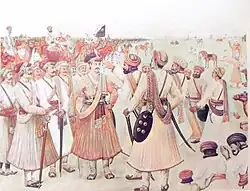
Jangladesh, also called Janglu, was a historical region located in the northern districts of modern Rajasthan. It was home to various Jat and Rajput clans. The dominant Rajput clans were the Johiyas and Bhattis,[1] while the dominant Jat clans were the Beniwals, Godaras, Punias, Sarans, Sahus, Kaswans, and Sihags.[2][3][4]
In the 15th century, Rao Bika led a coalition of Rathore Rajputs, Charans, and Godara Jats, annexing the local chiefdoms and petty states and establishing the Kingdom of Bikaner. The region was thus renamed to Bikaner.[5][6]
References
- ↑ Hooja, Rima (2006). A History of Rajasthan. Rupa & Company. p. 385. ISBN 978-81-291-0890-6.
the Bhatis who controlled the territories to the north and west while to the east, north-east and south east were the settlements of different Jat clans...around this renowned Bhatner were the settlements of the chiefly muslim Bhattis, Johiyas and others.
- ↑ Sharma, Dasharatha (1966). Rajasthan Through the Ages: From the earliest times to 1316 A.D. Bikaner: Rajasthan State Archives. pp. 287–288.
There is good reason to believe that parts of the present north-eastern and north-western Rajasthan were inhabited by Jat clans ruled by their own chiefs and largely governed by their own customary law.
- ↑ L. S. Rathore (2005). Maharaja Sadul Singh of Bikaner: a biography of the co-architect of India's unity, Volume 1. Books Treasure. p. 13. ISBN 9788190042208.
Nearly the whole of the territory that formed the boundaries of Bikaner was possessed by six Jat clans, namely, Poonia, Godara, Saran, Asiagh, Beniwal and Johiyas.
- ↑ K.K. Segahl (1962). Rajasthan District Gazetteers Bikaner. Directorate Of District Gazetteers, Govt. Of Rajasthan.
They lived as semi-autonomous tribes-especially the Jats, who formed the seven different clans amongst themselves (1) Punia, (2) Godara, (3) Saran, (4) Kaswa, (5) Beniwal, (6) Sihag, and (7) Sohua, but Tod enumerates only six Jat clans, i.e. Punia, Godara, Saran, Asiach, Beniwal and Johiya though this last clan is by some termed a ramification of the Yadu-Bhati Rajputs.
- ↑ Kothiyal, Tanuja (2016). Nomadic Narratives: A History of Mobility and Identity in the Great Indian. Cambridge University Press. p. 78. ISBN 9781107080317. Retrieved 17 September 2020.
- ↑ Panikkar, Kavalam Madhava (1937). His Highness the Maharaja of Bikaner: A Biography. Oxford University Press.