Jan Masaryk
Jan Masaryk | |
|---|---|
 | |
| Foreign Minister of Czechoslovakia | |
| In office 21 July 1940 – 10 March 1948 | |
| President | Edvard Beneš |
| Preceded by | German occupation |
| Succeeded by | Vladimír Clementis |
| Czechoslovakia Ambassador to the United Kingdom | |
| In office 1925 – December 1938 | |
| Preceded by | Vojtěch Mastný |
| Succeeded by | Max Lobkowicz |
| Personal details | |
| Born | Jan Garrigue Masaryk 14 September 1886 Prague, Austria-Hungary |
| Died | 10 March 1948 (aged 61) Prague, Czechoslovakia |
| Cause of death | Disputed – see text |
| Parents | Tomáš Garrigue Masaryk |
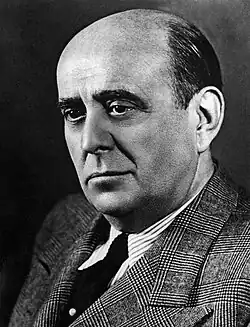
Jan Garrigue Masaryk (14 September 1886 – 10 March 1948) was a Czech diplomat and politician. He was the Foreign Minister of Czechoslovakia from 1940 to 1948. American journalist John Gunther called him "a brave, honest, turbulent, and impulsive man".[1]
Early life
Masaryk was born in Prague. He was the son of Tomáš Garrigue Masaryk, the first president of Czechoslovakia, and his American wife Charlotte Garrigue. He studied in Prague and in the United States. In America he worked different jobs, including as a steelworker. Because of his time in the US, he spoke Czech and English with an American accent. He returned to Prague in 1913 and served in the Austro-Hungarian Army during World War I.[2] He served in Galicia and learned Polish. His father’s exile made him unpopular in the army, where he was bullied as the son of a "traitor". He rarely spoke about his military service later.
After the war, he joined the diplomatic service. In 1919 he became chargé d'affaires to the US, and later counselor in London. In 1922 he became secretary to foreign minister Edvard Beneš. In 1925 he was appointed minister-plenipotentiary to Britain.[3] Scholars described him as unconventional, witty, and direct. Some historians, however, saw him as weak and dependent on others.[4]
Career in London
Masaryk warned Prague that many in the British Foreign Office disliked Czechoslovakia and wanted Austria-Hungary restored.[5] He worked to improve Czechoslovakia’s image in Britain by supporting journalists and scholars who wrote in favor of his country. He gave money to writers like Wickham Steed and Robert Seton-Watson to spread pro-Czechoslovak views.[6]
He often clashed with German ambassador Joachim von Ribbentrop and criticized King Edward VIII for being close to fascism.[7] He also opposed the influence of Princess Stephanie von Hohenlohe, whom he described as a spy working for Hitler.[8]
During the Sudetenland crisis in 1938, Masaryk tried to defend Czechoslovakia’s position in Britain. He worked with opposition politicians like Winston Churchill and Clement Attlee. He opposed the Munich Agreement, which gave the Sudetenland to Germany. He resigned as ambassador in protest in December 1938.[9]
Wartime
After Germany occupied Czechoslovakia in March 1939, Masaryk spoke on American radio, condemning the occupation. He returned to London later that year. During World War II, he became famous for his weekly radio broadcasts on the BBC to occupied Czechoslovakia, called Volá Londýn ("London Calling"). These speeches made him a national hero.[10]
In July 1940, he became Foreign Minister in the Czechoslovak government-in-exile. He worked closely with President Beneš. His main goal was to have Britain cancel the Munich Agreement and restore the Sudetenland to Czechoslovakia after the war. At first, Britain refused, but later agreed.[11]
Death
Masaryk died on 10 March 1948 in Prague. He was found below his bathroom window. His death was officially called a suicide, but many believe he was murdered. The true cause remains disputed.[12]
References
- ↑ Gunther, John (1961). Inside Europe Today. New York: Harper & Brothers. p. 335.
- ↑ Vratislav Preclík, Masaryk a legie, Paris Karviná, 2019.
- ↑ Carey, Nick (12 April 2000). "Czechs in History: Jan Masaryk". Radio Prague.
- ↑ Zeman & Karlsch, 2008.
- ↑ Orzoff, 2009.
- ↑ Orzoff, 2009.
- ↑ Lukes, 1996.
- ↑ Lendvai, 2004.
- ↑ Powell, 1950.
- ↑ Zeman, 1976.
- ↑ Smetana, 2008.
- ↑ "Jan Masaryk's mysterious death". Radio Prague.