Israeli razing of cemeteries and necroviolence against Palestinians
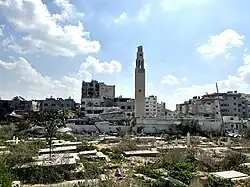
Israeli forces have damaged or destroyed at least 16 cemeteries across the Gaza Strip during the ongoing war, according to evidence collected by CNN, The New York Times, and the Euro-Med Human Rights Monitor.[1] Israel said its military operations aimed to locate the bodies of Israeli hostages based on intelligence reports. The Israel Defense Forces (IDF) also claimed—without providing evidence—that they dug up the Beit Hanoun Cemetery near Khan Yunis because a Hamas command center was located in a tunnel beneath it. However, CNN found no signs of a tunnel entrance in the cemetery and could not confirm the IDF’s claim.[2] More generally, reports describe different forms of necroviolence—violence against the dead—toward Palestinians in both the West Bank and Gaza. This includes the destruction of cemeteries, the withholding of bodies from families (which prevents proper mourning), and the use of so-called “cemeteries of numbers,” where graves are marked only with numbers instead of names, dehumanizing the deceased.[3]
Razing of cemeteries in the Gaza Strip
Israel has carried out several operations in cemeteries across Gaza, including setting up military bases and, according to the Israel Defense Forces (IDF), exhuming bodies in an effort to find the remains of hostages. The IDF described these actions as “precise hostage rescue operations” conducted only in locations where intelligence suggested hostages’ bodies might be buried. However, under international law, deliberately destroying religious sites without a clear military necessity could be considered a war crime.[4][5][6]
The New York Times report
In December 2023, The New York Times reported that Israeli forces had razed six cemeteries across the Gaza Strip. [5] In Gaza City’s Shajaiye neighborhood, parts of the Tunisian Cemetery were destroyed, and Israeli military vehicles damaged dozens of graves at a smaller nearby cemetery. Additional damage was reported at the Al-Faluja Cemetery, Beit Hanoun Cemetery, and cemeteries in Sheikh Ijlin and Beit Lahia, both in northern Gaza. Journalists from The New York Times Visual Investigations unit confirmed the destruction using satellite imagery and video evidence. When asked for comment, the Israel Defense Forces (IDF) did not respond. The report also noted that, under the laws of armed conflict, the deliberate destruction of religious sites without military necessity could constitute a war crime. [5]
Euro-Med Human Rights Monitor report
On January 16, 2024, the Euro-Med Human Rights Monitor reported that Israeli forces had bulldozed and desecrated more cemeteries in Gaza than previously documented by The New York Times—up to 12 sites, though the report listed 9 by name. The organization stated that repeated Israeli attacks had created large craters in several cemeteries, destroying dozens of graves and scattering or displacing human remains. It also alleged that in Gaza’s Al-Faluja Cemetery, graves were dug up and the bodies of Palestinian activists were taken.[7] Rami Abdu, the director of Euro-Med Monitor, accused the Israeli army of desecrating the Al-Tuffah Cemetery, claiming that Israeli bulldozers “ruthlessly dug and destroyed” the site. The Palestinian government in Gaza condemned the army for disturbing about 1,100 graves and allegedly removing 150 bodies, calling the leveling of the cemetery a “heinous crime.”[8] According to Euro-Med’s report, the cemeteries affected included:[7]
- Al-Tuffah Cemetery
- Al-Batsh Cemetery – established in October 2023 to bury unidentified victims from the Al-Shifa Hospital complex; reportedly leveled by Israeli forces in early January 2024, with many bodies “removed, dismembered, and looted,” along with some tombstones.
- Sheikh Shaaban Cemetery in Palestine Square, Gaza City – destroyed between December 17 and 20, with reports of corpses being trampled.
- A cemetery east of central Khan Yunis (about 1.7 km away) – damaged on December 20, 2023.
- Al-Fallujah Cemetery in northern Gaza.
- Ali bin Marwan Cemetery.
- Sheikh Radwan Cemetery.
- St. Porphyrius Church Cemetery in Gaza City.
- Al-Shuhada Cemetery in Beit Lahia, northern Gaza.
Khan Yunis Central Cemetery
On January 17, 2024—one day after the Euro-Med Human Rights Monitor released its report—NBC News reported that Israeli forces had heavily damaged the Khan Yunis Central Cemetery (31.348°N, 34.293°E), located near Nasser Hospital. According to the report, Israeli troops bulldozed parts of the site, crushing tombstones, damaging graves, and exposing human remains in several burial plots. The Israel Defense Forces (IDF) stated that the operation was part of a targeted effort to locate and recover the bodies of hostages held by Hamas. The IDF said it was committed to treating the deceased respectfully and returning any bodies not identified as hostages “with dignity.” Ramy Abdu, chairman of the Euro-Med Human Rights Monitor, said the attack—along with previous incidents involving Palestinian cemeteries—showed that Israel “systematically violates the sanctity of the deceased and their graves.”[9]
CNN report of 16 cemeteries damaged
On January 20, 2024, CNN reported that at least sixteen cemeteries across the Gaza Strip had been damaged during Israeli military operations. The outlet published before-and-after satellite images of several sites and identified seven specific cemeteries affected:[1]
- Khan Yunis Central Cemetery
- A cemetery in Shajaiya
- Bani Suheila Cemetery, east of Khan Yunis — described as showing “deliberate and progressive bulldozing” and the construction of defensive fortifications over at least two weeks in late December and early January.
- New Bureij Cemetery in Al-Bureij, a Palestinian refugee camp in central Gaza — where “graves were visible on either side of the newly bulldozed dirt road.”
- Al-Falouja Cemetery in the Jabalya neighborhood, north of Gaza City.
- Al-Tuffah Cemetery, east of Gaza City.
- A cemetery in the Sheikh Ijlin neighborhood of Gaza City.
CNN reported that at Al-Falouja, Al-Tuffah, and Sheikh Ijlin cemeteries, “destroyed tombstones and heavy tread marks pointed to heavily armored vehicles or tanks driving over graves.”[1] Janina Dill, co-director of the Oxford Institute for Ethics, Law and Armed Conflict, told CNN that attacking or destroying cemeteries violates international law except in very limited cases—specifically when a cemetery itself constitutes a legitimate military objective.[1]
Israeli reaction and claims
Up to January 30, 2024, the Israel Defense Forces (IDF) had not provided a detailed explanation for the widespread bulldozing of cemeteries in Gaza—whether for establishing military outposts, constructing roads, or other purposes. The IDF stated, however, that there was no official policy authorizing the conversion of graveyards into military positions.[1] On January 30, the IDF announced that it had discovered a Hamas operations room inside an underground tunnel allegedly located about 20 meters (66 feet) beneath the Bani Suheila Cemetery in Khan Yunis. According to Israel, the tunnel contained explosives, sliding doors, and living quarters for Hamas fighters. The IDF claimed it also found the office of the eastern battalion commander from Hamas’s Khan Yunis Brigade, which it described as a command center connected to the October 7 attacks. Additional findings allegedly included operations rooms, a battalion combat control room, and bedrooms for senior Hamas officials. The tunnel—said to be part of a larger underground network—was later destroyed by Israeli engineering units after inspection. Israel stated that Hamas had used the site for combat operations against Israeli forces.[10] The Israeli military granted CNN limited access to the cemetery and surrounding area for three hours, but did not allow reporters to view the alleged tunnel entrance said to be within the cemetery itself. CNN visited the tunnel through an entrance outside the cemetery’s perimeter but was unable to confirm whether it extended beneath the cemetery grounds. The IDF later shared drone footage of that entrance and another external one. CNN’s footage showed the cemetery completely destroyed and dug up, damage the IDF said was necessary to locate and demolish the tunnel.[2]
Other Israeli necroviolence against Palestinians
In Gaza–Israel conflict
Israeli forces have previously faced accusations of necroviolence—violence or desecration involving the dead. In 2020, video evidence from Gaza showed an Israeli bulldozer violently scooping up a Palestinian corpse, drawing international condemnation.[11] On January 30, 2024, the bodies of around 100 people taken by Israeli forces were reburied in a mass grave in Rafah. Medical sources reported that some of the bodies were missing organs. [12] In 2019, the Israeli Supreme Court ruled that the state could withhold the bodies of alleged Palestinian assailants from their families. Following the decision, Defense for Children International stated that Israel was violating international humanitarian and human rights law by confiscating the body of a 14-year-old Palestinian boy in the West Bank. [13] In February 2024, Emek Shaveh, an Israeli NGO of archaeologists, reported that Orthodox Jews in West Jerusalem had taken over a Muslim shrine and vandalized Muslim graves. [14] The following month, an Israeli F-16 airstrike struck a newly built cemetery in Jabalia, displacing human remains that later had to be reburied. [15][16] On March 7, Israeli authorities returned the bodies of 47 Palestinians whose remains had been removed during the Nasser Hospital siege. [17] Two days later, on March 9, Israeli settlers were filmed smashing and defacing gravestones at the Bab al-Rahma Cemetery in East Jerusalem.[18]
In April 2024, the Gaza Ministry of Endowments and Religious Affairs accused the Israel Defense Forces (IDF) of mutilating corpses, including acts of postmortem decapitation and dismemberment. [19] In September 2024, footage emerged from Qabatiya, near Jenin in the occupied West Bank, showing Israeli soldiers discarding the bodies of three Palestinians from a rooftop during a raid. Local reports said that at least seven people were killed during the operation, in which Israeli forces surrounded a building. Witnesses described how four men attempted to flee to the roof before being shot by snipers. Afterward, soldiers were seen throwing the bodies over the edge, and a bulldozer later arrived to remove them.[20] On September 25, 2024, a truck carrying 88 unidentified Palestinian bodies was transferred through an Israeli-controlled crossing to Nasser Hospital in Khan Yunis. Zaher al-Wahadi, head of the Palestinian Health Information Centre, said no information was provided regarding their identities or the circumstances of their deaths. This was the fifth such delivery of unidentified remains. The International Committee of the Red Cross (ICRC) reiterated that under international humanitarian law, the bodies of those killed in conflict must be treated with dignity, properly identified, and returned to families when possible. [21]
Ongoing Israeli necroviolence methods
Randa May Wahbe, a Harvard PhD candidate in anthropology, has described Israeli practices toward Palestinian cemeteries and corpses as forms of necroviolence, including:[3]
- Ambiguous loss: withholding Palestinian bodies in freezers, preventing families from mourning their loved ones.
- Cemeteries of numbers: graves marked only with numbers rather than names, dehumanizing the deceased.
- Demolition of historic gravesites.
References
- 1 2 3 4 5 Diamond, Jeremy (20 January 2024). "At least 16 cemeteries in Gaza have been desecrated by Israeli forces, satellite imagery and videos reveal". CNN.
- 1 2 Diamond, Jeremy (29 January 2024). "IDF says they destroyed this Gaza graveyard because of Hamas activity. CNN can't find the evidence | CNN". CNN. Retrieved 31 January 2024.
- 1 2 Wahbe, Randa May (September 2020). "The politics of karameh: Palestinian burial rites under the gun". Critique of Anthropology. 40 (3): 323–340. doi:10.1177/0308275X20929401. Retrieved 17 January 2024.
- ↑ Kottasová, Ivana; Dahman, Ibrahim; Brown, Benjamin; Diamond, Jeremy; Darwish, Muhammad (18 January 2024). "Israel says it is exhuming bodies in Gaza to determine if they're hostages". CNN. Retrieved 21 January 2024.
- 1 2 3 "Satellite Imagery and Video Shows Some Gazan Cemeteries Razed by Israeli Forces". The New York Times. 14 December 2023. Retrieved 16 December 2023.
- ↑ "Destruction of Cemeteries" (PDF). United States Commission on International Religious Freedom. Retrieved 22 December 2023.
- 1 2 "Israeli army defiles hundreds of graves in the Gaza Strip, steals dead bodies". Euro-Med Human Rights Monitor. Retrieved 16 January 2024.
- ↑ "Gaza accuses Israel of exhuming 1,100 Palestinian graves, stealing 150 bodies". EFE Noticias. 6 January 2024. Retrieved 17 January 2024.
- ↑ Salam, Yasmine; Segev, Yarden; Talmazan, Yuliya; Arian, Alfred; Razak, Khalid; Abdelkader, Rima (2024-01-20). "Israel says troops searched a Gaza cemetery for dead hostages". Yahoo News. Retrieved 2024-01-20.
- ↑ "IDF unearths Hamas operation room in tunnel under Khan Yunis cemetery". The Jerusalem Post. 2024-01-29. ISSN 0792-822X. Retrieved 2024-01-30.
- ↑ Alsaafin, Linah (24 February 2020). "Israel slammed for necroviolence on bodies of Palestinians". Al Jazeera. Archived from the original on 5 February 2024. Retrieved 27 September 2024.
- ↑ "100 bodies stolen by Israel reburied in mass grave in Rafah". Al Jazeera. Retrieved 31 January 2024.
- ↑ "Confiscation of Palestinian child's body a violation of international law: Advocacy group". Al Jazeera. Retrieved 8 February 2024.
- ↑ "Orthodox Jews take over Muslim shrine, vandalise graves in West Jerusalem". Al Jazeera. Retrieved 26 February 2024.
- ↑ "Israeli strike scatters bodies after hitting Jabalia cemetery". Al Jazeera. Retrieved 4 March 2024.
- ↑ "'Grave has no resistance': Israel bombs cemetery in northern Gaza's Jabalia camp". Al Jazeera. Retrieved 6 March 2024.
- ↑ Mahmoud, Hani. "Israel returns 47 bodies to Gaza after digging up graveyard". Al Jazeera. Retrieved 9 March 2024.
- ↑ "Israeli settlers desecrate tombstones at Islamic cemetery". Al Jazeera. Retrieved 12 March 2024.
- ↑ "Ministry of religious affairs accuses Israel of desecrating Palestinian bodies". Al Jazeera. Retrieved 5 May 2024.
- ↑ Knell, Yolande; Gregory, James (20 September 2024). "Israel investigates after its soldiers filmed throwing bodies off roof". BBC. Archived from the original on 20 September 2024. Retrieved 21 September 2024.
- ↑ Jabakhanji, Sara (25 September 2024). "Palestinians demand details after 88 unidentified bodies arrive on Israeli truck in Gaza". CBC News. Archived from the original on 27 September 2024. Retrieved 27 September 2024.