Irritable bowel syndrome
| Irritable bowel syndrome | |
|---|---|
| Other names | Spastic colon, nervous colon, mucous colitis, spastic bowel[1] |
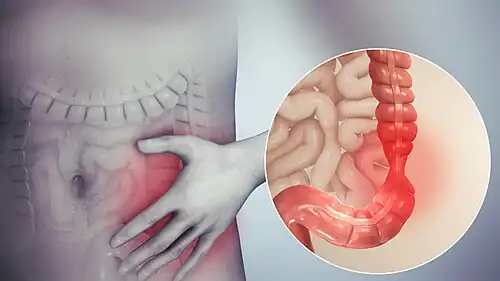 | |
| 3D depiction of the pain of IBS | |
| Medical specialty | Gastroenterology |
| Symptoms | Diarrhea, constipation, abdominal pain[1] |
| Usual onset | Before 45 years old[1] |
| Duration | Long term[2] |
| Causes | Unknown[2] |
| Risk factors | Genetic predisposition,[3] psychological stress,[4] childhood abuse, food poisoning,[5] psychiatric illness[6] |
| Diagnostic method | Based on symptoms, exclusion of other diseases |
| Differential diagnosis | Celiac disease, giardiasis, non-celiac gluten sensitivity, microscopic colitis, inflammatory bowel disease, small intestine bacterial overgrowth, bile acid malabsorption, colon cancer |
| Treatment | Symptomatic (dietary changes, medication, human milk oligosaccharides, probiotics, counseling) |
| Prognosis | Normal life expectancy |
| Frequency | 10–15% (developed world) and 15–45% (globally) |
Irritable bowel syndrome (IBS) is a functional gastrointestinal disorder by a group of symptoms that usually include abdominal pain, abdominal bloating and changes in bowel movements.[1] These symptoms may happen over a long time, sometimes for years.[2] IBS can affect quality of life and may impact daily life activities.[7] Disorders such as anxiety, major depression, and myalgic encephalomyelitis/chronic fatigue syndrome (ME/CFS) are common among people with IBS.[1][8][note 1][9]
The cause of IBS is not known, but it can be triggered by stress,[10] or an intestinal infection.[11]
Notes
- ↑ The cited review is based on sources ranging from 1988 to 2001 and is probably biased relative to a more recent research.
References
- 1 2 3 4 5 "Definition and Facts for Irritable Bowel Syndrome". NIDDKD. February 23, 2015. Archived from the original on April 2, 2016. Retrieved March 29, 2016.
- 1 2 3 "Symptoms and Causes of Irritable Bowel Syndrome". NIDDK. February 23, 2015. Archived from the original on April 5, 2016. Retrieved March 29, 2016.
- ↑ Li J, Zhu W, Liu W, Wu Y, Wu B (January 2016). "Rifaximin for Irritable Bowel Syndrome: A Meta-Analysis of Randomized Placebo-Controlled Trials". Medicine. 95 (4): e2534. doi:10.1097/MD.0000000000002534. PMC 5291563. PMID 26825893.
{{cite journal}}: CS1 maint: article number as page number (link) - ↑ Fukudo S, Nomura T, Muranaka M, Taguchi F (September 1993). "Brain-gut response to stress and cholinergic stimulation in irritable bowel syndrome. A preliminary study". Journal of Clinical Gastroenterology. 17 (2): 133–41. doi:10.1097/00004836-199309000-00009. PMID 8031340.
- ↑ "Post Infectious IBS - About IBS". March 8, 2021.
- ↑ Barreau F, Ferrier L, Fioramonti J, Bueno L (September 2007). "New insights in the etiology and pathophysiology of irritable bowel syndrome: contribution of neonatal stress models". Pediatric Research. 62 (3): 240–5. doi:10.1203/PDR.0b013e3180db2949. PMID 17622962. S2CID 26538682.
- ↑ Hulisz D (2004). "The burden of illness of irritable bowel syndrome: current challenges and hope for the future". Journal of Managed Care Pharmacy. 10 (4): 299–309. doi:10.18553/jmcp.2004.10.4.299. PMC 10437478. PMID 15298528. S2CID 9413379.
- ↑ Whitehead WE, Palsson O, Jones KR (April 2002). "Systematic review of the comorbidity of irritable bowel syndrome with other disorders: what are the causes and implications?". Gastroenterology. 122 (4): 1140–56. doi:10.1053/gast.2002.32392. PMID 11910364.
- ↑ "Irritable bowel syndrome - Symptoms and causes". Mayo Clinic. Retrieved 2023-12-05.
- ↑ Chang L (March 2011). "The role of stress on physiologic responses and clinical symptoms in irritable bowel syndrome". Gastroenterology. 140 (3): 761–5. doi:10.1053/j.gastro.2011.01.032. PMC 3039211. PMID 21256129.
- ↑ Spiller R, Garsed K (May 2009). "Postinfectious irritable bowel syndrome". Gastroenterology. 136 (6): 1979–88. doi:10.1053/j.gastro.2009.02.074. PMID 19457422.