Definition
An inner product space is defined with two pieces, the vector space  and the inner product function. Also important is
 , the field that used to define . The inner product takes two vectors from and sends them to . The domain of the inner product is commonly written with the Cartesian product:

In order to be an inner product space, the function needs three properties:
- It must be conjugate symmetric, meaning that the inner product of the complex conjugates must be equal to the conjugate of the reversed product:
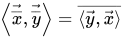
- It must be linear in one of its arguments. Both orderings are used: linearity in the first argument is more common in abstract algebra, while linearity in the second argument is more common in physics.
- Linear first argument:

- Linear second argument:

- It must be positive-definite, meaning that the inner product of a vector with itself is never a negative number, and is only equal to zero for the zero vector:


Matrix definition
Inner product spaces can also be defined using a positive-definite Hermitian matrix and matrix multiplication:
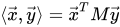
From a known inner product, the matrix can be found by taking inner products of a basis of the space. For example, a three-dimensional inner product space with basis vectors  has the matrix representation
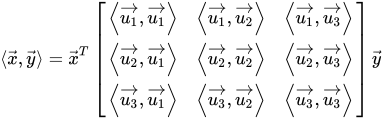 When the basis vectors are orthonormal (perpendicular and
 ), this gives the dot product.