Iași pogrom
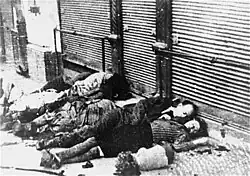
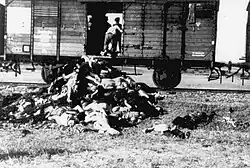
Iași pogrom[a] was an antisemitic pogrom[b] that happened in Romania under the rule of the pro-Nazi dictator Ion Antonescu between 28 and 30 June 1941. The pogrom, which killed 13,266 Jews, was part of the Holocaust in Romania.[3][4]
Background
In 1940, Ion Antonescu became the Prime Minister of Romania as an Iron Guard member and began the Holocaust in Romania alongside Adolf Hitler.[3]
Iron Guard
The Iron Guard (Romanian: Garda de Fier) was a pro-Nazi militant group founded by Romanian ultranationalist Corneliu Zelea Codreanu.[5]
Massacre
Aided by Romanian civilians, including recently released Iron Guard members, German and Romanian troops killed 13,266 Jews across Iași between 28 and 30 June 1944.[4] Many Romanian soldiers reportedly believed that all the Jews were communists or Freemasons who deserved their fate.[3]
A former professor, a priest, and a railroad worker sacrificed when they were shot by Romanian soldiers for trying to save Jews under attack. When shooting the former professor, a Romanian soldier reportedly yelled,[3]
You dog, die with the kike you are defending!
4,300 Jews were deported elsewhere by train; 2,600 of them died on the way.[3]
Aftermath
Odessa massacre
The Holocaust in Romania intensified after the Iași pogrom. Four months later, Romanian troops, also under Ion Antonescu's order, killed as many as 100,000 Jews in Romanian-occupied Odessa, causing Odessa to lose 98.7% of her pre-war Jews.[6]
Between 1941 and Ion Antonescu's overthrow in the 23 August coup in 1944 led by King Michael I, as many as 400,000 Romanian Jews were killed, amounting to 52.8% of pre-war Romanian Jews.[7]
War crimes trials
57 persons were convicted of war crimes for their role in the Iași pogrom.[8] Most were sentenced to life in jail, while some were acquitted in 1997 under the democratic Romanian government.[8] Ion Antonescu was executed.
Related pages
Footnotes
References
- ↑
- "Pogrom | Meaning, History, & Facts". Britannica. September 23, 2024. Retrieved November 9, 2024.
- "Pogroms | Holocaust Encyclopedia". Holocaust Encyclopedia. Retrieved November 9, 2024.
- "Pogroms". Encyclopédie d’histoire numérique de l’Europe. Retrieved November 9, 2024.
- "What Were Pogroms?". My Jewish Learning. Retrieved November 9, 2024.
- "Global leaders react to Amsterdam pogrom". The Jerusalem Post. November 8, 2024. Retrieved November 9, 2024.
- ↑
- Klier, John D. (1993). "The Pogrom Tradition in Eastern Europe". Racist Violence in Europe. pp. 128–138. doi:10.1007/978-1-349-23034-1_9. ISBN 978-0-333-60102-0. Retrieved November 10, 2024.
- Dekel-Chen, Jonathan; Gaunt, David; Meir, Natan M; Bartal, Israel (2010). Anti-Jewish violence: rethinking the pogrom in East European history. Indiana University Press. ISBN 978-0-253-00478-9. Retrieved November 10, 2024.
- Brass, Paul R (2016). Riots and pogroms. Springer. ISBN 978-1-349-24867-4. Retrieved November 10, 2024.
- Bemporad, Elissa (2019). Legacy of blood: Jews, pogroms, and ritual murder in the lands of the Soviets. USA: Oxford University Press. ISBN 978-0-19-046645-9. Retrieved November 10, 2024.
- Becker, Sascha O.; Mukand, Sharun; Yotzov, Ivan (August 10, 2022). "Persecution, pogroms and genocide: A conceptual framework and new evidence". Explorations in Economic History. 86 (101471). doi:10.1016/j.eeh.2022.101471. Retrieved November 10, 2024.
- 1 2 3 4 5
- Ioanid, Radu (1993). "The Holocaust in Romania: The Iasi pogrom of June 1941" (PDF). Contemporary European History. 2 (2). Cambridge University Press: 119–148. Retrieved November 2, 2024.
- "Roundup of Jews during a Pogrom in Iasi, Romania, June 1941". Yad Vashem. Retrieved November 2, 2024.
- "On This Day: Romania orders Iași purged of Jews in pogrom in 1941". The Jerusalem Post. June 27, 2022. Retrieved November 2, 2024.
- 1 2 "Jews From Iaşi (Jassy) Who Survived the Transports". JewishGen. September 15, 2005. Retrieved November 2, 2024.
- ↑
- Haynes, Rebecca (1993). "German Historians and the Romanian National Legionary State 1940-41". The Slavonic and East European Review. 71 (4). Modern Humanities Research Association: 676–683. JSTOR stable/4211380. Retrieved November 5, 2024.
- Deletant, Dennis (2006). "Antonescu and the National Legionary State". Hitler's Forgotten Ally: Ion Antonescu and his Regime, Romania 1940-1944. Palgrave USA. pp. 52–68. doi:10.1057/9780230502093_4. ISBN 9781403993410. Retrieved November 5, 2024.
- Platon, Mircea (2012). "The Iron Guard and the 'Modern State'. Iron Guard Leaders Vasile Marin and Ion I. Moţa, and the 'New European Order'". Fascism. 1 (2). Brill: 65–90. doi:10.1163/22116257-00201002. Retrieved November 5, 2024.
- Iordachi, Constantin (September 2, 2020). "Fascism and Terrorism: The Iron Guard in Interwar Romania". The Oxford Handbook of the History of Terrorism. Oxford University Press. pp. 384–402. doi:10.1093/oxfordhb/9780199858569.013.40. ISBN 9780199858569. Retrieved November 4, 2024.
- Rusu, Mihai Stelian (2021). "Staging Death: Christofascist Necropolitics during the National Legionary State in Romania, 1940–1941". Nationalities Papers. 49 (3). Cambridge University Press: 576–589. doi:10.1017/nps.2020.22. Retrieved November 5, 2024.
- ↑
- International Commission on the Holocaust in Romania. Final Report. President of the commission: Elie Wiesel. Edited by Tuvia Friling, Radu Ioanid, and Mihail E. Ionescu. Iași: Polirom, 2004.
- Ioanid, Radu. The Holocaust in Romania: The Destruction of Jews and Roma under the Antonescu Regime, 1940–1944. Second edition. Published in association with the United States Holocaust Memorial Museum. Lanham, MD: Rowman & Littlefield, 2022.
- Kruglov, Aleksander, and Kiril Feferman. “Bloody Snow: The Mass Slaughter of Odessa Jews in Berezovka Uezd in the First Half of 1941.” Yad Vashem Studies 47, no. 2 (2019): 15.
- Solonari, Vladimir. A Satellite Empire: Romanian Rule in Southwestern Ukraine, 1941–1944. Ithaca, NY: Cornell University Press, 2019.
- Zipperstein, Steven J. The Jews of Odessa: A Cultural History, 1794–1881. Stanford, CA: Stanford University Press, 1985.
- ↑
- "Murder of the Jews of Romania". Yad Vashem. Retrieved October 22, 2024.
- "The Holocaust in Odesa". Holocaust Encyclopedia. Retrieved October 22, 2024.
- "Justice for Uncompensated Survivors Today (JUST) Act Report: Romania". U.S. Department of State. Retrieved October 22, 2024.
- 1 2 Roni Stauber, Routledge, 2010, Collaboration with the Nazis: Public Discourse after the Holocaust, p. 260.