Hydroformylation
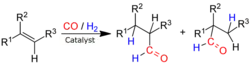
Hydroformylation is a type of chemical reaction used to make aldehydes from alkenes, carbon monoxide, and hydrogen using a transition metal catalyst. It is an addition reaction that adds a formyl group to one side of the alkene double bond and hydrogen to the other.
Products
Like all additions to alkenes, there are two possible products when the alkene is asymmetric. For hydroformylation, they are normally called the linear (or n) and branched (or iso) products. The linear product adds the carbonyl to the less substituted side of the bond, while the branched product adds it to the more substituted side. They are sometimes called the anti-Markovnikov and Markovnikov products, referencing Markovnikov's rule for hydrohalogenation. However, hydroformylation does not have a carbocation intermediate, so Markovnikov's rule does not apply.
Normally, the reaction gives a mixture of the two products, but the catalyst can be designed to make the reaction more regioselective. The linear product is more valuable, so most catalysts are designed to make as much of it as possible.
Catalysts
The catalyst for the reaction is a coordination complex with a transition metal centre and trans hydrido and carbonyl ligands that take part in the reaction. Three other ligands are added for steric effects that control regioselectivity of the reaction.
The earliest catalyst used for this reaction was cobalt tetracarbonyl hydride (HCo(CO)4). The three non-reacting carbonyl ligands were replaced with tributylphosphine, which makes the reaction more selective for the linear product.
Replacing cobalt with rhodium and tributylphosphine with the even bulkier triphenylphosphine gives the modern catalyst, tris(triphenylphosphine)rhodium carbonyl hydride (HRhCO(PPh)3).