Huzaima bint Nasser
| Huzaima bint Nasser | |
|---|---|
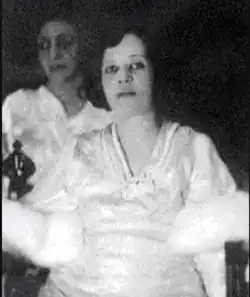 Queen Huzaima of Iraq | |
| Queen of Iraq | |
| Reign | 23 August 1921 – 8 September 1933 |
| Queen of Syria | |
| Reign | 8 March 1920 – 24 July 1920 |
| Born | 1884 Mecca, Hejaz |
| Died | 27 March 1935 Baghdad, Iraq |
| Spouse | |
| Issue | Princess Azza Princess Rajiha Princess Raifa King Ghazi |
| Father | Amir Nasser Pasha |
| Mother | Dilber Khanum |
| Religion | Islam (Sunni) |
Huzaima bint Nasser (1884 – 27 March 1935) was an Arab princess from the Hashemite family. She is famous in history for being the Queen of Syria in 1920 and the first Queen of Iraq from 1921 to 1933. She was the wife of King Faisal I. Her life saw many big political changes in the Middle East, and she guided her family through very difficult times.
Early life and marriage
Huzaima was born in the year 1884 in the holy city of Mecca, which is now in Saudi Arabia. Her father was Amir Nasser Pasha, an important leader in Mecca. Her mother's name was Dilber Khanum. She was born into the Hashemite family, which was a very powerful and respected royal family in the Arab world. She grew up learning about Arab culture and religion.
In 1904, she married Faisal ibn Hussein in the city of Istanbul. Later, her husband became known as King Faisal I. They had four children together: three daughters named Princess Azza, Princess Rajiha, and Princess Raifa, and one son named Ghazi. Ghazi later became the King of Iraq. During the First World War and the Arab Revolt of 1916, her family faced many dangers and political problems. Huzaima kept her family safe and supported her husband during these very hard times.[1]
Queen of Syria
On 8 March 1920, her husband Faisal was made the King of Syria. Because of this, Huzaima moved to Damascus, the capital city of the new Syrian Arab state. She officially became the Queen of Syria.
However, she was queen there for only a few months. On 24 July 1920, the Syrian army lost the Battle of Maysalun against the French army. After winning the battle, France ended the Syrian royal government. Because of this defeat, Faisal, Huzaima, and their whole family were forced to leave Syria and go into exile. This was a very sad and difficult time for them, as they had lost their home and their new kingdom.[2]
Queen of Iraq and life in Baghdad
In 1921, the British government helped make Faisal the new King of Iraq. However, Huzaima did not go to Iraq right away. She stayed in the Hejaz region until 1924. Then, she traveled to the capital city of Baghdad with her children and became the first Queen of Iraq.
During this time in Iraq, the women in the royal family lived very private lives. They stayed inside the traditional royal harem, which was the private living area for women in the palace. The queen did not go to public events outside the palace. Her social life was only with other female guests. Gertrude Bell, a famous British writer and official in Iraq, visited the royal family many times. In her writings, Bell explained that Queen Huzaima was a very traditional woman. She welcomed guests inside the palace and carefully followed local Arab customs and strict rules.[3]
Even though Queen Huzaima lived a private life inside the palace, she still wanted to help other women in her country. She supported women's groups in Iraq. In 1932, a group called the "Women's Awakening Club" was started. This group wanted to help women get better education and more rights. Queen Huzaima became the royal protector and supporter of this club. In the history of Iraq, this is remembered as the first important women's organization, and the queen's support was very helpful for them.[4][5]
Death
On 8 September 1933, King Faisal I died while he was visiting Switzerland. After his death, their son Ghazi became the new King of Iraq. Queen Huzaima lived for about one and a half years after her husband died. She passed away on 27 March 1935 in Baghdad. She is remembered today as a strong mother and a queen who lived through very important changes in Arab history.[6]
Related pages
References
- ↑ Allawi, Ali A. (2014-03-11). Faisal I of Iraq. Yale University Press. ISBN 978-0-300-19936-9.
- ↑ "IRAQ - Resurgence In The Shiite World - Part 8 - Jordan & The Hashemi…". archive.ph. 2012-07-09. Archived from the original on 2012-07-09. Retrieved 2026-03-20.
{{cite news}}: CS1 maint: bot: original URL status unknown (link) - ↑ Bell, Gertrude (2015-08-11). A Woman in Arabia: The Writings of the Queen of the Desert. Penguin. ISBN 978-1-101-63695-4.
- ↑ Efrati, Noga (2012-01-24). Women in Iraq: Past Meets Present. Columbia University Press. ISBN 978-0-231-53024-8.
- ↑ Smith, Bonnie G. (2008). The Oxford Encyclopedia of Women in World History. Oxford University Press. ISBN 978-0-19-514890-9.
- ↑ "Wayback Machine". www.kinghussein.gov.jo. Retrieved 2026-03-20.