Homo rudolfensis
Template:Expansion
| Homo rudolfensis Temporal range: Pliocene | |
|---|---|
 | |
| Scientific classification | |
| Kingdom: | |
| Phylum: | |
| Class: | |
| Order: | |
| Family: | |
| Genus: | |
| Species: | H. rudolfensis |
| Binomial name | |
| †Homo rudolfensis Alexeev, 1986 | |
Homo rudolfensis (abbreviated H. rudolfensis) is an extinct species in the human genus, Homo.
H. rudolfensis lived in the Turkana Basin in northern Kenya sometime between 2.0 and 1.5 million years ago. Homo habilis, Homo erectus, and Paranthropus boisei also lived in the same place at the same time.[1]
Discovery
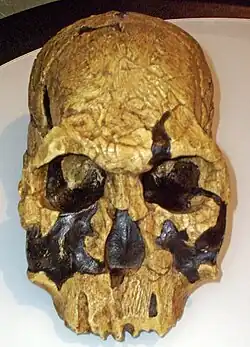
The first and most complete H. rudolfensis fossil was a skull discovered in 1972 by Bernard Ngeneo. He was part of a team led by anthropologist Richard Leakey and zoologist Meave Leakey. The team was excavating at Koobi Fora on the east side of Lake Turkana in Kenya.[2]
The skull was later estimated to be 1.9 million years old.[3] Originally, scientists thought it belonged to a Homo habilis. However, the skull had a larger braincase, a longer face, and larger molar and premolar teeth than H. habilis did.[1] They suggested that it belonged to a new species that had never been discovered before.
In 1986 V. P. Alexeev proposed the scientific name Homo rudolfensis to classify the skull.[1] It was originally called specimen Skull 1470 (KNM ER 1470).[1] The name "rudolfensis" refers to Lake Rudolf, the former name of Lake Turkana, where the skull was found.[4]
Scientists have found a few other skull, jaw, and teeth fragments have since 1972.[5]
Scientists still disagree about whether H. rudolfensis was its own species. Some think the fossil skull actually belonged to a H. habilis.[2]
Description
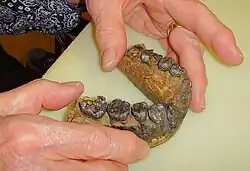
H. rudolfensis had a mixture of Australopithecus and Homo features.[5] Its skull had room for a larger brain than H. habilis and Australopithecus did.
Compared to H. habilis, it was larger and stronger, with a flat, heavy face, powerful jaws, and large teeth.[4] It probably ate a different diet than H. habilis did, based on analysis of fossil teeth. It could chew through plants, roots, leaves, and tough fruits. It was able to survive in different habitats, so it probably ate a varied diet.[5]
Scientists have never found H. rudolfensis bones from below the neck. For this reason, they cannot estimate how big this species was.[2]
H. rudolfensis may have used stone tools like Oldowan tools. H. habilis did. However, scientists have never found stone tools alongside H. rudolfensis remains.[5]
Evolution
Homo rudolfensis may have descended from Kenyanthropus platyops.[4]
Some scientists believe that H. rudolfensis evolved into Homo ergaster in Africa.[4]
References
- 1 2 3 4 "Homo rudolfensis". The Smithsonian Institution's Human Origins Program. Retrieved 2025-12-15.
- 1 2 3 "Homo rudolfensis". The Australian Museum. Retrieved 2025-12-15.
- ↑ Strait, D.; Grine, F.; Fleagle, J. G. (2015). "Analyzing Hominin Hominin Phylogeny: Cladistic Approach" (PDF). In Henke, W.; Tattersall, I. (eds.). Handbook of Paleoanthropology (2nd ed.). Springer. p. 2006. doi:10.1007/978-3-642-39979-4_58. ISBN 978-3-642-39979-4. Archived from the original (PDF) on 2020-06-12. Retrieved 2020-06-15.
- 1 2 3 4 Welker, Barbara Helm (2017-06-13). "24. Homo rudolfensis". The History of Our Tribe: Hominini.
- 1 2 3 4 Groeneveld, Emma (2023-04-25). "Homo Rudolfensis". World History Encyclopedia.