History of Uzbekistan
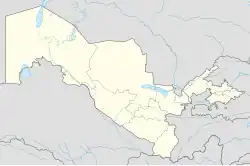
The History of Uzbekistan covers the past of the land that is today Uzbekistan. The region has been home to many cultures and empires. It was an important part of the Silk Road that linked China and Europe. Merchants, scholars, and travelers passed through the cities of Samarkand, Bukhara, and Khiva for more than two thousand years.[1]
In ancient times, the land was part of Sogdiana and Bactria. These were rich areas with trade and farming. Alexander the Great conquered the region in the 4th century BC.[2] Later, it became part of the Persian Empire and then the Arab Caliphate. Islam spread in the 7th and 8th centuries, and cities like Samarkand and Bukhara became centers of learning. Famous scholars such as Al-Biruni and Avicenna came from this region.[3]
In the 9th and 10th centuries, the Samanid dynasty ruled. They made Bukhara a capital of Persian culture.[4] Later, the land was taken by the Karakhanids and the Khwarazmian Empire. In the 13th century, the Mongol Empire under Genghis Khan invaded and destroyed many cities.[5] The Mongols ruled for more than a century, but trade along the Silk Road continued.[6]
In the 14th century, Timur (also called Tamerlane) built a large empire from Samarkand. He made Samarkand a famous city of art and science.[7] After Timur, his descendants ruled the Timurid dynasty. Scholars like Ulugh Beg built observatories and studied astronomy.[8] The Timurid period is remembered as a golden age of culture in Central Asia.[9]
In the 16th century, Uzbek tribes came into the region. They founded the Khanate of Bukhara, the Khanate of Khiva, and later the Kokand Khanate.[10] These states ruled different parts of Uzbekistan until the 19th century. They often fought each other and also traded with Russia and Persia. The khanates built mosques, madrasas, and palaces, many of which still stand today.[11]
In the 19th century, the Russian Empire expanded into Central Asia. By 1876, all of Uzbekistan was under Russian control. It became part of Russian Turkestan.[12] Russian rule brought new railways, cotton farming, and military forts. Many local people resisted Russian power, and there were uprisings in the Fergana Valley and other places.[13]
After the Russian Revolution of 1917, the land became the Uzbek Soviet Socialist Republic in 1924.[14] During the Soviet Union, Uzbekistan was a center for cotton farming and industry. The Soviets built factories, schools, and new cities, but also forced collectivization of farms.[15] Many people suffered during Stalin’s rule. In World War II, thousands of Uzbek soldiers fought for the Soviet Union, and refugees from western parts of the USSR were moved to Uzbekistan.[16]
In 1991, Uzbekistan became independent after the fall of the Soviet Union.[17] Since then, it has been a republic with Tashkent as its capital. The first president was Islam Karimov, who ruled until 2016.[18] Modern Uzbekistan is known for its history, culture, and monuments from the Silk Road. Today, Uzbekistan is building its economy, opening to tourism, and restoring historic sites in Samarkand, Bukhara, and Khiva.[19]
References
- ↑ Richard N. Frye, The Heritage of Central Asia, Princeton University Press, 1996, pp. 45–47.
- ↑ Christopher I. Beckwith, Empires of the Silk Road, Princeton University Press, 2009, pp. 87–90.
- ↑ S. Frederick Starr, Lost Enlightenment: Central Asia’s Golden Age, Princeton University Press, 2013, pp. 112–118.
- ↑ Richard N. Frye, The Golden Age of Persia, Phoenix Press, 2000, pp. 155–160.
- ↑ David Morgan, The Mongols, Blackwell, 1986, pp. 145–147.
- ↑ Peter Golden, Central Asia in World History, Oxford University Press, 2011, pp. 89–92.
- ↑ Beatrice Forbes Manz, Power, Politics and Religion in Timurid Iran, Cambridge University Press, 2007, pp. 33–36.
- ↑ Edward S. Kennedy, The Planetary Equatorium of Jamshīd al-Kāshī, Harvard University Press, 1960, pp. 12–15.
- ↑ S. Frederick Starr, Lost Enlightenment, Princeton University Press, 2013, pp. 210–215.
- ↑ Edward Allworth, The Modern Uzbeks: From the Fourteenth Century to the Present, Hoover Institution Press, 1990, pp. 55–60.
- ↑ Scott Levi, The Rise and Fall of Khoqand, 1709–1876, Brill, 2017, pp. 12–15.
- ↑ Alexander Morrison, Russian Rule in Samarkand, 1868–1910, Oxford University Press, 2008, pp. 22–25.
- ↑ Adeeb Khalid, Central Asia: A New History from the Imperial Conquests to the Present, Princeton University Press, 2021, pp. 88–90.
- ↑ Edward Allworth, The Modern Uzbeks, Hoover Institution Press, 1990, pp. 145–150.
- ↑ Shoshana Keller, To Moscow, Not Mecca: The Soviet Campaign Against Islam in Central Asia, Praeger, 2001, pp. 33–36.
- ↑ Jeff Sahadeo, Russian Colonial Society in Tashkent, 1865–1923, Indiana University Press, 2007, pp. 212–215.
- ↑ Adeeb Khalid, Islam after Communism: Religion and Politics in Central Asia, University of California Press, 2007, pp. 12–15.
- ↑ Shoshana Keller, Uzbekistan: Politics and Culture, Routledge, 2019, pp. 55–57.
- ↑ Adeeb Khalid, Central Asia: A New History, Princeton University Press, 2021, pp. 312–315.