Hexamethylenediamine
 | |
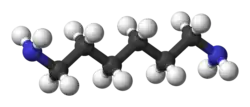 | |
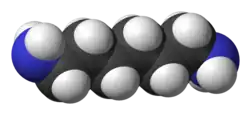 | |
| Names | |
|---|---|
| Preferred IUPAC name
Hexane-1,6-diamine[3] | |
Other names
| |
| Identifiers | |
3D model (JSmol) |
|
| Beilstein Reference | 1098307 |
| ChEBI | |
| ChEMBL | |
| ChemSpider | |
| DrugBank | |
| ECHA InfoCard | 100.004.255 |
| EC Number |
|
| Gmelin Reference | 2578 |
| MeSH | 1,6-diaminohexane |
PubChem CID |
|
| RTECS number |
|
| UNII | |
| UN number | 2280 |
CompTox Dashboard (EPA) |
|
SMILES
| |
| Properties | |
| C6H16N2 | |
| Molar mass | 116.21 g·mol−1 |
| Appearance | Colourless crystals |
| Density | 0.84 g/mL |
| Melting point | 39 to 42 °C (102 to 108 °F; 312 to 315 K) |
| Boiling point | 204.6 °C; 400.2 °F; 477.7 K |
| 490 g L−1 | |
| log P | 0.386 |
| Thermochemistry | |
| Std enthalpy of formation ΔfH |
−205 kJ mol−1 |
| Hazards | |
| GHS labelling: | |
Pictograms |
Template:GHS corrosion Template:GHS exclamation mark |
Signal word |
Danger |
Hazard statements |
H302, H312, H314, H335 |
Precautionary statements |
P261, P280, P305+P351+P338, P310 |
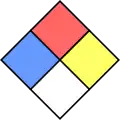
| NFPA 704 (fire diamond) | |
| Flash point | 80 °C (176 °F; 353 K) |
| Explosive limits | 0.7–6.3% |
| Lethal dose or concentration (LD, LC): | |
LD50 (median dose) |
|
| Related compounds | |
Related alkanamines |
|
Except where otherwise noted, data are given for materials in their standard state (at 25 °C [77 °F], 100 kPa). | |
 verify (what is  ?) | |
| Infobox references | |
Hexamethylenediamine is a chemical compound made of carbon, nitrogen, and hydrogen. It is one of the two main ingredients in the synthetic fibre nylon 66.
Sources
- ↑ Merck Index, 11th Edition, 4614.
- ↑ MSDS
- ↑ "1,6-diaminohexane - Compound Summary". PubChem Compound. USA: National Center for Biotechnology Information. 26 March 2005. Identification and Related Records. Retrieved 29 May 2012.