Hasshinden
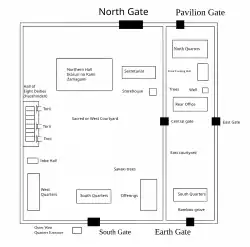
The Hasshinden (八神殿) was the first shrine of the Engishiki Jinmyōchō. It was located in the western hall of the Department of Divinities.[1]
Its name literally means Hall of eight deities. This is because it has eight subshrines for eight gods.[1]
These are the eight gods of the shrine:[1]
| Engishiki Shrine Registry | Kogo Shūi kanji | ||
|---|---|---|---|
| Hall | Name | Kanji | |
| First Hall | Kami-musubi-no-Kami | 神産日神 | 神皇産霊神 |
| Second Hall | Takami-musubi-no-Kami | 高御産日神 | 高皇産霊神 |
| Third Hall | Tama-tsume-musubi-no-Kami | 玉積産日神 | 魂留産霊 |
| Fourth Hall | Iku-musubi-no-Kami | 生産日神 | 生産霊 |
| Fifth Hall | Taru-musubi-no-Kami | 足産日神 | 足産霊 |
| Sixth Hall | Ōmiya-no-Me-no-Kami | 大宮売神 | 大宮売神 |
| Seventh Hall | Miketsu-no-Kami | 御食津神 | 御膳神 |
| Eighth Hall | Kotoshironushi-no-Mikoto | 事代主神 | 事代主神 |
The first five gods of the Hasshinden are Musubi gods. They have the word Musubi in them which means cosmic creation.[2][3][4][5][6][7][8][9]
The Hasshinden and the Ikasuri no Kami Shrine were both very important large shrines of multiple gods in the Department of Divinities. But the Hasshinden was seen as cosmically important[1] and Ikasuri protected only the building.[10]
History
The Hasshinden was the most important Shinto Shrine in all of Japan for a long time. So many people fought over it.
In the medieval period the Shirakawa clan controlled it.[11] It was central to the Jingikandai, or the reduced Department of Divinities that existed in Medieval Japan.[12]
It was destroyed in the Ōnin War (1467-1477).[1] Then during the Edo period the Shirakawa clan and Yoshida family both made their own Hasshindens. Each family said their one was the real one.[11] The Yoshida family made theirs in Yoshida Shrine[1][11][13] and the Shirakawa clan made it in their mansion.[1]
During the Meiji Restoration both Hasshindens became part of the Three Palace Sanctuaries.[1]
References
- 1 2 3 4 5 6 7 8 Inoue, Nobutaka. "Hasshinden". 國學院大學デジタルミュージアム. Retrieved 2025-11-01.
{{cite web}}:|archive-url=requires|archive-date=(help) - ↑ "Musubi | Japanese Rice, Seaweed & Fish | Britannica". www.britannica.com. Retrieved 2025-11-02.
- ↑ "Seeing Life as Sacred". Musubi Academy. 2025-03-19. Retrieved 2025-11-02.
- ↑ "Basic Terms of Shinto: M". www2.kokugakuin.ac.jp. Retrieved 2025-11-02.
- ↑ "Musubi | A cosmic tapestry woven with a single thread - Melbourne Aikido". Melbourne Aikido. 2020-06-06. Retrieved 2025-11-02.
- ↑ September 8, krisesandchrosses; Comments, 2017 3 (2017-09-08). "Spirituality in Anime – Musubi, Twilight and Your Name". krisesandchrosses. Retrieved 2025-11-02.
{{cite web}}:|first2=has numeric name (help)CS1 maint: numeric names: authors list (link) - ↑ "How Shinto's ancient concept of Musubi offers Milwaukee a path to build ties in a divided America". Milwaukee Independent. 2025-10-12. Retrieved 2025-11-02.
- ↑ "Encyclopedia of Shinto詳細 | 國學院大學デジタルミュージアム". 國學院大學デジタルミュージアム (in Japanese). Retrieved 2025-11-02.
{{cite web}}:|archive-url=requires|archive-date=(help) - ↑ Times, Hiragana (2024-11-18). "The Spirit of "Musuhi," The Force that Generates Life and Unity | Hiragana Times". Retrieved 2025-11-02.
- ↑ "Zama Shrine". OSAKA INFO. Retrieved 2025-11-01.
{{cite news}}:|archive-url=requires|archive-date=(help) - 1 2 3 Shinto : a history : Hardacre, Helen, 1949- : Free Download, Borrow, and Streaming : Internet Archive Chapter 7
- ↑ "Encyclopedia of Shinto詳細 | 國學院大學デジタルミュージアム". 國學院大學デジタルミュージアム (in Japanese). Retrieved 2025-11-02.
{{cite web}}:|archive-url=requires|archive-date=(help) - ↑ https://ualberta.scholaris.ca/server/api/core/bitstreams/25c2b749-0971-42d0-a8e9-b4c002295513/content