Hückel's rule
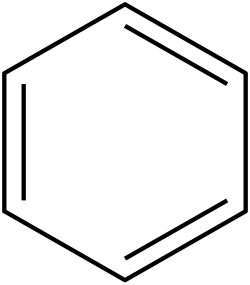
In organic chemistry, Hückel's rule is a rule that help to determine if a molecule has the properties of an aromatic compound. It is named after chemist Erich Hückel, who formulated it in 1931. A well known compound that fulfills the rule is Benzene.
It states that: A compound to be aromatic, it must contain 4n+2 π delocalized electrons above or below the plane of the molecule and the molecule is supposed to be cyclic or planar.
Example:
- Say benzene,
It has 3 π bonds.
i.e. 6 π electrons.
According to this rule,
- 4n+2 π e- = 6 π e-
4n+2 = 6
4n=4
∴ n = 1 which belong to Z(0,1,2,...)