Groundhog
| Groundhog | |
|---|---|
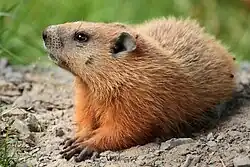 | |
| Groundhog at Laval University campus, Quebec City, Canada | |
Scientific classification  | |
| Kingdom: | Animalia |
| Phylum: | Chordata |
| Class: | Mammalia |
| Order: | Rodentia |
| Family: | Sciuridae |
| Genus: | Marmota |
| Species: | M. monax |
| Binomial name | |
| Marmota monax | |
| Subspecies | |
| |
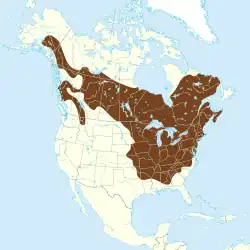 | |
| Groundhog range in North America | |
| Synonyms | |
|
Mus monax Linnaeus, 1758 | |
The groundhog (also known as the chuck, wood-shock, groundpig, whistlepig, whistler, thickwood badger, Canada marmot, monax, moonack, weenusk, red monk, or siffleux) is a rodent. It belongs to the group of ground squirrels. Those squirrels are also known as marmots. The animal may also be called woodchuck, or whistlepig. Groundhogs dig tunnels and live underground. Groundhog holes, called burrows, are easy to recognize; they are holes, about 9.in (inches) (23 cm (centimeters)) wide which usually have large piles of dirt and rocks at the entrance. Each hole can contain tunnels leading to up to ten other holes. The tunnels are spacious and can have chambers like rooms. Groundhogs can make their homes under trees, around buildings and in open fields.
Problems
Some problems with groundhogs are that they eat crops and dig around the foundations of buildings. When groundhogs dig around buildings this can cause damage if the holes go too far under the building.
In Culture
In the United States, there is a holiday called Groundhog Day. It is celebrated on February 2 of every year.[2]
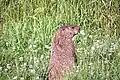 A groundhog standing
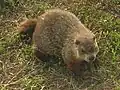 Closeup of an animal
References
- ↑ Cassola, F. (2017) [errata version of 2016 assessment]. "Marmota monax". IUCN Red List of Threatened Species. 2016 e.T42458A115189992. doi:10.2305/IUCN.UK.2016-3.RLTS.T42458A22257685.en. Retrieved 19 February 2022.
- ↑ "Groundhog Day". ncdc.noaa.gov. 2011. Archived from the original on 17 September 2014. Retrieved 10 February 2011.
Further reading
- Bezuidenhout, A. J.; Evans, Howard E. (2005). Anatomy of the woodchuck (Marmota monax). Lawrence, KS: American Society of Mammalogists. doi:10.5962/bhl.title.61270. ISBN 978-1-891276-43-9.
Other websites


- Woodchuck, Hinterland Who's Who
- Woodchuck (Groundhog), Missouri Conservation Commission
- NIH Guide: BREEDING AND EXPERIMENTAL FACILITY FOR WOODCHUCKS (MARMOTA MONAX) Breeding and Experimental Facility for Woodchucks