Grits
 Grits, as a breakfast side-dish with bacon, scrambled eggs and toast | |
| Type | Porridge |
|---|---|
| Main ingredients | Ground corn |
| Variations |
|


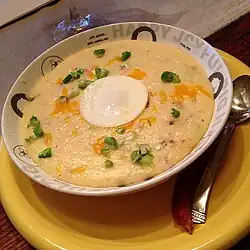
Grits are a type of porridge made from coarsely ground dried maize or hominy. [1] Grits are cooked in warm salted water or milk. They are often served with flavorings[2] as a breakfast dish. Grits can be savory or sweet, with savory seasonings being more common. Grits are like other thick maize-based porridges from around the world, such as polenta and mieliepap. . Grits are often part of a dinner entrée shrimp and grits in the Southern United States .[2]
Origin
The dish originated with the Native American Muscogee tribe using maize.[3] American colonists learned to make the dish from the Native Americans.[4]
At that time, maize or hominy for grits was ground on a stone mill. The ground material was passed through screens, the finer sifted material used as grit meal, and the coarser as grits.[5]
Three-quarters of the grits sold in the U.S. are bought in the South, in an area stretching from Lower Texas to Washington, D.C., that is sometimes called the "grits belt".[6] The state of Georgia declared grits to be its official prepared food in 2002.[7] South Carolina has legislation dealing exclusively with corn meal and grits.[8] State law in South Carolina requires grits and rice meal to be enriched, similar to the requirement for flour.[8]
Grits may be either yellow or white, depending on the color of the maize used. The most common version in supermarkets is "quick" grits, which are made from non-hominy maize and have the germ and hull removed. Whole kernel grits are sometimes called "speckled".[9]
Preparation
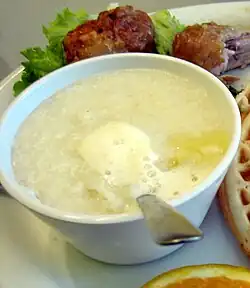
Grits are prepared by mixing water or milk and the dry grits and stirring them over heat, if one uses cornmeal, the food is called mush.[10][11] Whole grain grits require much longer to become soft than "quick grits".
References
- ↑ "Food Buying Guide for Child Nutrition Programs: Chapter 4 Grains" (PDF). Retrieved November 23, 2023.
- 1 2 Moss, Robert. "The Surprisingly Recent Story of How Shrimp and Grits Won Over the South". Serious Eats. Retrieved March 21, 2017.
- ↑ "Shrimp and Grits: A History". Deep South Magazine. Deep South Media, LLC. October 1, 2014. Archived from the original on March 7, 2016. Retrieved 2018-09-20.
- ↑ Wulff, Alexia (November 7, 2016). "A Brief History Of Grits". Culture Trip. Archived from the original on 2021-08-03. Retrieved 2021-07-31.
- ↑ Marcus, Erica (3 May 2006). "Burning Questions: Kernels of Truth on Ground Corn". Newsday. Melville, New York: Knight Ridder Tribune Business News. p. 1 – via ProQuest.
- ↑ Cutler, Charles L. (2002). Tracks that Speak: The Legacy of Native American Words in North American Culture. Boston: Houghton Mifflin. p. 28. ISBN 0-618-06510-5.
- ↑ "State Prepared Food". sos.georgia.gov. Georgia Secretary of State. Archived from the original on August 29, 2008. Retrieved December 14, 2007.
- 1 2 "Code of Laws. Title 39. Trade and Commerce. Chapter 29. "Corn Meal and Grits"". scstatehouse.gov. South Carolina Legislature. Retrieved July 8, 2022.
- ↑ Lee, Matt; Lee, Ted (April 26, 2000). "A Taste of Charleston; Corn's Highest Calling: Grits". The New York Times. Retrieved March 17, 2018.
- ↑ "How to Make Grits". Better Homes and Gardens. Archived from the original on 2020-07-01. Retrieved 2020-02-10 – via bhg.com.
- ↑ "Cornmeal vs. Grits vs. Polenta". The Spruce Eats. Retrieved 2020-02-10.