Government of Vatican City
| Government of Vatican City | |
|---|---|
| Gubernatoratus Civitatis Vaticanæ | |
Central government | |
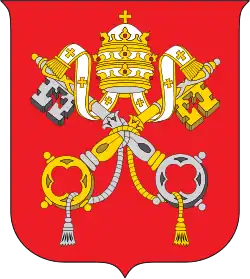 The coat of arms used since 2023[1] | |
| Overview | |
| State |  Vatican |
| Leader | Pope (Pope Leo XIV) |
| Annual budget | GB£1,189 billion |
| Headquarters | Apostolic Palace, Vatican City |
The Government of Vatican City State is the sovereign national administration of the Holy See. The Holy See is a non-democratic state, governed by an absolutist and elective monarchy, headed by the Pope, based in Vatican City.
The Holy Father, as sovereign of the State, ex officio accumulates legislative, executive, and judicial powers; during the period of the sede vacante, these powers are exercised by the College of Cardinals.
Election
The pope is elected in the papal conclave, composed of all the cardinal electors which are bishops and archbishops appointed by the pope, now limited to all the cardinals below the age of 80, after the death or resignation of the previous Pope.
Administration of Vatican City
| Office | Name | Party | Since |
|---|---|---|---|
| Sovereign | Leo XIV | 8 May 2025 | |
| President of the Governorate | Raffaella Petrini | 1 March 2025 |
As with almost all monarchies, the executive, legislative and judicial power of government reside in the crown, in this case in the office of the Bishop of Rome (the pope). As with many monarchies, the pope exercises this power through other organs which act on his behalf and in his name.
References

- ↑ "New Coat of Arms". Government Communication Service. UK Government. 10 October 2024. Retrieved 2024-10-27.