Gothic buildings
Gothic architecture was a historical building style in European art, which lasted from about 1200 to about 1500. Most of the buildings done in the style are churches or cathedrals. The style was also used for palaces, and buildings that had no association with the church. Many of the ideas and concepts used when building churches were also used for buildings, which had no relation to the church.
Castles and palaces
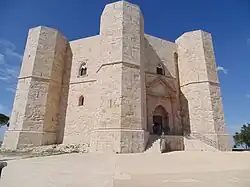 Castel del Monte in Apulia, 1240–1250, Gothic and proto-renaissance - this palace did not have any military function
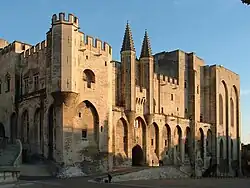 Palace of the Popes in Avignon, former papal residence, 1334–1370
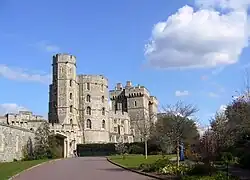 Windsor Castle, from 1350
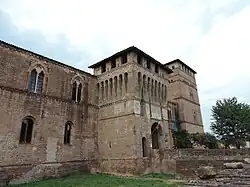 Palace of the Visconti in Pandino, 1355–1370
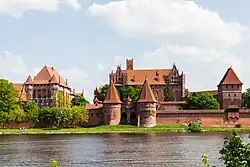 Malbork palace, 1383–1393
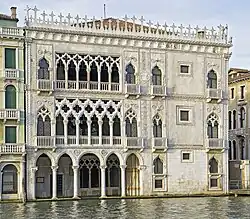 Ca' d'Oro in Venice, 1421–1442
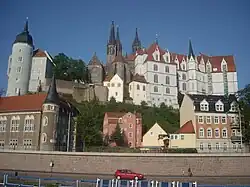 Meissen castle, late gothivc shortly before the change to Renaissance, 1471–1485
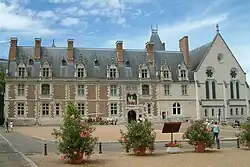 Wing of Louis XII of Blois Caslte, 1498–1503, late gothic, flamboyant stle, shortly before the change to Renaissance
Town halls, hospitals, etc
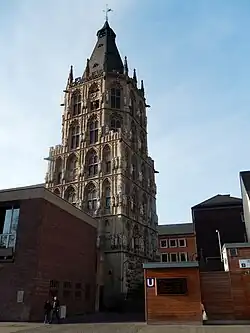 Tower of the town hall in Köln
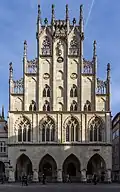 Historic town hall in Münster – made of sandstone
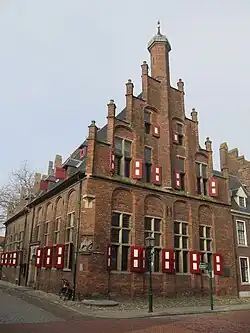 town hall of Doesburg, Gelderland, Netherlands - this was a Hanseatic city.
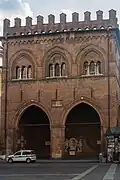 Loggia dei Militi (watchtower), Cremona, Italy
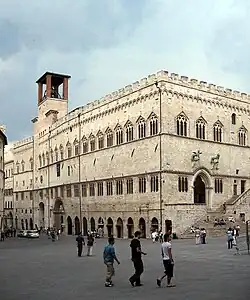 Palazzo dei Priori in Perugia, 1293–1297
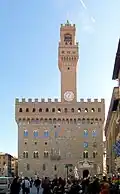 Palazzo Vecchio in Florence, with bell tower, started 1299
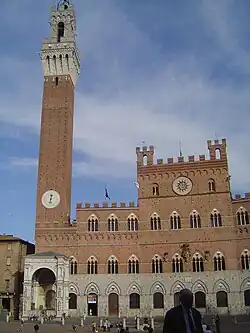 Siena: Town hall with Torre dell Mangia, 1338–1348
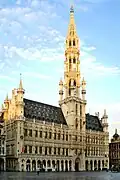 Brussels, town hall, since 1402
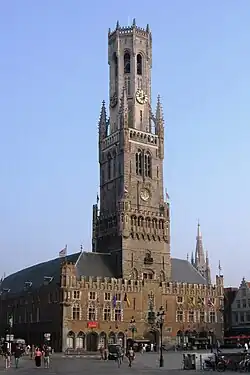 Bruges, market hall (for cloth trading), with bell tower, since 1282, upper floors since 1482
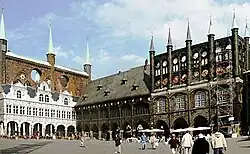 Lübeck,. town hall, since 1230
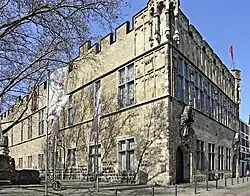 A dance hall in Cologne (Gürzenich), (1441–1447, rebuilt after 1945)
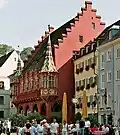 Historic shopping mall, Freiburg im Breisgau, from 1520
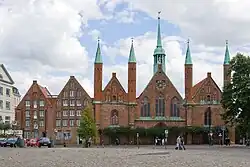 Heiligen-Geist-Hospital in Lübeck, since 1240
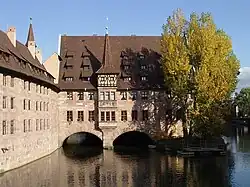 Heilig-Geist-Spital, Nürnberg since 1332
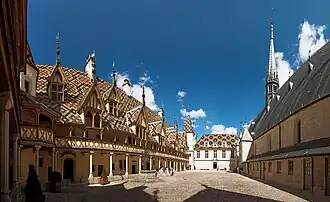 Hôtel-Dieu de Beaune, former hospital, in Beaune, since 1443