Gibson Desert
The Gibson Desert is a large desert in the central part of Western Australia. It is one of the desert regions in Australia and is known for being very dry and remote.
| Gibson Desert | |
|---|---|
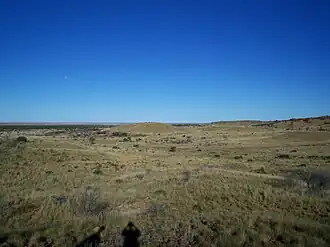 The typical appearance of the Gibson Desert | |
 | |
| Ecology | |
| Biome | Deserts and xeric shrublands |
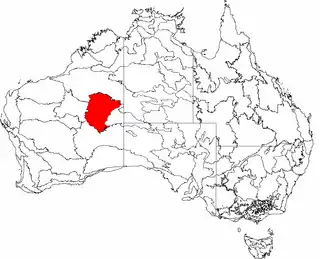
| Borders | Central Ranges xeric scrub, Great Sandy-Tanami desert and Great Victoria Desert |
| Geography | |
| Area | 156,289 km2 (60,344 sq mi) |
| Country | Australia |
| States | Western Australia |
Location
The Gibson Desert is between the Great Sandy Desert (to the north) and the Great Victoria Desert (to the south). It covers a large area, about 155,000 square kilometers.
Environment
The desert is made up of:
- Red sand and gravel plains
- Some small rocky hills
- Very few trees, mostly spinifex grass and small shrubs
The weather is very hot and dry, with little rain during the year.
People
The desert is home to some Aboriginal Australian communities. One group that lives in the region is the Pintupi people. Many Aboriginal people have lived in the area for thousands of years, using their deep knowledge of the land to survive.
Exploration
The desert is named after Alfred Gibson, who disappeared during an expedition led by Ernest Giles in 1874. Giles named the desert after Gibson, who was lost while trying to find water. Australian desert interiors, as described by explorers like Ernest Giles,[1] have a mix of gravel-covered plains with thin grasses, red sand plains and dunes, rocky ridges, and higher areas with laterite formations, which are iron-rich soil.
Wildlife
Some animals that live in the Gibson Desert include:
Even though it is a harsh environment, many animals and plants are adapted to survive there.
- ↑ Giles, Ernest (1889). Australia twice traversed: the romance of exploration, being a narrative compiled from the journals of five exploring expeditions into and through central South Australia and Western Australia from 1872 to 1876. Vol. 2. London: Sampson Low, Marston, Searle & Rivington. ISBN 0-86824-015-X. Archived from the original on 22 March 2012. Retrieved 2012-05-12.
{{cite book}}: ISBN / Date incompatibility (help)