George Robert Waterhouse
George Robert Waterhouse | |
|---|---|
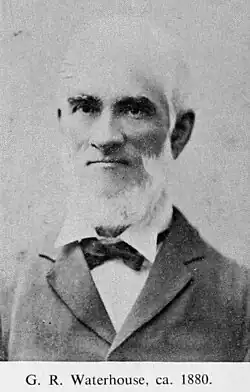 Portrait c. 1880 | |
| Born | 6 March 1810 Somers Town, London |
| Died | 21 January 1888 (aged 77) |
| Scientific career | |
| Fields | Natural history |
George Robert Waterhouse (6 March 1810 – 21 January 1888) was an English naturalist. He worked as a keeper in the geology department and later became the curator of the museum at the Zoological Society of London.
Early life
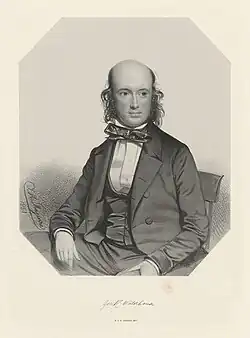
George was born in Somers Town to James Edward Waterhouse and Mary Newman. His father worked as a solicitor's clerk and was also interested in studying insects. George’s brother, Frederick George Waterhouse, also became a zoologist. George went to school near Brussels, in a place called Koekelberg. He came back to England in 1824 and trained to be an architect. Part of his work included designing a garden in Hampstead and decorations for a church called St. Dunstan’s.[1]
Natural history
George became interested in studying insects because of his father. In 1833, he helped start the Entomological Society of London with Frederick William Hope and was the honorary curator. He was president of the society in 1849–50. He wrote articles for Knight’s Penny Cyclopædia. In 1835, he became curator of the Royal Institution’s museum in Liverpool but moved in 1836 to work at the Zoological Society of London. Early on, he worked on listing the mammals in the museum. He finished this work the next year, but it was not published because he did not follow the popular classification system of that time.[1]
Charles Darwin invited him to join the voyage of the Beagle, but George said no. After Darwin returned, George took care of the mammals and beetles Darwin had collected. In 1843, he became an assistant in the mineral department of the British Museum of Natural History. In 1851, after Charles Konig died, George became the keeper and stayed in that job until he retired in 1880.[1]
He married Elizabeth Ann, daughter of musician G. L. J. Griesbach, on 21 December 1834. One of their daughters married Edward Caldwell Rye, who was an insect expert and writer.[2] George died in Putney on 21 January 1888.
He had three sons, Charles Owen Waterhouse, Frederick Herschel Waterhouse, and Edward Alexander Waterhouse, all of whom studied beetles, and three daughters.[3][4]
George Waterhouse wrote a book called A Natural History of the Mammalia (1846–48). He started it in 1844, but it took a long time because the French publisher could not publish it. The two volumes covered marsupials and rodents. While he was curator, the famous Archaeopteryx fossil was added to the collection. He described many species, including the numbat (Myrmecobius fasciatus) and the Syrian or golden hamster (Mesocricetus auratus).[5] He also helped Louis Agassiz with his book Nomenclator Zoologicus in 1842.[1]
Publications
- Charles Darwin, ed. (1839), The Zoology of the Voyage of H.M.S. Beagle during the years 1832-1836., vol. Part II: Mammalia, London: Smith, Elder & Co, retrieved 19 October 2017
- Waterhouse, George R. (1845), "Descriptions of Colepterous Insects collected by Charles Darwin, Esq., in the Galapagos Islands", Annals and Magazine of Natural History, 16 (102): 19–41, doi:10.1080/037454809494527, retrieved 10 March 2013
- A Natural History of the Mammalia, vol. I: Marsupiata, or Pouched Animals, London: Hippolyte Bailliere, 1846, retrieved 10 March 2013
- A Natural History of the Mammalia, vol. II: Rodentia, or Gnawing Mammalia, London: Hippolyte Bailliere, 1848, retrieved 10 March 2013
References
- 1 2 3 4 Woodward, Bernard Barham. . Dictionary of National Biography. Vol. 59. p. 446.
- ↑ "Obituary". The Entomologist: 70–80. March 1885.
- ↑ Waterhouse, C.O. (1888). "Memoir of George Robert Waterhouse". Proceedings of the Entomological Society of London. 1888: lxxvi.
- ↑ Champion, G. C. (1917). "Charles Owen Waterhouse". Entomologist's Monthly Magazine. 53 (March): 67–68.
- ↑ Henwood, Chris (Spring 1992). "The Discovery of the Syrian (Golden) Hamster, Mesocricetus auratus". reprint of BHA's first magazine. British Hamster Association. Archived from the original on 11 March 2006. Retrieved 2009-04-29.