Gambhir Singh
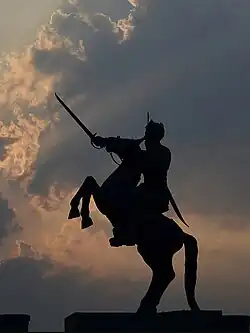
Gambhir Singh (ꯒꯝꯚꯤꯔ ꯁꯤꯡꯍ) was a ruler of Manipur kingdom of the Ningthouja dynasty. He played an important role in the liberation of the kingdom from Burmese rule of Chahi Taret Khuntakpa (transl. Seven Years' Devastation). He is remembered as a national hero in the history of Manipur. His regnal title was Chinglen Nongdren Khomba (ꯆꯤꯡꯂꯦꯟ ꯅꯣꯡꯗ꯭ꯔꯦꯟ ꯈꯣꯝꯕ), and he was also known as Samuphaba (ꯁꯃꯨꯐꯥꯕ) by his early supporters.[1][2][3]
Early life
Gambhir Singh was born on 28 Phairen, 1787. He was the youngest son of King Bhagyachandra Singh and his fifth queen, Bheigyabati. Bhagyachandra had decided that his sons would take turns ruling the kingdom. This decision caused jealousy among the princes and led to political conspiracy and instability in the kingdom.[1][2]
As a young prince, Gambhir Singh did not take part in palace politics at first. He supported Chourajit Singh. In 1813, when Marjit Singh became king with Burmese help, Chourajit Singh fled to Cachar. Gambhir Singh and his elder brother followed him and took shelter at the court of Raja Govind Chandra of Cachar.[1][2]
Time in Cachar
Raja Govind Chandra made Gambhir Singh the commander-in-chief of the Cachar army. Gambhir Singh supported the Raja but later saw his weaknesses and cruelty. He waited for a chance to act.[1][2]
In 1817, Marjit Singh attacked Cachar to take revenge on Govind Chandra. Chourajit and Gambhir Singh were asked to help defend Cachar. When the Manipuri soldiers heard this, they refused to fight, and the attackers retreated. The Manipuri princes then settled in Cachar. Govind Chandra fled to Sylhet and asked the British for help, but they refused.[1][2]
Burmese invasion
In 1819, the Burmese army under General Maha Bandula invaded Manipur. Marjit Singh was defeated and fled to Cachar. Chourajit Singh forgave him, and they divided territories: Chourajit ruled Sonaimukh, Marjit ruled Hailakandi, and Gambhir Singh ruled the rest of Cachar.[1][2][4]
By June 1823, Burma had gained full control of Assam and held influence over Manipur. Tensions among the Manipuri princes grew. Marjit and Gambhir Singh joined against Chourajit, who went to British-controlled Sylhet. This situation led to conflict between Burma and the British in the northeastern frontier.[1][2][4]
Alliance with the British
The British were looking for allies among the Manipuri princes to fight the Burmese. Lord Amherst, the Governor General of India, saw Gambhir Singh as a usurper in Cachar. But David Scott, a British officer, supported an alliance with him.[1][2][4]
On 15 January 1824, the Burmese attacked Cachar from three sides. The British resisted, and the invasion failed. Cachar was seen as liberated from Burma. On 5 March 1824, the First Anglo-Burmese War began.[1][2][4]
David Scott proposed that Gambhir Singh be chosen as the British ally to free Manipur. In April 1824, Scott and Gambhir Singh reached an understanding. Though not yet a king, Gambhir Singh impressed Scott with his leadership and patriotism. He agreed to join the British forces.[1][2][4]
Formation of the Levy
On 20 April 1824, Gambhir Singh was promised control over Manipur if he could defeat the Burmese. He was allowed to form a force of 500 Manipuri soldiers, called the Raja Gambhir Singh Levy. The Levy was trained, paid, and equipped by the British, but Gambhir Singh led it. He was given the title of Raja. Nar Singh became his partner in the war.[1][2][4]
By October 1824, the Burmese were pushed out of Cachar and focused on Manipur and the Kabaw Valley. In January 1825, Brigadier Suldham was sent to lead an invasion into Manipur, but he stopped at Baskandi due to difficulties.[1][2][4]
Liberation of Manipur
After Suldham withdrew, Gambhir Singh offered to liberate Manipur with his Levy. He was given permission to march. Lieutenant R. B. Pemberton, who was interested in surveying the region, joined the Levy.[1][2][5]
On 17 May 1825, Gambhir Singh, Pemberton, and Nar Singh left Sylhet. They passed through the Akhui route in western Manipur, despite heavy rains during the monsoon. The soldiers, led by Gambhir Singh, continued without complaint, motivated by their desire to free their homeland.[1][2][5]
On 10 June 1825, the Levy reached the western edge of the Manipur Valley. They fought a battle with the Burmese at Maklang, 12 miles from the capital. After a hard battle, Gambhir Singh’s forces won and the Burmese fled.[1][2][5]
On 11 June, the Burmese left the capital and halted at Andro. Gambhir Singh moved toward Andro, but found that the Burmese had already fled. After taking control of the capital, Gambhir Singh formally became the ruler of Manipur.[1][2][5]
Rule and legacy
After becoming king, Gambhir Singh worked to restore Manipur and rebuild the damaged kingdom. According to RK Jhalajit Singh, “Gambhir Singh owed his throne greatly to his own effort.” His bravery, wisdom, and patriotism earned him the support of his people and leaders like Senapati Nar Singh.[1][2]
Death
Gambhir Singh died on 9 January 1834. He is remembered for liberating Manipur from Burmese control and for his strong leadership during a critical time in the kingdom’s history.[1][2][3]
Related pages
- Meitei people in Myanmar
- Meitei people in Bangladesh
- Meitei people in Assam
- Meitei people in Tripura
- Meitei people in Nagaland
- Meitei people in Meghalaya
- Burmese–Meitei relations
- Meitei–Shan relations
- Meitei martial arts
- Meitei traditional weapons
- Meitei traditional toys
- Meitei traditional games
- Awaa Ngamba
- Khahi Ngamba
- Khagi Ngamba
- Samsok Ngamba
- Takhel Ngamba
References
- 1 2 3 4 5 6 7 8 9 10 11 12 13 14 15 16 17 18 "Maharaja Gambhir Singh By Budha Kamei". e-pao.net. Retrieved 2025-07-15.
- 1 2 3 4 5 6 7 8 9 10 11 12 13 14 15 16 17 18 "Maharaja Gambhir Singh". www.thesangaiexpress.com. Retrieved 2025-07-15.
- 1 2 Chandra Singh, Moirangthem (1996). Gambhir Singh Nonggaba.
- 1 2 3 4 5 6 7 Sharma, Gourachandra. Gambhir Singh Chahi Taret Khuntakpa.
- 1 2 3 4 Sharma, Gourachandra. Chahi Taret Khuntalngeida Manipurbu Pumnou Nouna Semgatkhiba.