GNOME
 | |
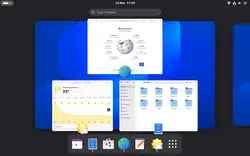 GNOME Shell with GNOME Web, Weather and Files (version 48, released in March 2025) | |
| Original author(s) | Miguel de Icaza and Federico Mena |
|---|---|
| Developer(s) | The GNOME Project |
| Initial release | 3 March 1999[1] |
| Stable release | |
| Repository | |
| Written in | C, XML, C++, C#, HTML, Vala, Python, JavaScript, CSS, and more[3] |
| Operating system | BSD, Linux, Unix |
| Platform | Wayland and X11 |
| Available in | 38 languages[4] |
| Type | Desktop environment |
| License | GPL-2.0-or-later[5] |
| Website | www |
GNOME is a computer desktop environment. It was designed for Linux, but many other operating systems can use it too. GNOME aims to provide an easy way to use a computer. GNOME is a free software project. It was made because at the time, people were questioning whether KDE was free software. GNOME is part of the GNU project.
Aims
According to the GNOME website:
The GNOME project provides two things: The GNOME desktop environment, an intuitive and attractive desktop for users, and the GNOME development platform, an extensive framework for building applications that integrate into the rest of the desktop.[6]
The GNOME project puts heavy emphasis on simplicity, usability, and making things “just work” (see KISS principle). The other aims of the project are:
- Freedom—to create a desktop environment with readily-available source code for re-use under a free software license.
- Accessibility—to ensure the desktop can be used by anyone, regardless of technical skill or physical circumstances.
- Internationalization and localization—to make the desktop available in many languages. At the moment, GNOME is being translated to 161 languages.[7]
- Developer-friendliness—to ensure ease of writing software that integrates smoothly with the desktop, and allow developers a free choice of programming language.
- Organization—to adhere to a regular release cycle and maintain a disciplined community structure.
- Support—to ensure backing from other institutions beyond the GNOME community.
Applications
GNOME has many applications written for it. Some of them include:
- Abiword - A word processor, used for writing documents
- Calculator - For doing maths
- Epiphany (software) - Internet browser
- Empathy - Internet messenger
- Ekiga - VoIP and video conferencing
- Eye of GNOME - View your picture files
- Gthumb - View your photos
- GIMP - Art and photo software
- Nautilus - File manager
- Totem - Play music and video
Related pages
- Ubuntu Linux
References
- ↑ "GNOME 1.0 Released" (Press release). San Jose, California: The GNOME Project. 3 March 1999. Archived from the original on 19 April 2016. Retrieved 11 January 2016.
- ↑ "GNOME 50.1 Released". 15 April 2026. Retrieved 16 April 2026.
- ↑ "The GNOME Open Source Project on Open Hub: Languages Page". www.openhub.net.
- ↑ "Introducing GNOME 41". Archived from the original on 2021-12-22. Retrieved 2021-12-20.
- ↑ "GNOME License". Archived from the original on 7 November 2017. Retrieved 8 December 2017.
- ↑ "About GNOME". Retrieved 2005-09-08.
- ↑ "GNOME Languages". Retrieved 2009-11-19.