G. M. Trevelyan
G. M. Trevelyan | |
|---|---|
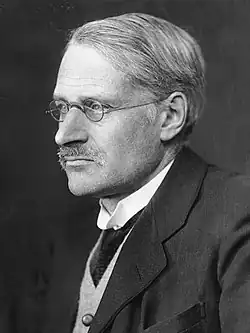 Trevelyan photographed by George Charles Beresford in 1926 | |
| 6th Chancellor of Durham University | |
| In office 1950–1957 | |
| Preceded by | The Marquess of Londonderry |
| Succeeded by | The Earl of Scarbrough |
| Master of Trinity College, Cambridge | |
| In office 1940–1951 | |
| Preceded by | Sir J. J. Thomson |
| Succeeded by | Edgar Adrian, 1st Baron Adrian |
| Regius Professor of History University of Cambridge | |
| In office 1927–1943 | |
| Preceded by | J. B. Bury |
| Succeeded by | Sir George Clark |
| Personal details | |
| Born | George Macaulay Trevelyan 16 February 1876[1] Stratford-upon-Avon, Warwickshire, England |
| Died | 21 July 1962 (aged 86) Cambridge, Cambridgeshire, England |
| Resting place | Holy Trinity Church, Chapel Stile, Great Langdale, Cumbria |
| Spouse(s) |
Janet Trevelyan, née Ward
(m. 1904; died 1956) |
| Children | 3 |
| Occupation | Historian |
George Macaulay Trevelyan OM CBE FRS FBA (16 February 1876 – 21 July 1962) was an English historian and academic. He was a Fellow of Trinity College, Cambridge from 1898 to 1903 and then spent more than twenty years as a full-time author. He later returned to the University of Cambridge and served as Regius Professor of History from 1927 to 1943. He was Master of Trinity College from 1940 to 1951. In retirement, he was Chancellor of Durham University.
Trevelyan was the third son of Sir George Otto Trevelyan, 2nd Baronet, and the great-nephew of Thomas Babington Macaulay. He followed Macaulay's firm liberal Whig principles and wrote popular, readable narrative histories that did not hide his political views. Over his long career, this style came to be seen as old-fashioned as academic history moved towards more neutral and analytical approaches. The historian E. H. Carr saw Trevelyan as one of the last major historians of the Whig tradition.[2]
Many of Trevelyan's writings defended and celebrated the Whig Party, an important British political movement from the 17th to the mid-19th centuries, and its successor, the Liberal Party. Whigs and Liberals believed that ordinary people had a more positive influence on history than kings and queens, and that democratic government would gradually bring social progress.[3]
Trevelyan's history is openly engaged and partisan. Speaking of his trilogy on Garibaldi, which has been described as "reeking with bias", he wrote in his essay "Bias in History": "Without bias, I should never have written them at all. For I was moved to write them by a poetical sympathy with the passions of the Italian patriots of the period, which I retrospectively shared."[3]
Early life
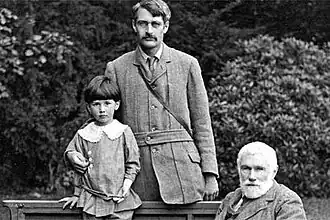
Trevelyan was born in late Victorian Britain at Welcombe House, Stratford-on-Avon, the large country house and estate owned by his maternal grandfather, Robert Needham Philips,[5] a wealthy Lancashire merchant and Liberal Member of Parliament (MP) for Bury. Welcombe is now a hotel and spa for visitors to Shakespeare's birthplace.[3]
On his father's side, Trevelyan was the third son of Sir George Trevelyan, 2nd Baronet, who had been Secretary for Scotland under the Liberal prime ministers William Gladstone and the Earl of Rosebery. His grandfather Sir Charles Trevelyan, 1st Baronet had been a civil servant and was criticised for his and the British government's role in handling the Great Famine in Ireland.
Trevelyan's parents used Welcombe as a winter home after they inherited it in 1890, but they saw Wallington Hall, the Trevelyan family estate in Northumberland, as their real home. Trevelyan was educated at Wixenford and Harrow, where he specialised in history. He then studied at Trinity College, Cambridge, where he joined the secret society of the Cambridge Apostles and founded the still-existing Lake Hunt, a human hare and hounds chase.[3][6]
In 1898 he won a fellowship at Trinity College with a dissertation that was published the next year as England in the Age of Wycliffe.[3] At Cambridge he was strongly influenced by Lord Acton, whose teaching impressed him with the importance of moral judgement and individual liberty in history.[3]
Garibaldi
Trevelyan became famous with his books on the Italian patriot Giuseppe Garibaldi, whom he portrayed as a great hero representing British ideals of liberty. According to historian David Cannadine:
[Trevelyan's] great work was his Garibaldi trilogy (1907–11), which established his reputation as the outstanding literary historian of his generation. It depicted Garibaldi as a Carlylean hero—poet, patriot, and man of action—whose inspired leadership created the Italian nation. For Trevelyan, Garibaldi was the champion of freedom, progress, and tolerance, who vanquished the despotism, reaction, and obscurantism of the Austrian empire and the Neapolitan monarchy. The books were also notable for their vivid evocation of landscape (Trevelyan had himself followed the course of Garibaldi's marches), for their innovative use of documentary and oral sources, and for their spirited accounts of battles and military campaigns.[7]
Historian Lucy Voakes argues that Trevelyan's Garibaldi project was part of a wider effort among English intellectuals to define, celebrate and sometimes criticise liberal culture and politics. She sees his view of the hero and his study of the Italian Risorgimento as growing out of his promotion of a specifically "English" patriotism based on Whig gradualism, parliamentary monarchy and a hierarchical but anti-republican outlook.[8]
Role in education
Trevelyan lectured in history at Cambridge until 1903, when he left academic life to work as a full-time writer. In 1927 he returned to the university as Regius Professor of Modern History. He took on only one doctoral student, J. H. Plumb, whose PhD he supervised in 1936. During his time as professor he also knew Guy Burgess and wrote a positive reference for him when Burgess applied for a job at the BBC in 1935, calling him a "first rate man" but also noting that "He has passed through the communist measles that so many of our clever young men go through, and is well out of it".[9]
In 1940 Trevelyan was appointed Master of Trinity College, a post he held until his retirement in 1951.
Trevelyan turned down the presidency of the British Academy, but he served as chancellor of Durham University from 1950 to 1958. Trevelyan College at Durham University is named after him.
He received the 1920 James Tait Black Memorial Prize for his biography Lord Grey of the Reform Bill. He was elected a Fellow of the British Academy in 1925, made a Fellow of the Royal Society in 1950,[1] and received honorary doctorates from several universities, including Cambridge.
Place in British ideas
Trevelyan served as an ambulance driver close to the front lines in the First World War. Shocked by what he saw, he became more aware of the value of conservatism and less certain that history showed an inevitable pattern of progress. In his History of England (1926), he tried to identify the deepest themes of English history. According to Cannadine, he saw these as "the nation's evolution and identity: parliamentary government, the rule of law, religious toleration, freedom from continental interference or involvement, and a global horizon of maritime supremacy and imperial expansion".[7]
In G.M. Trevelyan: A Life in History (1992), Cannadine summed up Trevelyan's importance:
During the first half of the twentieth century Trevelyan was the most famous, the most honored, the most influential and the most widely read historian of his generation. He was a scion of the greatest historical dynasty that (Britain) has ever produced. He knew and corresponded with many of the greatest figures of his time... For fifty years, Trevelyan acted as a public moralist, public teacher and public benefactor, wielding unchallenged cultural authority among the governing and the educated classes of his day.
Trevelyan was once described as "probably the most widely read historian in the world; perhaps in the history of the world".[10] However, after his death in 1962, historical writing changed, and faith in steady progress declined, especially after two world wars. Roy Jenkins wrote that:
Trevelyan's reputation as a historian barely survived his death in 1962. He is now amongst the great unread, widely regarded by the professionals of a later generation as a pontificating old windbag, as short on cutting edge as on reliable facts.[11]
By contrast, J. H. Plumb stressed Trevelyan's literary gifts and his place in the liberal tradition:
What is perhaps most frequently forgotten, or ignored, is the skill of his literary craftsmanship. Trevelyan was a born writer and a natural storyteller; and this, among historians, is a rare gift ... If one quality is to be singled out, is should be this, for all historians he is the poet of English history ... His work has one other great and enduring merit: the tradition within which it was written. The Victorian liberals and their Edwardian successors have made one of the greatest contributions to science and to culture ever made by a ruling class. To these by birth and by instinct Trevelyan belonged.[12]
Other activities
During the First World War, Trevelyan commanded a British Red Cross ambulance unit on the Italian front;[13] because of poor eyesight, he was unfit for regular military service. On 24 December 1915, King Victor Emmanuel III of Italy decorated him with the Silver Medal of Military Valor for bravely clearing a military hospital that had come under Austro-Hungarian fire.[14]
In 1919 he delivered the British Academy's Italian Lecture, later published as "Englishmen and Italians: Some Aspects of Their Relations, Past and Present".[15][16]
Trevelyan was the first president of the Youth Hostels Association, whose headquarters are named Trevelyan House in his honour. Throughout his life he worked for the National Trust, helping to protect historic buildings and landscapes. He was elected an International Honorary Member of the American Academy of Arts and Sciences in 1931[17] and an International Member of the American Philosophical Society.[18]
He was also a member of the Cambridge Apostles.[19]
Trevelyan's works
Trevelyan was a very productive writer. His main works include the following:
- England in the Age of Wycliffe, 1368–1520. Longmans, Green, and Company. 1900. His first book, based on his fellowship dissertation. The title is somewhat misleading, as the book focuses mainly on the political, social and religious conditions in England during the later years of Wycliffe's life. Six of its nine chapters cover the years 1377–1385, and the last two discuss the history of the Lollards from 1382 to the Reformation. The work is critical of Roman Catholicism and sympathetic to Wycliffe.[20]
- England Under the Stuarts. Psychology Press. 2002. ISBN 978-0-415-27785-3. A survey of English history from 1603 to 1714.[21]
- The Poetry and Philosophy of George Meredith. 1906.
- Garibaldi's Defence of the Roman Republic. 1907. The first volume of his Garibaldi trilogy, which introduced a new foreign historian into the study of the Italian Risorgimento, a period that had often been neglected or poorly treated outside Italy.[22]
- Garibaldi and the Thousand. Longmans, Green, and Company. 1909.
- Garibaldi and the Making of Italy. Longmans, Green and Company. 1911. ISBN 978-1-84212-473-4.
{{cite book}}: ISBN / Date incompatibility (help) - The Life of John Bright. 1913.[23]
- Trevelyan, G. M. (1949). Clio, A Muse and Other Essays.
- Scenes From Italy's War. T. C. and E. C. Jack. 1919.
- The Recreations of an Historian. 1919.
- Lord Grey of the Reform Bill. 1920. A biography of the Whig statesman Lord Grey, which won the James Tait Black Memorial Prize.
- British History in the Nineteenth Century, 1782–1901. London, New York, Longmans, Green, and Co. 1922.
- Manin and the Venetian Revolution of 1848. 1923.
- History of England. Garden City, N.Y., Doubleday. 1953. A single-volume history that grew out of his earlier work.
- Select Documents for Queen Anne's Reign, Down to the Union with Scotland 1702-7. 1929.
- England Under Queen Anne. Longmans. 1930. His three-volume study of the reign of Queen Anne: "Blenheim" (1930), "Ramillies and the Union with Scotland" (1932), and "Peace and the Protestant Succession" (1934), often considered his major scholarly work.
- Sir George Otto Trevelyan: A Memoir. 1932. A biography of his father.
- Grey of Fallodon. 1937. A shorter biographical study of Lord Grey.
- The English Revolution, 1688–1689. T. Butterworth Limited. 1938. ISBN 978-7-240-01048-8.
{{cite book}}: ISBN / Date incompatibility (help) A short account of the Glorious Revolution, portraying James II as a tyrant whose policies directly led to his overthrow. - A Shortened History of England. Penguin Books. 1987. An abridged version of his longer History of England.
- Trevelyan, George Macaulay (1944). English Social History. Longman. ISBN 978-0-582-48488-7.
{{cite book}}: ISBN / Date incompatibility (help) Published during the Second World War, this book described the everyday life of the English people from the Middle Ages to the 19th century. It offered a nostalgic picture of England as a champion of liberty and progress. It was his best-selling book and his last major historical work. - Trevelyan, George Macaulay (1943). Trinity College: An Historical Sketch. The University Press. ISBN 0-903258-01-3.
{{cite book}}: ISBN / Date incompatibility (help) A short history of Trinity College, Cambridge. - History and the Reader. 1945. A reflection on the relationship between historians and their audiences.
- Trevelyan, George Macaulay (1949). An Autobiography and Other Essays. Books for Libraries Press. ISBN 0-8369-2205-0.
{{cite book}}: ISBN / Date incompatibility (help) A collection of autobiographical and other essays. - Carlyle: An Anthology. 1953. A selection of writings by Thomas Carlyle edited by Trevelyan.
- A Layman's Love of Letters. 1954. A late collection of literary essays.
References
- 1 2 Adrian, L. (1963). "George Macaulay Trevelyan 1876-1962". Biographical Memoirs of Fellows of the Royal Society. 9: 315–321. doi:10.1098/rsbm.1963.0017.
- ↑ Carr, E. H. (2001). "The Historian and His Facts". What Is History?. Palgrave Macmillan UK. p. 17. ISBN 0333977017.
- 1 2 3 4 5 6 Hernon, Jr.; Joseph, M. (1976). "The Last Whig Historian and Consensus History: George Macaulay Trevelyan, 1876–1962". The American Historical Review. 81 (1): 66–97. doi:10.2307/1863741. JSTOR 1863741.
- ↑ [http://morpeth.journallive.co.uk/2009/04/journey-into-wallington-histor.html Journey into Wallington historian's own history]. Journal Live. 17 April 2009
- ↑ Chisholm, Hugh, ed. (1911). . Encyclopædia Britannica. Vol. 27 (11th ed.). Cambridge University Press. p. 255; see final three lines.
The third son, George Macaulay Trevelyan (b. 1876), became well known as a brilliant historical writer, notably with two books on Garibaldi (1907 and 1909)
- ↑ "Trevelyan, George Macaulay (TRVN893GM)". A Cambridge Alumni Database. University of Cambridge.
- 1 2 Cannadine, David (2004). [http://www.oxforddnb.com/view/article/36554 "Trevelyan, George Macaulay (1876–1962)"], Oxford Dictionary of National Biography.
- ↑ Lucy Turner Voakes, "The Risorgimento and English literary history, 1867–1911: the liberal heroism of Trevelyan's Garibaldi." Modern Italy 15.4 (2010): 433-450. [http://www.academia.edu/download/51730016/The_Risorgimento_and_English_literary_history_1867_1911_the_liberal_heroism_of_Trevelyan_s_Garibaldi.pdf Online]
- ↑ "Archive – Guy Burgess at the BBC – Memo quoting a recommendation for Burgess". bbc.co.uk. Archived from the original on 11 May 2012. Retrieved 27 July 2015.
- ↑ Tombs, Robert (2015). The English and Their History. Knopf Doubleday Publishing Group. p. 271. ISBN 9781101874776.
- ↑ Jenkins, Roy (2011). Portraits and Miniatures. A&C Black. p. 254. ISBN 9781448202881.
- ↑ Plumb, J. H. (1983) "G.M. Trevelyan". In: British Writers. Vol VI. Scribner's.
- ↑ Powell, Anne (2009). Women in the War Zone: Hospital Service in the First World War. History
Press. ISBN 978-0-7509-5059-6.
{{cite book}}: line feed character in|publisher=at position 8 (help) - ↑ Francesco degli Azzoni Avogadro, L'Amico del Re - Il diario di guerra inedito dell'Aiutante di campo di Vittorio Emanuele III, Leggiamo la Grande Guerra, I, Gaspari editor, 2009, ISBN 88-7541-177-8
- ↑ Trevelyan, G. M. (1919). "Englishmen and Italians: Some Aspects of Their Relations, Past and Present". Proceedings of the British Academy. 9: 91–108.
- ↑ "Italian Lectures". British Academy.
- ↑ "George Macaulay Trevelyan". American Academy of Arts & Sciences. Retrieved 27 February 2023.
- ↑ "APS Member History". search.amphilsoc.org. Retrieved 27 February 2023.
- ↑ Ryan, Alan (28 October 1999). "The Voice from the Hearth-Rug". London Review of Books.
- ↑ Kriehn, George (1899). "England in the Age of Wycliffe". The American Historical Review. 5 (1): 120–122. doi:10.1086/ahr/5.1.120.
- ↑ Smith, David L. (2002) [http://www.history.ac.uk/reviews/review/364 Review of England under the Stuarts] Archived 2018-07-10 at the Wayback Machine. history.ac.uk
- ↑ Grey, Nelson H.; Trevelyan, George Macaulay (2008). "Garibaldi's Defence of the Roman Republic (1907)". The American Historical Review. 14 (1): 134–136. doi:10.2307/1834542. hdl:2027/coo1.ark:/13960/t04x5vt29. JSTOR 1834542.
- ↑ "Review of John Bright by George Macaulay Trevelyan". The Athenaeum (4467): 609–610. 7 June 1893.