Funmilayo Ransome-Kuti
Funmilayo Ransome-Kuti | |
|---|---|
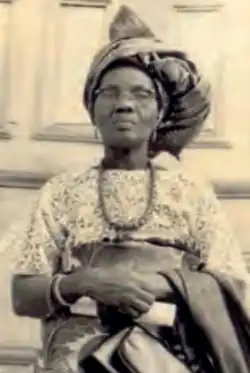 Ransome-Kuti in 1970 | |
| Personal details | |
| Born | Frances Abigail Olufunmilayo Olufela Folorunso Thomas 25 October 1900 Abeokuta, Nigeria |
| Died | 13 April 1978 (aged 77) Lagos, Nigeria |
| Spouse(s) |
Israel Oludotun Ransome-Kuti
(m. 1925; died 1955) |
| Children | 4 |
| Occupation |
|
| Awards | Lenin Peace Prize (1970) |
Funmilayo Ransome-Kuti (25 October 1900 – 13 April 1978) was a Nigerian teacher, politician, and women's rights activist. She was born in Abeokuta, in what is now Ogun State, Nigeria. She is known for leading protests against unfair taxes on women and for working to get Nigerian women the right to vote.[1]
Early life and education
Ransome-Kuti was born Frances Abigail Olufunmilayo Thomas on 25 October 1900 in Abeokuta, Nigeria.[2] Her father was a farmer and trader. Her mother worked as a dressmaker.
She attended Abeokuta Grammar School, where she was the first girl to be admitted, in 1914.[3] From 1919 to 1922, she studied at a school for girls in Cheshire, England. When she returned to Nigeria, she stopped using her English names and used only her Yoruba name, Funmilayo, which means "God has given me joy."[4]
Personal life
In 1925, she married Reverend Israel Oludotun Ransome-Kuti, a school principal. They had four children: a daughter named Dolupo, and three sons named Olikoye, Olufela (later known as Fela Kuti), and Bekololari.[5] Her husband died in 1955.
Activism
Abeokuta Women's Union
In the 1940s, Ransome-Kuti began organizing market women in Abeokuta. In 1946, she helped form the Abeokuta Women's Union (AWU), which she led as president. The union fought against unfair taxes that were placed on market women by local authorities.[6]
The AWU organized marches and protests with up to 10,000 women taking part. In 1948, local authorities agreed to stop the tax on women for a time. In 1949, pressure from the AWU caused the local traditional ruler, the Alake, to leave his position for a period.[7]
National work
In 1947, Ransome-Kuti was part of a group that travelled to London to protest against a Nigerian constitution that did not give women political rights. She was the only woman in the group.[8]
In 1949, she proposed the creation of the Nigerian Women's Union to support women's rights across the country. She served as its president.[9]
In 1953, she helped form the Federation of Nigerian Women's Societies, which worked for women's right to vote and better education and healthcare for women.[10]
International work
Ransome-Kuti became vice president of the Women's International Democratic Federation in 1953. In 1963, she led the Nigerian branch of the Women's International League for Peace and Freedom.[11]
British authorities refused to renew her passport in 1957, and the United States refused her a visa in 1958. Both governments said they suspected her of having communist ties. Her passport was only renewed after Nigeria became independent in 1960.[12]
Awards
In 1965, she received membership in the Order of the Niger.[13] In 1968, the University of Ibadan gave her an honorary degree. She received the Lenin Peace Prize in 1970.[14]
Death
On 18 February 1977, Nigerian soldiers raided the home of her son Fela Kuti in Lagos. Ransome-Kuti was thrown from a second-floor window during the raid. She was taken to hospital and fell into a coma. She died on 13 April 1978 from her injuries. She was 77 years old.[15]
Her body was buried in Abeokuta alongside her husband. Market women across the city closed their shops on the day of her funeral.[16]
References
- ↑ "Funmilayo Ransome-Kuti". Britannica. 21 October 2019. Retrieved 18 December 2019.
- ↑ "Funmilayo Ransome-Kuti". Britannica. Retrieved 18 December 2019.
- ↑ Johnson-Odim, Cheryl; Mba, Nina Emma (1997). For Women and the Nation: Funmilayo Ransome-Kuti of Nigeria. University of Illinois Press. ISBN 0-252-06613-8.
- ↑ Agunbiade, Tayo. "Remembering Funmilayo Ransome-Kuti: Nigeria's 'lioness of Lisabi'". Al Jazeera. Retrieved 9 March 2022.
- ↑ Johnson-Odim, Cheryl; Mba, Nina Emma (1997). For Women and the Nation: Funmilayo Ransome-Kuti of Nigeria. University of Illinois Press. ISBN 0-252-06613-8.
- ↑ "Funmilayo Ransome-Kuti". Britannica. Retrieved 18 December 2019.
- ↑ Byfield, Judith A. (2003). "Taxation, Women, and the Colonial State: Egba Women's Tax Revolt". Meridians. 3 (2): 250–277.
- ↑ Johnson-Odim, Cheryl (1997). For Women and the Nation: Funmilayo Ransome-Kuti of Nigeria. University of Illinois Press. ISBN 0-252-06613-8.
- ↑ Johnson-Odim, Cheryl; Mba, Nina Emma (1997). For Women and the Nation: Funmilayo Ransome-Kuti of Nigeria. University of Illinois Press. ISBN 0-252-06613-8.
- ↑ "Ransome-Kuti, Funmilayo". International encyclopedia of women's suffrage. ABC-CLIO. 2000. pp. 251–253. ISBN 1-57607-390-4.
- ↑ "Funmilayo Ransome-Kuti". Britannica. Retrieved 18 December 2019.
- ↑ Johnson-Odim, Cheryl (1992). Expanding the boundaries of women's history. Indiana University Press. pp. 144–157. ISBN 0-253-33097-1.
- ↑ "Funmilayo Ransome-Kuti". Britannica. Retrieved 18 December 2019.
- ↑ Sansom, Ian (11 December 2010). "Great Dynasties: The Ransome-Kutis". The Guardian.
- ↑ "Funmilayo Ransome-Kuti". Britannica. Retrieved 18 December 2019.
- ↑ Johnson-Odim, Cheryl; Mba, Nina Emma (1997). For Women and the Nation: Funmilayo Ransome-Kuti of Nigeria. University of Illinois Press. ISBN 0-252-06613-8.