Freedom of panorama
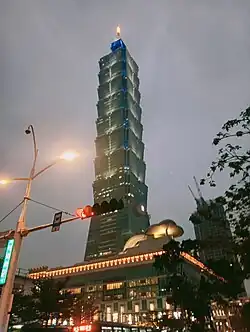
Freedom of panorama (which can be shortened as FoP) is a rule within the laws on copyright of some countries of the world. This rule lets the people make and use pictures of large things that are found in public places for a very long time (not those things that are only found in those places for a short time), such as buildings (which are products of the practical art of architecture) and sculptures (which are products of the fine art). The pictures can be drawings, photographs, or videos (which are "pictures that move").
The rule helps those people to use those pictures for free, without the need for approval (by asking for a "license") from the person or persons who made those things, or from someone who owns the copyright on those things, like the children of the makers or the representatives of those makers. It is a difference to the normal rule of copyright, which says that only those makers (or the owners of copyright) can say if they want to have those pictures (of their things) made or not.
The word "freedom of panorama" comes from the German word panoramafreiheit, which exactly means "panorama freedom". The rule started in Germany in 1876.[1]
Examples
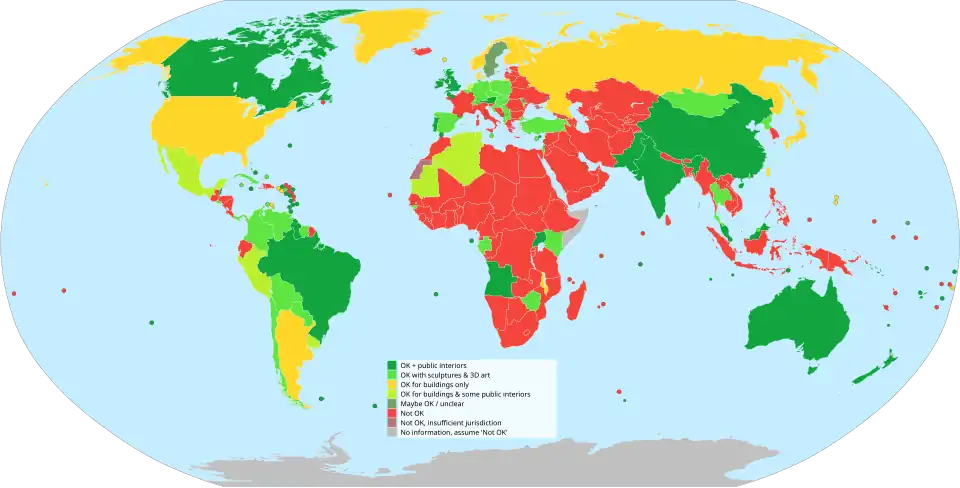
Brazil, Germany, and the United Kingdom are examples of countries with freedom of panorama rules. Some countries do not have freedom of panorama rules, such as France and Greece. In these countries with no freedom of panorama rules, their governments do not like anyone using pictures of buildings and sculptures of their countries for free if there is no approval from the makers of those works (like architects and sculptors).[1]
Germany
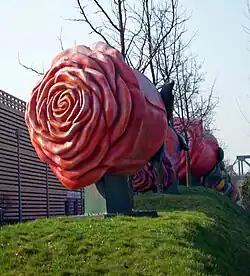
In Germany, the rule of freedom of panorama is:
It is allowed to make, give, and show to other people pictures of things of art that are always found in public places or streets using painting, photography, or film. In the example of buildings, this rule only covers the outer views.
— Section 59 of their law on copyright.[2]
Section 63 of their copyright law says the person using or sharing the pictures of art needs to give the name of the maker or makers of those things.[3] This is called the rule on attribution.
United States
There is a freedom of panorama rule in the United States, but it is only good for the use of the pictures of buildings for free. The rule says that pictures of buildings can be used and shared with anyone for free, with no approval from the architects, if the building is in the public place or can be seen from the public place. The exact sentence of this rule is:
The copyright in an architectural work that has been constructed does not include the right to prevent the making, distributing, or public display of pictures, paintings, photographs, or other pictorial representations of the work, if the building in which the work is embodied is located in or ordinarily visible from a public place.
— Section 120(a) of the Title 17 of the United States Code (the copyright rule of the United States)[4]
References
- 1 2 Rosnay, Mélanie Dulong de; Langlais, Pierre-Carl (2017-02-16). "Public artworks and the freedom of panorama controversy: a case of Wikimedia influence". Internet Policy Review. 6 (1). doi:10.14763/2017.1.447. hdl:10419/214035. ISSN 2197-6775. Archived from the original on 2018-01-18.
- ↑ Seiler, David (2001-06-24). "Fotografieren von und in Gebäuden". visuell. p. 50. Archived from the original on 2007-09-30. See also: "§59 UrhG (Germany)" (in German). Archived from the original on 2011-02-23.
- ↑ "§63 UrhG (Germany)" (in German).
{{cite web}}: CS1 maint: url-status (link) - ↑ "17 U.S. Code § 120 - Scope of exclusive rights in architectural works". Archived from the original on 2016-04-19. Retrieved 2016-04-04.