Four simple chemical reactions
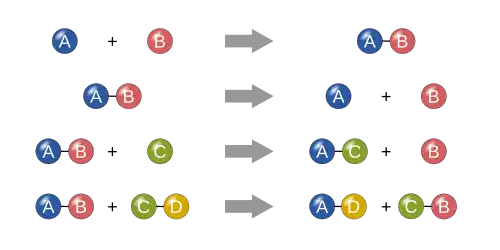
The four simple chemical reactions are categories of chemical reaction used in chemistry education. They group reactions with one or two reactants or products into four types: synthesis, decomposition, single replacement, and double replacement. Some books include combustion as a fifth type of reaction.
Types
Synthesis
A synthesis reaction has two separate chemicals coming together to make one product. For example, magnesium metal and chlorine gas make magnesium chloride:
- Mg + Cl2 → MgCl2
Decomposition
A decomposition reaction is the opposite of a synthesis reaction: one reactant breaks apart into two products. For example, calcination of limestone breaks the calcium carbonate into calcium oxide and carbon dioxide:
- CaCO3 → CaO + CO2
A related type of reaction is disproportionation, where a large amount of one compound rearranges into equal or proportional amounts of two compounds, without a single piece breaking off the rest. For example, sodium hypochlorite disproportionates into sodium chlorate and sodium chloride:[1]
- 3 NaClO → 2 NaCl + NaClO3
Single replacement
A single replacement reaction has two reactants and two products, where one of the reactants replaces a piece of the other, and that piece makes the second product. Single replacement reactions follow the reactivity series of metals, with more reactive metals replacing less reactive ones. For example, aluminium will react with copper(II) sulfate to make copper metal and aluminium sulfate:[2]
- 2 Al + 3 CuSO4 → Al2(SO4)3 + 3 Cu
The opposite reaction will not happen unless something happens to drive the reverse reaction, like the addition of more aluminium sulfate for Le Chatelier's principle. Even then, any regenerated reactants will quickly re-react unless one is removed.
Double replacement
A double replacement reaction has two reactants and two products, but instead of one reactant replacing another, the two reactants exchange a part. For example, silver nitrate and potassium iodide react to make silver iodide and potassium nitrate:
- AgNO3 + KI → AgI + KNO3
Solubility is an important part of double replacement reactions. If the reactants and products are of similar solubility, the reaction forms a chemical equilibrium; to make the reaction happen in one direction, something needs to remove one of the products (Le Chatelier's principle), which can be forming a precipitate or releasing a gas.
Problems
While the four types are useful for classifying many simple reactions, they are limited in many ways. They do not classify reactions with three or more chemicals on one or both sides of the equation, or reactions where more than one piece of a molecule or salt reacts at a time. They assume that all the compounds involved are simple enough to break apart into one or two pieces. They are phenomenological: they only look at reactants and products, not the reaction mechanism that explains what actually happens.
The categories can separate reactions that have more in common with each other than simply the numbers of reactants and products. For example, Lewis acid-base reactions can be found that match all four types,
- CaO + CO2 → CaCO3
- H2CO3 → H2O + CO2
- BF3(C2H5)2O + C4H4O → BF3(C4H4) + (C2H5)2O
- NaOCH3 + HCl → NaCl + CH3OH
while redox reactions can be found for all but double replacements:
- 2 Mg + O2 → 2 MgO
- IF7 → IF5 + F2
- TiCl4 + 2 Mg → Ti + 2 MgCl2
Other reactions and processses do not fit into any category, even if they have simple equations. The water gas shift is an important reaction found in catalytic converters:
- CO + H2O → CO2 + H2
It has two reactants and two products, so it could only be one of the replacement reactions. Hydrogen is a pure element, so it cannot be a double replacement, but hydrogen was never attached to carbon, so single replacement does not fit either.
In organic chemistry
A similar set of four reaction types is used in organic chemistry. These are addition reactions, elimination reactions, substitution reactions, and rearrangement reactions. Like the four simple reactions, these categories are phenomenological and don't think about reaction mechanism.
References
- ↑ Lister, M. W. (1956). "Decomposition of Sodium Hypochlorite: The Uncatalyzed Reaction". Canadian Journal of Chemistry. 34 (4): 465–478. Bibcode:1956CaJCh..34..465L. doi:10.1139/v56-068.
- ↑ "The reaction of aluminium and copper(II) sulfate". RSC Education. Royal Society of Chemistry. Retrieved 2026-04-14.