Forced marriage
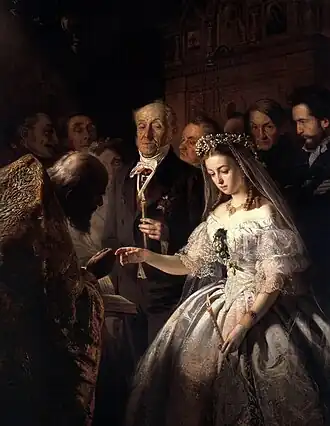
A forced marriage is a marriage which happens against the will of one or both partners.[1] A forced marriage is different from an arranged marriage: In an arranged marriage, the parents or other third parties will help finding a suitable partner. In a forced marriage, coercion is used, to comple one or both partners to agree to the marriage. This coercion can have different forms, such as physical violence, moey being paid, but also using subtle psychological pressure.[2][3]
Note that for a marriage to be legal, both people need to agree, and there should not be any force involved. So,There are difference cases:
- In a child marriage, one of the partners is a child who cannot legally agree; usually, there is a minimum age,at which people can marry. Very often it is close to the age when they become adult. While the parents can handle some of the legal matters of the child, a marriage is one legal matter where the child needs to agree, and this agreement cannot be done by the parents.
- In a forced marriage, people are forced or coerced to agree. Such "agreements" do not count, as for marriage, people need to agree witohut being forced.
International human rights law including International Covenant on Civil and Political Rights[4] and Supplementary Convention on the Abolition of Slavery[5] also prohibit unfree marriage without consent of each person.
As outlined above, a marriage is when two people agree they want to get married. No one is forced, both are adult, and are capable of seeing the consequences of their marriage. Some people have said that using the term "marriage" gives the wrong impression.[6] Other terms habe been proposed. Among them are forced conjugal association and conjugal slavery.[7][8]
Today, forced marriages are still common in parts of Sooutheast Asia, and in Africa. In such cases, people very often use religious beliefs to try to legitimate the practice.
Reasons for forced marriage
There are diffewrent reasons for forced marriage:
- Very often there are materialistic interests: Even if it is symbolic, a bride price is often paid.
- Children who grew up in "liberal societies" such as Europe, are married with a partner from the origin country of their parents. This is done ot realigh their values with what the parents think their values should be.
- Familiies fear that they might lose their honor, or standing
- People marry to get entitlement ot stay in a county
- "Fighting" against homosexualiy
References
- ↑ "Arranged/Forced Marriage". Unchained At Last. Archived from the original on 8 October 2022. Retrieved 6 October 2022.
- ↑ Sharp, Nicola. "Forced Marriage in the UK: A scoping study on the experience of women from Middle Eastern and North East African Communities" (PDF). Refuge. London: 6, 10. Archived (PDF) from the original on 10 August 2017.
- ↑ "Forced marriage and human trafficking: What you need to know". United Nations : Office on Drugs and Crime. Retrieved 2026-04-02.
- ↑ Article 23, section 3
- ↑ Article 1, (c)
- ↑ Bunting, Annie. "'Forced Marriage' in Conflict Situations: Researching and Prosecuting Old Harms and New Crimes". Canadian Journal of Human Rights: 179. Archived from the original on 1 August 2023. Retrieved 28 August 2022.
... the term marriage should be avoided because the crime in Sierra Leone was 'one of sexual slavery, poorly veiled by the euphemism marriage.'
- ↑ Jenni Millbank (7 February 2011). "Forced Marriage and the Exoticization of Gendered Harms in United States Asylum Law". Columbia Journal of Gender and Law. SSRN 1757283.
- ↑ Dauvergne, Catherine (2 March 2010). "Forced Marriage as a Harm in Domestic and International Law". Modern Law Review. 73: 57–88. doi:10.1111/j.1468-2230.2009.00784.x. hdl:10453/10487. S2CID 143663015. SSRN 1563842.