Feihyla palpebralis
| Feihyla palpebralis | |
|---|---|
Scientific classification  | |
| Kingdom: | Animalia |
| Phylum: | Chordata |
| Class: | Amphibia |
| Order: | Anura |
| Family: | Rhacophoridae |
| Genus: | Feihyla |
| Species: | F. palpebralis |
| Binomial name | |
| Feihyla palpebralis (Smith, 1924) | |
| Synonyms[2] | |
| |
The Vietnamese bubble-nest frog or Annamite jelly-nest tree frog (Feihyla palpebralis) is a frog. It lives in Vietnam in the Langbian Peaks. Scientists think it might live in Laos or China too.[2][3][1]
People see this frog near swampy streams on mountains between 700 and 2000 meters above sea level.[1]
The female frog lays eggs on plants over the water. When the eggs hatch, the tadpoles fall into the pond. She lays about 52 eggs at a time.[1]
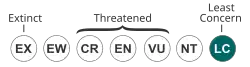
Scientists believe this frog is not in much danger of dying out because it lives in a large place. However, human beings have cut down the trees in the forests where it lives to build farms, especially for things to sell for example coffee , rubber, and tea. Two of the places this frog lives are protected parks: Kon Cha Rang Nature Reserve and Kon Ka Kinh National Park.[1]
References
- 1 2 3 4 5 IUCN SSC Amphibian Specialist Group (2023). "Vietnamese Bubble-nest Frog: Feihyla palpebralis". IUCN Red List of Threatened Species. 2023: e.T58792A63851708. doi:10.2305/IUCN.UK.2023-1.RLTS.T58792A63851708.en. Retrieved April 21, 2024.
- 1 2 Frost, Darrel R. "Feihyla palpebralis (Smith, 1924)". Amphibian Species of the World, an Online Reference. Version 6.0. American Museum of Natural History, New York. Retrieved April 21, 2024.
- ↑ "Feihyla palpebralis (Smith, 1924)". AmphibiaWeb. University of California, Berkeley. Retrieved April 21, 2024.