Eviction
Eviction is the process of forcing a tenant or homeowner to move out of a property, In the United States, this is usually for failure to pay rent, mortgage or property taxes, (the latter two resulting from foreclosure) or for breaking the rules the landlord, homeowners association or municipality has enacted upon said property. Eviction can take a long time.
Lots of reasons throughout history have been given for evictions, such as when the United States Government evicted Native Americans from their original lands with little or no compensation,[1] All over the world indigenous people were evicted in similar ways in what we call colonialism. We call this forced eviction, and the people who were evicted as dispossessed. Today this is considered a violation of Human Rights [2]
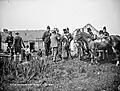 Eviction The Council,1763
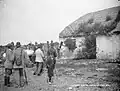 Eviction of Michael Connell, Moyasta, Co.Clare"1764
 Group gathered outside the house of Mary O'Dea, Tullycrine, Co.Clare following an eviction 1765
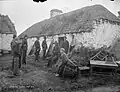 Michael Connell, Moyasta, Co.Clare after eviction" 1767
 Mathias Magrath's house, Moyasta, Co.Clare with the Battering Ram in front 1768
 T.Birmingham's house, Moyasta, Co.Clare with Battering Ram and soldiers outside 1769
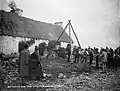 Battering Ram "Back with them, away with them"1771
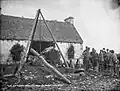 The Battering Ram has done its work" 1772
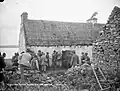 Eviction scene "Ready for hot water"1773
 Eviction scene, 1774
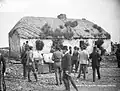 Eviction scene at the house of John Connell, Moyasta, Co.Clare 1775
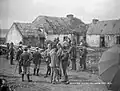 T.Birmingham's house, Moyasta, Co.Clare 1777
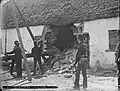 Eviction scene (Battering Ram)1779
 Mathias Magrath's house, Moyasta, Co.Clare after destruction by the Battering Ram 4918
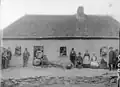 Widow Macnamara in her fortress
References
- ↑ National Geographic Society (2023). The United States Government’s Relationship with Native Americans. Retrieved from (https://education.nationalgeographic.org/resource/united-states-governments-relationship-native-americans/)
- ↑ Amnesty International UK (2024). Stop Forced Evictions. Retrieved from (https://www.amnesty.org.uk/stop-forced-evictions)