Evangelos Zappas
Evangelis Zappas Ευαγγέλης Ζάππας | |
|---|---|
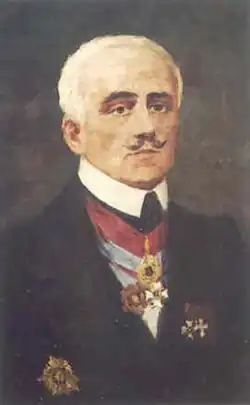 Portrait of Evangelis Zappas in Zappeion | |
| Born | 23 August 1800 Labovë e Madhe, Ottoman Empire[1] |
| Died | 19 June 1865 (aged 64)[2] Broșteni, Ialomița, United Principalities |
| Nationality | Greek |
| Citizenship | Greek, Romanian |
| Occupation | Businessman |
| Known for | Benefactor Revival of modern Olympic Games |
Evangelis or Evangelos Zappas (Greek: Ευαγγέλης/Ευάγγελος Ζάππας; Romanian: Evanghelie Zappa; 23 August 1800 – 19 June 1865) was a Greek patriot, philanthropist and businessman who established the modern Olympic Games.[1][3][4][5][6]
Biography
Early life
Evangelis Zappas was born to a Greek family on August 23, 1800 in the village of Labovo in the Ottoman Empire.[1][4][6][7][8][9][10][11] His parents were Vasileios and Sotira Zappas.[12] Zappas received no education during his youth.[4] At 13, he left his village and worked as a mercenary in the Ottoman militia of Ali Pasha.[13][14] Zappas was involved in the Filiki Eteria, a Greek patriotic organization, and served in the Greek War of Independence when it started in 1821.[14][15] He claimed to have been wounded five times during the war.[13][16] Zappas later moved to Wallachia in 1831 and made a fortune in land and agriculture.[14] In the 1850s, Zappas became one of the wealthiest businessmen in Eastern Europe.[17] The value of his whole fortune was calculated at six million gold drachmas.[18]
Revival of the Olympic Games
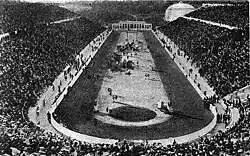
Zappas was a nationalist inspired to revive the Olympic Games by Panagiotis Soutsos, a Greek poet.[19] He sent a letter in 1856 to King Otto of Greece offering to pay to restore the Olympics.[7] The first modern Olympic Games were held on November 15, 1859 in Athens, Greece.[4] And just like in the ancient Olympics, the athletes competed in running, discus throwing, javelin throwing, wrestling, jumping, and pole-climbing.[4] Zappas died on June 19, 1865 with no children.[5][20] His money was used for developing athletic buildings in Athens, as well as for continuing the Olympic Games.[21] He left instructions for the building of the Zappeion Exhibition and Conference Center named in both his honour and in the honour of his cousin, Konstantinos Zappas.[5]
Legacy
Evangelos Zappas made several donations to Greek schools, libraries and scholarships.[18][22] He also financed the Romanian Academy where he has a statue there today.[23][24][25] Zappas also funded a Romanian dictionary, a newspaper and books in the Albanian language, and research on the history of the Romanian people.[6]
References
Citations
- 1 2 3 Decker 2005, p. 273: "E. Zappas, a Greek born in Albania (Ottoman Empire) but living in Romania, founded modern Olympic Games that were held in 1859, 1870, 1875 and 1888."
- ↑ Philologikos Syllogos "Parnassos" 1977, p. 81.
- ↑ Golden 2009, p. 129; Trager 1979, p. 654; Young 1991, p. 108.
- 1 2 3 4 5 Young 1991, p. 103.
- 1 2 3 "Zappeion Culture and Exhibition Center". 2007. Archived from the original on 27 March 2009. Retrieved 3 November 2010.
- 1 2 3 Iordachi 2013, p. 148.
- 1 2 Gerlach 2004, p. 25.
- ↑ Hill 1992, p. 15.
- ↑ Gerlach 2004, p. 37.
- ↑ Brownell 2008, Susan Brownell, "Introduction: Bodies before Boas, Sport before the Launcher Left", p. 36; Alexander Kitroeff, "Chapter 8: Greece and the 1904 "American Olympics", p. 303.
- ↑ Chatziefstathiou & Henry 2012, p. 23.
- ↑ Young 2005, p. 276.
- 1 2 Ruches 1967, p. 79.
- 1 2 3 Matthews 1904, p. 45.
- ↑ Hill 1992, p. 16.
- ↑ Decker 2005, p. 277.
- ↑ Young 1996, p. 142.
- 1 2 Ruches 1967, p. 80.
- ↑ Reisler 2012, p. 24; Matthews 1904, p. 46.
- ↑ Philologikos Syllogos "Parnassos" 1977, p. 81.
- ↑ Gerlach 2004, p. 29.
- ↑ Vassiadis 2007, p. 119.
- ↑ Constantinoiu, Marina (20 February 2020). "Primul mare donator al Societăţii Literare Române, devenită Academia Română, un Meccena pentru Ţara Românească". Evenimentul Istoric.
- ↑ Academia Română (6 February 2020). "Comunicate de presa 2020". Academia Română.
- ↑ Popescu, George (1 November 2016). "Evanghelie Zappa – un Meccena aromân pentru Ţara Românească". Radio România Actualităţi Online.
Sources
- Brownell, Susan (2008). The 1904 Anthropology Days and Olympic Games: Sport, Race, and American Imperialism. Lincoln, NE: University of Nebraska Press. ISBN 978-0-8032-1098-1.
- Chatziefstathiou, Dikaia; Henry, Ian P. (2012). Discourses of Olympism: From the Sorbonne 1894 to London 2012. Houndmills, Basingstoke, Hampshire: Palgrave Macmillan. ISBN 9781137035561.
- Decker, Wolfgang (2005). Festschrift für Wolfgang Decker zum 65. Geburtstag: dargebracht von Schülern, Freunden und Fachkollegen. Berlin: Weidmann. ISBN 3-615-00326-8.
- Gerlach, Larry R. (2004). The Winter Olympics: From Chamonix to Salt Lake. Salt Lake City, UT: University of Utah Press. ISBN 0-87480-778-6.
- Golden, Mark (2009). Greek Sport and Social Status. Austin, TX: University of Texas Press. ISBN 978-0-292-71869-2.
- Hill, Christopher R. (1992). Olympic Politics. New York and Manchester: Manchester University Press. ISBN 0-7190-3792-1.
- Iordachi, Constantin (2013). "From Imperial Entanglements to National Disentaglement: The "Greek Question" in Moldavia and Wallachia, 1611–1863". In Daskalov, Roumen; Marinov, Tchavdar (eds.). Entangled Histories of the Balkans – Volume One: National Ideologies and Language Policies. Balkan Studies Library. Leiden and Boston: Brill. pp. 67–148. ISBN 9789004250765.
- Matthews, George R. (1904). America's First Olympics: The St. Louis Games of 1904. Columbia, MO: University of Missouri Press. ISBN 0-8262-1588-2.
{{cite book}}: ISBN / Date incompatibility (help) - Philologikos Syllogos "Parnassos" (1977). Parnassos (in Greek). Athens: Philologikos Syllogos Parnassos.
- Reisler, Jim (2012). Igniting the Flame: America's First Olympic Team. Guilford, CT: Lyons Press. ISBN 978-0-7627-8660-2.
- Ruches, Pyrrhus J. (1967). Albanian Historical Folksongs, 1716–1943: A Survey of Oral Epic Poetry from Southern Albania, with Original Texts. Chicago, IL: Argonaut Incorporated.
- Rühl, Joachim K. (2004). "Olympic Games Before Coubertin". In Findling, John E.; Pelle, Kimberly D. (eds.). Encyclopedia of the Modern Olympic Movement. Westport, CT: Greenwood Publishing Group. pp. 3–16. ISBN 978-0-313-32278-5.
- Ruprecht, Louis A. (2002). Was Greek Thought Religious?: On the Use and Abuse of Hellenism, from Rome to Romanticism. New York, NY: Palgrave Macmillan. ISBN 978-0-312-29563-9.
- Trager, James (1979). The People's Chronology: A Year-by-year Record of Human Events from Prehistory to the Present. New York, NY: Holt, Rinehart and Winston. ISBN 9780030178115.
- Vassiadis, George A. (2007). The Syllogos Movement of Constantinople and Ottoman Greek Education 1861–1923. Athens: Centre for Asia Minor Studies. ISBN 978-960-87610-6-3.
- Young, David C. (2008). A Brief History of the Olympic Games. Wiley Brief Histories of the Ancient World. Hoboken, NJ: Wiley. ISBN 978-047-07777-5-6.
- Young, David C. (2005). "Evangelis Zappas: Olympian Sponsor of Modern Olympic Games". Nikephoros: Zeitschrift für Sport und Kultur im Altertum. 18: 273–288. ISSN 0934-8913.
- Young, David C. (1996). The Modern Olympics – A Struggle for Revival. Baltimore, MD: Johns Hopkins University Press. ISBN 0-8018-5374-5.
- Young, David C. (1991). "Myths and Mist Surrounding the Olympic Games: the Hidden Story". In Landry, Fernand; Landry, Marc; Yerlès, Magdeleine (eds.). Sport...Le Troisième Millénaire. Quebec City: Presses Université Laval. pp. 99–115. ISBN 2-7637-7267-6.
Further reading
- Mallon, Bill; Heijmans, Jeroen (2011). "ZAPPAS, EVANGELOS (GRE)". Historical Dictionary of the Olympic Movement. Lanham, MD: Scarecrow Press. p. 397. ISBN 978-0-8108-7522-7.