Etiquette in Asia
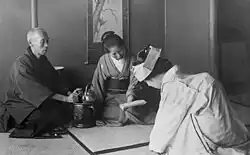
Etiquette in Asia is different in each country, even though some actions look similar. Etiquette is a set of rules, customs, or codes guiding socially acceptable behavior. No guide about manners or list of mistakes can ever be complete. People see behaviors in different ways, so it is very important to understand different cultures. Not knowing the customs and what people expect in Asia can make someone seem rude, silly, or disrespectful, even if they mean well.
Asian etiquette often shows "respect," "good manners," and "filial piety" (which means respect for parents and elders). These manners are strongly influenced by Chinese culture.[1][2][3]
Bangladesh

People in Bangladesh are quiet and follow many rules. Even though some customs can change, some things stay the same, like respecting older people and caring about family. Young people always show respect to elders. It is rude for young people to speak directly or strongly to older people. Also, looking too long into an elder’s eyes is seen as bad manners.[4]
Bangladeshis are modest and do not like too much praise.[4] Giving too much praise can seem fake and may upset people. Religion is very important and affects manners. For example, a man should not shake hands with a woman unless she offers her hand first. Religion and social rules decide what is okay and what is not.[5]
In business, manners are like in other Asian countries. People do not speak too directly about their ideas or opinions.[6]
Brunei
China
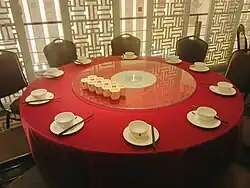
Eating is very important in Chinese culture. Eating out is a common way to welcome guests, meet friends, and build relationships. Chinese dining manners are similar to those in Korea and Japan, but with some differences. Usually, food is shared by everyone at the table. Small groups may sit at square or rectangular tables, but large groups prefer round tables. At formal dinners, there is a special seating order based on age and rank. The most important seat is for the host or the oldest person, usually in the center facing east or the door. People use chopsticks instead of forks and knives.[7] In most Chinese restaurants, you don’t need to tip unless it says so. Tea is almost always served before or right after you sit down. You should say "谢谢" (xiexie), meaning "thank you," to the person pouring the tea.[8]
Handshake Etiquette
Who shakes hands first depends on respect for age and position.
- If a higher-ranking person meets a lower-ranking person, the higher-ranking person offers their hand first.
- If a woman shakes hands with a man, the woman offers her hand first.
- If an older person shakes hands with a younger person, the older person offers their hand first.
- If a married person shakes hands with someone who is not married, the married person offers their hand first.
- If a teacher shakes hands with a student, the teacher offers their hand first.
- If the first person to arrive shakes hands with the last person, the first person offers their hand first.
- When a host meets guests, the host offers their hand first; when guests leave, the guests offer their hand first.[9]
Bowing Etiquette
Bowing in China started a long time ago during the Shang Dynasty as a way to show respect in religious ceremonies. After the Xinhai Revolution, people stopped kneeling and bowing became the main way to show respect to others equally.[10] At first, bowing meant bending like the way animals were bent into a bow shape to be used in sacrifices to honor heaven. Later, people used bowing every day to show respect, obedience, and that they were not hostile. Today, bowing is a common way to greet people, show thanks, or say sorry.[11] When you bow, you should be careful not to be rude. For example, do not take off your hat, talk, laugh, look around, eat, or put your hand in your pocket while bowing. When bowing, you should avoid looking directly at the other person’s eyes. Looking at their face while bowing can make the bow look strange and is seen as disrespectful. Also, just nodding or a small bow can be seen as not respectful enough in some situations. It is important to bow properly to show respect.[12]
Chinese Table Manners
At a round table, the person sitting facing the door is the host or main guest. The people sitting closest to the host or guest are the most respected. If two people are the same distance from the host, the person on the left side is more respected than the one on the right. The host should arrive early, wait at the door, and help guests find their seats. Guests sit where the host arranges.[13]
When eating, do not stick your chopsticks straight up in your bowl because it looks like burning incense, which is bad luck. Put down your chopsticks when drinking soup. Never hold a spoon and chopsticks at the same time because it is rude. Do not use chopsticks to stir food in the dish, and do not leave chopsticks resting on your bowl after eating.[14]
Ancient Chinese Sacrificial Rituals
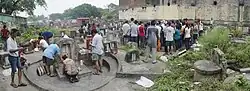
Sacrifice is an old ritual in China and is very important. It was part of the ancient Chinese ritual system and was the most important of five rituals. People used to offer sacrifices to heaven, earth, and humans. Later, this became the "three sacrifices": to heaven and earth, to ancestors, and to wise people. The Qingming Festival (Tomb Sweeping Day) is the biggest ceremony to honor ancestors and has deep cultural meaning.[15]
Today, sacrifices are often done during tomb sweeping. People bring wine, food, fruit, and paper money to the graves of their relatives. They offer the food, burn the paper money, cover the grave with fresh soil, and place green branches on the tomb. Then they bow and pray, and finally, they eat and drink before going home.[16]
Congratulation Etiquette
Congratulating others is common during festivals. It shows respect from younger people to elders or from people with lower status to those with higher status. It is also used among friends to celebrate. When giving congratulatory gifts, you should be respectful, say kind words, and give a gift.[17]
India
_Great_Bharatas)_LACMA_M.82.225.3.jpg)
Etiquette in India is similar to its South and Southeast Asian neighbours, however, there are some differences across the country.[18] Greetings often involve saying "Namaste" with hands pressed together in front of the chest.[19] It is polite to remove your shoes before entering someone's home or a temple.[19] Respect for elders is very important. Younger people may touch the feet of elders as a sign of respect.[19] Using the right hand for eating, giving, or receiving things is important. The left hand is used for personal hygiene, so it is considered unclean.[19]
Indonesia
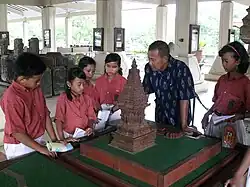
Indonesia is a large tropical country made up of many islands with many different cultures. Each ethnic group has its own traditions, language, and sometimes religion with different rules. This makes Indonesia a mix of many different customs that can change from place to place. Indonesia shares many manners with other Southeast Asian countries. Since most people in Indonesia are Muslim, some manners from the Middle East are also followed.
Here are some important manners in Indonesia:[20]
Japan
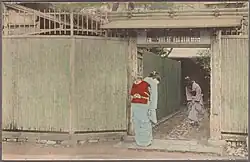
Japanese customs and manners can be very complicated and sometimes hard to understand. When people from other countries make mistakes, some Japanese may feel upset because their expectations about manners are not met, even if they know the mistakes are from not knowing better.
- When giving or receiving business cards, use both hands. Look at the card carefully and show respect, then place it on the table during the meeting. After the meeting, keep the card carefully and never put it in your back pocket. Do not write on business cards. To be taken seriously in business, always carry cards in a cardholder, not in your pocket.[22]
- When someone offers a gift, do not accept it right away. The giver will usually offer it several times (about three). Gifts are usually not opened in front of the giver.[23]
- When greeting or thanking someone, a person with lower status should bow lower than the other person. But foreigners are not expected to bow. How deep and long the bow is depends on age, status, and other things.[24]
- Pouring soy sauce on rice is unusual in Japan.
- People usually do not pour their own drinks at social events. Instead, one person pours for the other, and the other person pours back. If one person drinks from a bottle to a glass and the other only from a glass, it is okay to pour your own drink.[24]
- Blowing your nose in public is rude. Also, Japanese people do not use handkerchiefs for nose blowing.[24]
- For women, not wearing makeup or a bra may be seen as unprofessional or careless.[24]
- Even though many Japanese are kind to foreigners, it is rude not to use polite language and honorifics when speaking Japanese to someone with higher status. The honorific "san" can be used in English but never when talking about yourself. Japanese usually say the family name first and the given name second, but sometimes they switch it for Westerners.
- A smile or laughter from a Japanese person may mean they feel nervous or uncomfortable, not always happy.[24]
- Tipping is not common in Japan and can be seen as rude, except in some cases like tipping a surgeon, staying at a fancy inn (ryokan), or paying movers. It is good to ask locals what is okay. If you don’t want your change, you can tell a taxi driver to keep it.[24]
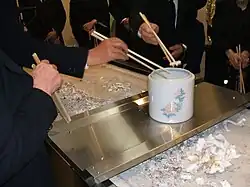
- In Japanese cremation rituals, family members use chopsticks to pick bones from ashes. Two people may hold the same bone with chopsticks at the same time. This is the only time it is okay for two people to hold the same thing with chopsticks. At other times, passing or holding something together with chopsticks reminds people of funerals and is considered rude.
Korea
Here are some important etiquette guides for Korea. The number 4 is seen as unlucky, so you should not give gifts in groups of 4. Giving 7 of something is thought to be lucky.[25] Blowing your nose at the table, even if the food is spicy, is a little rude. If you need to blow your nose, it’s better to go to the bathroom or do it quietly.[26]
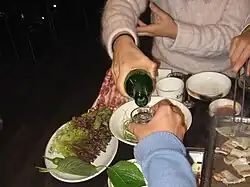
In restaurants and bars, it is rude to pour your own drink. Watch your friends’ glasses and fill them when they are empty; they will do the same for you. To avoid drinking too much, you can leave your glass almost full. When pouring drinks, hold the bottle with your right hand and gently support your right arm with your left hand near the elbow. If someone with much higher status pours you a drink, it is polite to turn away from them when you drink.[24]
Couples kissing in public is considered rude because it is not seen as modest.
Malaysia

Here are some important etiquette guides for Malaysia:
- It is rude to wear shoes inside a house. People usually take off their shoes outside and leave them by the door.
- When shaking hands with elders like parents, grandparents, or teachers, younger people show respect by touching the elder's palm with the tip of their nose or forehead. This is like kissing the hand but using the nose or forehead instead of lips. This is common among Malays or Malaysian Muslims and is called "Salam." It is rude not to do this when visiting or being visited.
- Showing affection, like kissing your partner or spouse in public, is seen as improper because it is not modest or respectful.
- People usually eat with their right hand.
- When giving something to others, use your right hand or both hands, not the left hand.
- Girls should dress modestly and avoid wearing revealing clothes.
- In Malaysia, Malays, Chinese, and Indians all try to keep "face", which means avoiding shame in public and private. You lose face by criticizing, insulting, causing shame, or showing anger. You save face by staying calm, polite, and using body language to say "no' instead of saying it directly.
- People who are a little older are called "kak" (older sister) for girls and "abang" (older brother) for boys. "Adik" means younger sibling for both boys and girls. For much older people or married people with children, "makcik" (aunty) or "pakcik" (uncle) is used. It is polite to call people by these names instead of their first names, even if they are not family.[27]
- When greeting a Malaysian ruler or royal family member, press your palms together and bow slightly to show respect.
- It is important to use the right titles when talking to people. For example, call a teacher "Cikgu," and someone with an honorary title "Datuk." If you are not sure, call a man "Encik" (Mister), a woman "Puan" (Mrs. or Miss), or "Cik" (Miss).
- The head is sacred and should not be touched by hand.
- Feet are seen as unclean. Do not point your feet at people or things, and do not show the soles of your feet to others when sitting on the floor.
- When pointing at someone, use your thumb. Pointing with your index finger is rude in Malaysia.
- To call someone over, wave your hand down with your palm facing the ground. It is rude to wave with your palm facing up.
- Never say "Oi!" to call someone.
- When talking to elders, bosses, or teachers, do not use informal words like "aku" (me) or "kau" (you). Use "saya" instead. Using "aku" and "kau" with parents or teachers is rude because it treats them like equals.
Pakistan
In cities of Sindh and other parts of Pakistan, men and women usually greet each other by lowering their head and raising their hand to their forehead. This is called the "adab" gesture and is used instead of shaking hands. To show respect, when a man greets a woman who is younger or about the same age, he gently places his hand on the top of her head. Women often hug each other as a sign of respect, whether they know each other or not. They also politely invite guests to sit down and offer food or drinks, even if the guest does not plan to eat or drink.
Philippines
The Philippines has a special way of showing manners that comes from many influences. Three hundred years of Spanish rule and 48 years of American rule, plus ideas from Japan, China, India, the Middle East, and the West, have mixed with the original local customs. This created a unique and very formal style of manners, especially for social events, respect for family, and public behavior. Age is very important in Filipino society. It decides how people show respect, who goes first, and what titles they use.
Singapore
In Singapore, which used to be a British colony, many manners and rules from Western countries are followed.[28]
Thailand
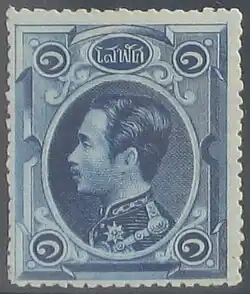
The people of Thailand respect their king and the Royal Family very much. Showing disrespect to them can lead to jail because of a law called "lèse-majesté". Some people have been arrested for saying bad things about the Royal Family.[29]
Things with the king’s picture on them, like money, stamps, or magazine covers, should never be thrown on the ground or treated badly. Even licking the back of a stamp is seen as rude. These items should never be stepped on because putting your foot above the king’s head is very disrespectful. If money or other things fall on the ground by accident, you should pick them up right away and gently clean them instead of stepping on them to stop them from rolling away.[30]
In Thailand, the head is very special and should not be touched by hand.[31] Feet are seen as unclean. You should not point at people or things with your feet, and when sitting on the floor, you should not show the soles of your feet to others.[32]
Turkey
In Turkey family members and friends use the word "sen" (you, singular) when talking to each other. Adults also use "sen" when speaking to children. In formal situations, like meeting new people, business, or with customers and coworkers, people use "siz" (you, plural) almost all the time. In very formal cases, "sizler" (double plural you) is used to show great respect. Sometimes, verbs are changed to third person plural form (without using the pronoun) to show very high respect.
For commands, there are three forms:
- "sen" form for informal (one person)
- "siz" form for formal (more than one person or polite)
- "sizler" form for very formal (rarely used)
For example, the verb "gelmek" (to come) has these forms:
- gel (informal)
- gelin (formal)
- geliniz (very formal)
Turkish honorifics (titles) usually come after the first name. They show gender or social status, like:
- Name Bey (Mr.)
- Name Hanım (Ms.)
- Name Hoca (teacher or religious leader)
These are used in both formal and informal situations. A newer title is "Sayın," which goes before the last name or full name and is not for a specific gender. It is used in very formal situations, like "Sayın Name Surname."
People do not wear shoes inside the house to keep the floor clean from dirt or dust. Shoes are taken off before entering and left outside or in a shoe cabinet. People often wear slippers inside, or just socks in informal places. There are special slippers for the bathroom to keep it clean. Some people believe it is bad luck to open umbrellas indoors, so they close umbrellas before coming inside. Passing a knife or scissors directly to someone is also thought to bring bad luck. These beliefs are common especially among older people.
Hosts usually ask guests to keep eating. You don’t have to eat a lot, but you should try a little of everything and say nice things about the food. If someone offers food or help, they usually offer more than once. It is polite to say no the first time to avoid trouble. If you are invited to dinner, it is polite to bring something, usually dessert. Don’t bring alcohol unless you know the host drinks it. If you bring food or drinks, offer them at the right time during the visit. Before starting to eat, wait for the oldest people to begin first. But when drinking water, younger people can go first. Blowing your nose at the table is rude and makes people uncomfortable, even if you have a cold. Sniffing is also rude. It is best to go to the bathroom to clear your nose.
Avoid hand signs you don’t know because some can be rude or offensive. Also, don’t comment on the looks of someone’s wife or female family members because it can be rude. Friends greet each other by shaking hands and sometimes touching or kissing one or both cheeks. This is not okay in business. It is usually disrespectful to sit with crossed legs near parents, grandparents, or teachers. When sitting with crossed legs, don’t point your foot at someone, especially older or important people. Showing the bottom of your shoes or feet is also rude. Couples kissing in public is not polite in more traditional areas because it is not seen as modest.
All over Turkey, people observe one minute of silence at 9:05 am on November 10. This is to remember Mustafa Kemal Atatürk, the founder of Turkey.[33][34]
References
- ↑ "Asian Manners and Etiquette". www.pitlanemagazine.com. Archived from the original on May 12, 2016.
- ↑ Oster, Grant (6 April 2014). "Chinese Civilization's Impact on Japan and Korea". Hankering for History.
- ↑ Merchant, Chad (14 November 2014). "Chinese Etiquette and How it Influences Business Dealings in Malaysia". ExpatGo.
- 1 2 Shrestha, Nanda; Paul, Bimal (2002). Nepal and Bangladesh: A Global Studies Handbook. Santa Barbara, CA: ABC-CLIO. p. 290. ISBN 1576072851.
- ↑ Taylor, Ken; Williams, Victoria (2017). Etiquette and Taboos around the World: A Geographic Encyclopedia of Social and Cultural Customs. Santa Barbara, CA: ABC-CLIO. p. 26. ISBN 978-1440838200.
- ↑ Leung, Mikey; Meggitt, Belinda (2012). Bangladesh. Guilford, CT: Bradt Travel Guides. p. 97. ISBN 978-1841624099.
- ↑ "Chinese Food Culture: Table Manners, Dining Etiquette". www.travelchinaguide.com. Retrieved 2018-12-05.
- ↑ "这篇文章告诉你,为什么酒店餐厅需要提供茶叶茶水服务" [This article tells you why hotels and restaurants need to provide tea service]. www.sohu.com. 2021-10-27. Retrieved 2024-06-06.
在这样的背景之下,酒店餐馆除了可提供免费茶水外,还可以在菜单中添加上茶饮,方便不同年龄、爱好的客人,根据自己的喜好做出选择,这既丰富了酒店餐厅的服务,同样也满足了当下人对于健康的追求。
[In this context, in addition to providing free tea, hotels and restaurants can also add tea drinks to their menus to make it easier for guests of different ages and hobbies to make choices based on their preferences. This not only enriches the services of hotel restaurants, but also meets people's current pursuit of health.] - ↑ "【文明讲堂】握手礼仪篇" [【Civilization Lecture】Handshake etiquette]. m.thepaper.cn. 2021-04-04. Retrieved 2024-06-05.
握手的顺序主要取决于"尊者优先"的原则。在正式场合下,握手时伸手的先后次序主要取决于职位、身份。在一般场合,则主要取决于年龄、性别、婚否。(1)职位高的人与职位低的人握手,应由职位高的人先伸手为礼。(2)女士与男士握手,应由女士先伸手为礼。(3)长辈与晚辈握手,应由长辈先伸手为礼。(4)已婚者与未婚者握手,应由已婚者先伸手为礼。(5)老师与学生握手,应由老师先伸手为礼。(6)社交场合的先到者与后到者握手,应由先到者先伸手为礼。(7)主人待客时应先伸手,与来访客人握手;客人告辞时,应由客人先伸手为礼。
[The order of handshakes is mainly determined by the principle of "the elder comes first". In formal occasions, the order of extending hands when shaking hands is mainly determined by position and identity. In general occasions, it is mainly determined by age, gender, and marital status.(1) When a person of higher position shakes hands with a person of lower position, the person of higher position should extend his hand first.(2) When a lady shakes hands with a man, the lady should extend her hand first.(3) When an elder shakes hands with a younger person, the elder should extend his hand first.(4) When a married person shakes hands with an unmarried person, the married person should extend his hand first.(5) When a teacher shakes hands with a student, the teacher should extend his hand first.(6) When the first person to arrive shakes hands with the last person in a social occasion, the first person to arrive should extend his hand first.(7) When the host entertains guests, he should extend his hand first to shake hands with the visiting guest; when the guest leaves, the guest should extend his hand first.] - ↑ "《觉醒年代》中的鞠躬礼 | 文明礼仪小知识" [Bowing in "Awakening Age" | Tips on etiquette]. m.thepaper.cn. 2021-07-08. Retrieved 2024-06-05.
鞠躬,原为祭祀之礼,形成于商朝。辛亥革命废除跪拜礼后,鞠躬成为最平等的社交礼仪。
[Bowing was originally a sacrificial ritual that was formed in the Shang Dynasty. After the Xinhai Revolution abolished the kneeling ceremony, bowing became the most equal social etiquette.] - ↑ Baofeng, Ma (2013-01-12). "说说鞠躬礼(礼仪漫谈(110))" [Talking about bowing (Etiquette talk (110))]. paper.people.com.cn. Retrieved 2024-06-05.
鞠躬,即上身向前弯曲,源自我国古代祭天仪式。当时人们认为,在祭坛上将牛、羊等祭品弯成鞠形,才能表达对上天的恭敬与虔诚。后世演绎成日常礼节,弯腰、低头,避开对方视线,向其表示恭顺和没有敌意。现在我们看到,鞠躬礼已经成了向人致意、表示尊敬、谢意、致歉等方面的常用礼节。
[Bowing, which means bending the upper body forward, originated from the ancient Chinese ritual of offering sacrifices to heaven. At that time, people believed that only by bending the sacrifices such as cattle and sheep into a bow shape on the altar could they express their respect and piety to heaven. Later generations interpreted it into daily etiquette, bending over, lowering the head, avoiding the other person's sight, to show obedience and lack of hostility. Now we can see that bowing has become a common etiquette for greeting people, showing respect, gratitude, and apology.] - ↑ Baofeng, Ma (2013-01-12). "说说鞠躬礼(礼仪漫谈(110))" [Talking about bowing (Etiquette talk (110))]. paper.people.com.cn. Retrieved 2024-06-05.
鞠躬行礼时,忌讳不郑重。如不脱帽,或边鞠躬边说话,甚至嬉笑、左顾右盼、吃东西、一只手插在衣袋里等。鞠躬时应避开受礼人视线,这是表示恭敬、恭顺的重点所在。鞠躬时试图看对方的脸,势必要把头抬起、倾斜,使眼睛上翻,使鞠躬动作滑稽可笑,是不尊重对方的严重失礼行为。在应该行鞠躬礼的时候,以点头哈腰应付,是轻视受礼人的不严肃表现。
[When bowing, be careful not to be disrespectful. For example, do not take off your hat, talk while bowing, or even laugh, look around, eat, put one hand in your pocket, etc. When bowing, avoid the recipient's line of sight, which is the key to showing respect and obedience. When trying to look at the other person's face, you will have to raise your head, tilt your head, roll your eyes up, and make the bow look funny, which is a serious disrespect for the other person. When you should bow, nodding and bowing is a disrespectful and disrespectful expression of the recipient.] - ↑ Guangliang, Shi (2017-12-22). "中国餐桌礼仪:你可千万别坐错了位置" [Chinese table manners: Don’t sit in the wrong seat]. m.xinhuanet.com. Archived from the original on 2024-04-18. Retrieved 2024-04-18.
总的来讲,座次是"尚左尊东""面朝大门为尊"。若是圆桌,则正对大门的为主客,主客左右手边的位置,则以离主客的距离来看,越靠近主客位置越尊,相同距离则左侧尊于右侧。如果你是主人,你应该提前到达,然后在靠门位置等待,并为来宾引座。如果你是被邀请者,那么就应听从东道主安排入座。
[Generally speaking, the seating order is "to the left and to the east" and "to face the door is to respect". If it is a round table, the one facing the door is the host and guest, and the positions to the left and right of the host and guest are based on the distance from the host and guest. The closer the host and guest are, the more respectable they are. At the same distance, the left side is more respected than the right side. If you are the host, you should arrive early, then wait near the door and lead the guests to their seats. If you are an invitee, you should follow the host's seating arrangements.] - ↑ Runping, Yao (2017-01-25). "【提醒】过年聚餐,这些餐桌礼仪别忘啦" [[Reminder] Don’t forget these table manners during Chinese New Year gatherings]. www.xinhuanet.com. Retrieved 2024-04-18.
筷子不能竖插在碗里,原因是插在碗里像烧香,不太好。另外,盛汤时,一定要把筷子放下,绝不可以勺子、筷子同时拿在手上,否则是很不礼貌的。夹菜时,不能用筷子在菜里面翻来翻去的挑;吃饭时不能将菜、饭掉在桌上、地上到处都是;碗里的饭要吃干净,要吃得一粒不剩;吃完后筷子不能搁在碗上。
[Don't stick chopsticks upright in a bowl because it looks like burning incense, which is not good. In addition, when serving soup, you must put down your chopsticks. Never hold a spoon and chopsticks in your hand at the same time, otherwise it is very impolite.When picking up vegetables, do not use chopsticks to turn around inside the vegetables; when eating, do not drop vegetables or rice on the table or everywhere on the floor; eat the rice in the bowl cleanly, and eat every grain; Do not place chopsticks on the bowl after eating.] - ↑ "深入挖掘清明节丰厚的文化意蕴" [Deeply explore the rich cultural connotations of Qingming Festival]. news.cctv.com. 2016-04-03. Retrieved 2024-06-10.
祭祀是一种具有悠久历史的礼仪,在古代礼仪体系中被称为吉礼,位居五礼之首。中国古代祭祀对象繁多,其中最基本的三要素是天、地、人,后来演变成三祭之礼:祭天地、祭袓先、祭圣贤。清明节属于最为广泛的祭祀祖先之礼,具有深厚的文化蕴含。
[Sacrifice is a ritual with a long history. In the ancient ritual system, it is called auspicious ceremony and ranks first among the five rituals. In ancient China, there were many objects of sacrifice, among which the three most basic elements were heaven, earth and man. Later, it evolved into three rituals of sacrifice: sacrifice to heaven and earth, sacrifice to ancestors, and sacrifice to saints. Qingming Festival is the most widespread ritual of ancestor worship, with profound cultural connotations.] - ↑ Xing, Han (April 3, 2016). "深入挖掘清明节丰厚的文化意蕴" [Deeply explore the rich cultural connotation of Qingming Festival]. news.cctv.com. Retrieved 2024-05-16.
扫墓俗称上坟,是对已故亲人的祭祀活动。按照传统习俗,扫墓时,人们要携带酒食果品、纸钱等物品到墓地,将食物供祭在亲人墓前,再将纸钱焚化,为坟墓培上新土,折几枝嫩绿的新枝插在坟上,然后叩头行礼祭拜,最后吃掉酒食回家。
[Tomb sweeping, commonly known as visiting graves, is a sacrificial activity for deceased relatives. According to traditional customs, when sweeping graves, people should bring wine, food, fruits, paper money and other items to the cemetery, offer food in front of the graves of their relatives, burn the paper money, add new soil to the graves, break off a few green branches and insert them on the graves, then kowtow and pay homage, and finally eat the wine and food and go home.] - ↑ "【文明礼仪】如此优秀中国传统礼仪文化你知道吗?赶紧学起来!" [[Civilized Etiquette] Do you know the excellent Chinese traditional etiquette culture? Learn quickly!]. m.thepaper.cn. 2023-03-17. Retrieved 2024-05-17.
一般行于节庆期间,是晚辈或低级地位的人向尊长的礼敬,同辈之间也有相互的拜贺。行拜贺礼时,不仅态度恭敬,口诵贺词,俯首叩拜,同时也得有贺礼奉上。
[Generally used during festivals, it is a salute from juniors or people with lower status to their elders, and also to congratulate each other among peers. When performing the congratulatory ceremony, you should not only be respectful, recite the congratulatory message, and bow your head, but also be presented with congratulatory gifts.] - ↑ "Culture and etiquette – About India". Rough Guides. Archived from the original on 3 August 2019. Retrieved 23 April 2018.
- 1 2 3 4 Wesseldyke, Joe (23 March 2026). "India Culture and Etiquette Guide: Temples, Dress Codes, and Local Customs". The Traveler. Retrieved 2 April 2026.
- ↑ "Indonesia – Language, Culture, Customs and Business Etiquette". Kwintessential. Archived from the original on 26 April 2016. Retrieved 2 April 2012.
- 1 2 Lucy Debenham BA (27 July 2010). "Etiquette in Indonesia". Travel Etiquette. Retrieved 2 April 2012.
- ↑ Scott Reeves Forbes Magazine July 28th, 2005
- ↑ Terri Morrison The Business of Gifts Archived 2013-06-15 at the Wayback Machine
- 1 2 3 4 5 6 7 Fodor's Tokyo Etiquette & Behavior
- ↑ "South Korea - Etiquette, Customs, Culture & Business". kwintessential.co.uk. Archived from the original on 1 May 2016. Retrieved 23 April 2018.
- ↑ Airman's Quarterly Spring 2006
- ↑ "Good Manners | Business and Social Etiquette for Malaysia". destination-asia.com. Archived from the original on 3 September 2014. Retrieved 6 September 2014.
- ↑ "Singapore's position in the World in terms of Quality of Life". The Economist. 17 November 2004. Retrieved 17 August 2006.
- ↑ "Military Courts Sentence Man To Jail For Lese Majeste | Thailand: Flights, Hotels, News, Thai Girls, Pattaya, Phi Phi Islands, Phuket". www.thailandinthenews.com. Retrieved 2015-12-26.
- ↑ ACIS Travel Talk August 2006 Archived 2018-04-18 at the Wayback Machine
- ↑ "Cultural Etiquette". eDiplomat.
- ↑ "Thai Etiquette". Asia Tours. Archived from the original on 2014-02-10. Retrieved 2014-04-22.
- ↑ Ashaboglu, Maya (2022-11-18). "When 24 hours aren't enough". Yale Daily News. Archived from the original on 2025-07-08. Retrieved 2025-12-10.
- ↑ "Türkiye marks 87th anniversary of Atatürk's passing with nationwide tributes - Türkiye News". Hürriyet Daily News. 2025-11-10. Retrieved 2025-12-10.