Ethylene oxide
| |||
| Names | |||
|---|---|---|---|
| Preferred IUPAC name
Oxirane | |||
| Systematic IUPAC name
Epoxyethane Oxacyclopropane | |||
| Other names
Ethylene oxide Dimethylene oxide 1,2-Epoxyethane [3]-crown-1 Epoxide | |||
| Identifiers | |||
3D model (JSmol) |
|||
| Abbreviations | EO, EtO | ||
| ChEBI | |||
| ChemSpider | |||
| ECHA InfoCard | 100.000.773 | ||
| EC Number |
| ||
| KEGG | |||
| MeSH | Ethylene+Oxide | ||
PubChem CID |
|||
| RTECS number |
| ||
| UNII | |||
CompTox Dashboard (EPA) |
|||
SMILES
| |||
| Properties | |||
| C2H4O | |||
| Molar mass | 44.052 g·mol−1[1] | ||
| Appearance | Colorless gas | ||
| Odor | Ether-like | ||
| Density | 0.8821 g·cm−3[1] | ||
| Melting point | −112.46 °C (−170.43 °F; 160.69 K)[1] | ||
| Boiling point | 10.4 °C (50.7 °F; 283.5 K)[1] | ||
| Miscible | |||
| Vapor pressure | 1.46 atm (20 °C)[2] | ||
| −30.5·10−6 cm3/mol[3] | |||
Refractive index (nD) |
1.3597 (589 nm)[1] | ||
| 1.94 D | |||
| Thermochemistry | |||
| Std enthalpy of formation ΔfH |
−52.6 kJ·mol−1[4] | ||
| Standard molar entropy S |
242.5 J·mol−1·K−1[4] | ||
| Specific heat capacity, C | 47.9 J·mol−1·K−1[4] | ||
| Hazards | |||
| Occupational safety and health (OHS/OSH): | |||
Main hazards |
Carcinogen Extremely flammable | ||
| GHS labelling: | |||
Pictograms |
   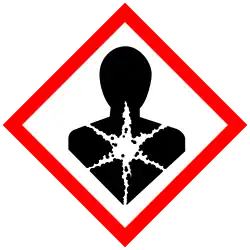   | ||
Hazard statements |
H220, H280, H301+H331, H314, H335, H336, H340, H350, H360, H372, H402 | ||
Precautionary statements |
P201, P202, P210, P260, P264, P270, P271, P273, P280, P301+P310+P330, P301+P330+P331, P303+P361+P353, P304+P340+P310 | ||
| NFPA 704 (fire diamond) | |||
| Flash point | −20 °C (−4 °F; 253 K)[5] | ||
Autoignition temperature |
429 °C (804 °F; 702 K)[5] | ||
| Explosive limits | 3 to 100% | ||
| Lethal dose or concentration (LD, LC): | |||
LC50 (median concentration) |
836 ppm (mouse, 4 hr) 4000 ppm (rat, 4 hr) 800 ppm (rat, 4 hr) 819 ppm (guinea pig, 4 hr) 1460 ppm (rat, 4 hr) 835 ppm (mouse, 4 hr) 960 ppm (dog, 4 hr)[6] | ||
| NIOSH (US health exposure limits): | |||
PEL (Permissible) |
TWA 1 ppm 5 ppm [15-minute excursion][2] | ||
REL (Recommended) |
Ca TWA <0.1 ppm (0.18 mg/m3) C 5 ppm (9 mg/m3) [10-min/day][2] | ||
IDLH (Immediate danger) |
Ca [800 ppm][2] | ||
| Safety data sheet (SDS) | ICSC 0155 Sigma-Aldrich Co., product no. 387614. | ||
| Related compounds | |||
Related heterocycles |
Aziridine, Thiirane, Borirane | ||
Except where otherwise noted, data are given for materials in their standard state (at 25 °C [77 °F], 100 kPa). | |||
 verify (what is  ?) | |||
| Infobox references | |||

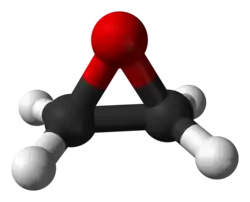

Ethylene oxide, called oxirane by IUPAC, is an organic compound with the chemical formula C
2H
4O.[7] It is the simplest epoxide.
References
- 1 2 3 4 5 Haynes, p. 3.430
- 1 2 3 4 NIOSH Pocket Guide to Chemical Hazards. "#0275". National Institute for Occupational Safety and Health (NIOSH).
- ↑ Haynes, p. 3.576
- 1 2 3 Haynes, p. 5.22
- 1 2 Haynes, p. 15.20
- ↑ "Ethylene oxide". Immediately Dangerous to Life or Health Concentrations. National Institute for Occupational Safety and Health.
- ↑ Rebsdat, Siegfried and Mayer, Dieter (2005) "Ethylene Oxide" in Ullmann's Encyclopedia of Industrial Chemistry. Wiley-VCH, Weinheim. doi:10.1002/14356007.a10_117.