Erythrina vespertilio
Erythrina vespertilio is a tree that grows naturally in northern and northeastern Australia. People call it by different names like grey corkwood, bat's wing coral tree,[1] yulbah,[2] and sometimes just "bean tree." In the Western Desert language, it is called ininti, and in the Arrernte and Anmatyerr languages, it is called atywerety.
Description
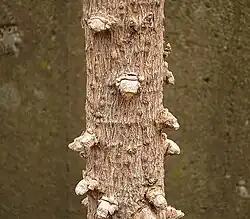
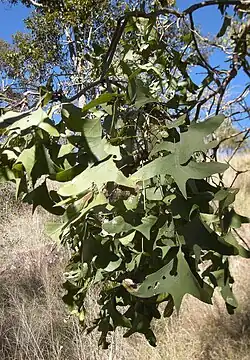
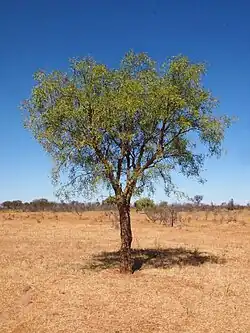
This small tree looks a bit messy and usually grows between 6 m (20 ft) and 10 m (33 ft) tall.[2][3] Its trunk is about 30 cm (12 in) wide. The trunk and branches have thorns, and the bark is thick, rough, cork-like, and creamy-grey in color.[3] The leaves have two (bifoliolate) or three (trifoliolate) leaflets and are 10 cm (4 in) to 15 cm (6 in) long. The leaflets are shaped like a wide wedge with three parts, looking like a bat’s open wings. Each leaflet is 7 cm (3 in) to 12 cm (5 in) long and 5 cm (2 in) to 12 cm (5 in) wide. The tree loses its leaves during the dry season.[3] The tree flowers from August to September. It produces bright red to orange-red flowers that look like pea flowers.[3] Each flower is 3 cm (1 in) to 4 cm (2 in) long and grows in clusters that are 5 cm (2 in) to 25 cm (10 in) long. The flowers usually appear when the tree has no leaves.[4] The seeds look like beans and are orange to dark yellow. They are about 12 mm (0 in) long and grow inside pods that are 6 cm (2 in) to 12 cm (5 in) long and 15 mm (1 in) to 18 mm (1 in) wide.[3]
Distribution
E. vespertilio is found in all Australian states except Victoria and Tasmania. It grows in open woodlands, but can be found in desert areas and on the edge of rainforests.[3] It is found in the Kimberley, Pilbara and northern Goldfields-Esperance regions of Western Australia,[2] the Northern Territory and Queensland, northern South Australia and north eastern New South Wales. It found near sea level and as high as 800 metres (2,625 ft).[4] It grows in well drained soil in full sun.[3]
Classification
The species was first described by the botanist George Bentham in 1848.[5]
There are two known subspecies:
- Erythrina vespertilio subsp. biloba[2]F.Muell. & A.R.Bean
- Erythrina vespertilio subsp. vespertilio
Uses
It was used by Indigenous Australians in Central Australia for making woomeras and coolamons. The Warlpiri, Anmatyerr, Arrernte and Alyawarr, use the wood to make shields. These could also be used for making fire with the friction method.
The bark can also be used as a medicine. The fruit contains alkaloids and the stem contains isoflavonoids. Phaseollidin (a flavonoid) has shown it can kill prostate cancer cells at high doses.[6]
The seeds are used to make decorations.
References
- ↑ Philip A. Clarke (2012). Australian plants as Aboriginal Tools. Rosenberg Publishing. ISBN 9781922013576.
- 1 2 3 4 Erythrina vespertilio, Western Australian Herbarium (1998–). Florabase—the Western Australian flora. Department of Biodiversity, Conservation and Attractions. https://florabase.dbca.wa.gov.au/ (Accessed 13 March 2026), https://florabase.dbca.wa.gov.au/browse/profile/3871
- 1 2 3 4 5 6 7 "Erythrina vespertilio". Australian Native Plants Society. January 2016. Archived from the original on 26 October 2017. Retrieved 30 April 2017.
- 1 2 F.A.Zich; B.P.M.Hyland; T.Whiffen; R.A.Kerrigan (2020). "Erythrina vespertilio". Australian Tropical Rainforest Plants (RFK8). Centre for Australian National Biodiversity Research (CANBR), Australian Government. Retrieved 31 May 2021.
- ↑ "Erythrina vespertilio Benth. (misapplied to Erythrina numerosa)". Atlas of Living Australia. Global Biodiversity Information Facility. Retrieved 30 April 2017.
- ↑ Iranshahi M., Vu H., Pham N., Zencak D., Forster P., Quinn R.J.,"Cytotoxic evaluation of alkaloids and isoflavonoids from the Australian tree erythrina vespertilio". Planta Medica. 78 (7) (pp 730-736), 2012.