Equal justice under law
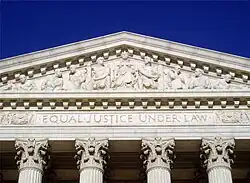
Equal justice under law is a sentence on the front of the United States Supreme Court building in Washington D.C.. It is also an ideal influencing U.S. law.
The idea for the sentence was given by the architects of the building, and was approved by the Court in 1932. It is inspired by the Equal Protection Clause of from the Fourteenth Amendment to the United States Constitution: "[no State shall] deny to any person within its jurisdiction the equal protection of the laws."
Origin
The sentence was suggested in 1932 by the architects that designed the Supreme Court Building.[1] Chief Justice Charles Evans Hughes and Justice Willis Van Devanter soon approved it, and so did the United States Supreme Court Building Commission which Hughes chaired and Van Devanter was a member of.[2][3]
The architect group that proposed the phrase was headed by Cass Gilbert, but Gilbert was more interested in design than in meaning.[4] According to David Lynn who at the time was Architect of the Capitol, the two people at Gilbert's firm who were responsible for the sentence were Gilbert's son (Cass Gilbert, Jr.) and Gilbert's partner, John R. Rockart.[3]
In 1935, the writer Herbert Bayard Swope objected to Chief Justice Hughes about this inscription, saying that the word "equal" be removed because such a "qualification" renders the phrase too narrow; the equality principle would still be implied without that word, Swope said. Hughes refused, writing that it was appropriate to "place a strong emphasis upon [fairness]".[3]
The sentence is perceived differently by different people.[5] According to law professor Jim Chen, it is common for people to "suggest that disagreement with some ... legal proposition or another would be [the same as] to [putting] 'Equal Justice Under Law' from the Supreme Court's portico."[5]
From the Fourteenth Amendment
The words "equal justice under law" paraphrase an earlier phrase said in 1891 by the Supreme Court.[6][7] For Caldwell v. Texas, Chief Justice Melville Fuller wrote for the Court, regarding the Fourteenth Amendment: "the powers of the States in dealing with crime within their borders are not limited, but no State can [stop] particular persons or classes of persons of equal and [fair] justice under the law."[8] The last seven words are shortened by the sentence.[6]
Since moving into their building, the Court has often used the words "equal justice under law" with the Fourteenth Amendment. For example, in the 1958 case of Cooper v. Aaron, the Court said: "The Constitution created a government dedicated to equal justice under law. The Fourteenth Amendment embodied and emphasized that ideal."[9][10]
The words "equal justice under law" are not in the Constitution, which instead says that no state shall "deny to any person within its jurisdiction the equal protection of the laws."[11] From an architectural perspective, the good thing of the sentence used over the sentence from the Constitution was length — the Equal Protection Clause was not short enough to fit because of the size of the letters used.
See also
References
- ↑ Pusey, Merlo. Charles Evans Hughes, Volume 2, p. 689 (Columbia University Press 1963).
- ↑ West Pediment Information Sheet via U.S. Supreme Court website. At that time, the other members of the Commission were Senator Henry W. Keyes, Senator James A. Reed, Representative Richard N. Elliott, Representative Fritz G. Lanham, and Architect of the Capitol David Lynn See Liu, Honxia. "Court Gazing: Features of Diversity in the Supreme Court Building Archived 2012-03-02 at the Wayback Machine", Court Review (Winter 2004)
- 1 2 3 McGurn, Barrett. "Slogans to Fit the Occasion", pp. 170-174, United States Supreme Court Yearbook (1982).
- ↑ Goodwin, Priscilla. "A Closer Look at the Bronze Courtroom Gates", Supreme Court Quarterly, Vol. 9, p. 8 (1988).
- 1 2 Chen, Jim. "Come Back to the Nickel and Five: Tracing the Warren Court's Pursuit of Equal Justice Under Law", Washington and Lee Law Review, Vol. 59, pp. 1305-1306 (2002).
- 1 2 Cabraser, Elizabeth. "The Essentials of Democratic Mass Litigation", Columbia Journal of Law & Social Problems, Vol. 45, p. 499, 500 (Summer 2012).
- ↑ Peccarelli, Anthony. "The Meaning of Justice", DuPage County Bar Association Brief (March 2000), via Archive.org.
- ↑ Caldwell v. Texas, 137 U.S. 692 (1891).
- ↑ Cooper v. Aaron, 358 U.S. 1 (1958).
- ↑ Mack, Raneta and Kelly, Michael. Equal Justice in the Balance: America's Legal Responses to the Emerging Terrorist Threat, p. 16 (U. Mich. Press 2004).
- ↑ Feldman, Noah. Scorpions: The Battles and Triumphs of FDR's Great Supreme Court Justices, p. 145 (Hachette Digital 2010).