Engystomops pustulosus
| Engystomops pustulosus | |
|---|---|
 | |
Scientific classification  | |
| Kingdom: | Animalia |
| Phylum: | Chordata |
| Class: | Amphibia |
| Order: | Anura |
| Family: | Leptodactylidae |
| Genus: | Engystomops |
| Species: | E. pustulosus |
| Binomial name | |
| Engystomops pustulosus (Cope, 1864) | |
| Synonyms[2] | |
| |
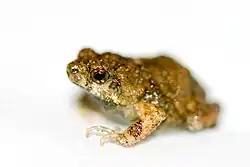
The Tungara frog or sapito Túngara (Engystomops pustulosus) is a frog. It lives as far north as Mexico and as far south as Colombia, Venezuela, and Guyana. It lives in Belize, Costa Rica, El Salvador, Guatemala, Honduras, Panama, Trinidad and Tobago, and Nicaragua.[2][3][1]
Home
This frog lives in forests, edges of forests, and grassy places and in places that people have changed. People see the frog near human-made ponds and puddles. Scientists have seen it between 0 and 1,540 m (0 and 5,052 ft) above sea level. Scientists have seen the frog in protected places.[1]
Young
These frogs have young in pools of water. The female frogs lay eggs in the same places as each other.[1]
Danger
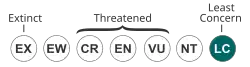
Scientists from the IUCN say this frog is not in danger of dying out. There are many protected places in its home and it is good at living in places that people have changed.[1]
References
- 1 2 3 4 5 IUCN SSC Amphibian Specialist Group; Instituto Boitatá de Etnobiologia e Conservação da Fauna (2023). "Tungara Frog: Engystomops pustulosus". IUCN Red List of Threatened Species. 2023: e.T57272A53969023. doi:10.2305/IUCN.UK.2020-2.RLTS.T57272A53969023.en. Retrieved June 3, 2026.
- 1 2 Frost, Darrel R. "Engystomops pustulosus (Cope, 1864)". Amphibian Species of the World, an Online Reference. Version 6.0. American Museum of Natural History, New York. Retrieved June 3, 2026.
- ↑ "Engystomops pustulosus (Cope, 1864)". AmphibiaWeb. University of California, Berkeley. Retrieved June 3, 2026.