Engystomops petersi
| Engystomops petersi | |
|---|---|
 | |
Scientific classification  | |
| Kingdom: | Animalia |
| Phylum: | Chordata |
| Class: | Amphibia |
| Order: | Anura |
| Family: | Leptodactylidae |
| Genus: | Engystomops |
| Species: | E. petersi |
| Binomial name | |
| Engystomops petersi Jiménez de la Espada, 1872 | |
| Synonyms[2] | |
| |
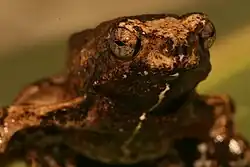
Peters' dwarf frog, Peters' bully foam frog, or sapito bullanguero de Peters (Engystomops petersi) is a frog. It lives in Brazil, Colombia, Ecuador, and Peru. Scientists say it might also live in Bolivia, French Guiana, and Suriname.[2][3][1]
Body
The adult male frog is 20.6–31.3 mm long from nose to rear end and the adult female frog is 25.2–39.1 mm. The skin of the frog's back can be gray or brown in color with red or orange spots. Some frogs have lighter color on their sides. There are large black spots near where the back legs meet the body. Parts of the throat and chest are dark gray with small white marks. Some frogs have some yellow color near the throat and chest. The iris of the eye is bronze in color.[3]
Home
This frog is awake at night. It lives on the ground in forests that were never cut down and forests that are growing back. People see the frog on the dead leaves on the ground. Scientists have seen it between 89 and 1,200 m (292 and 3,937 ft) above sea level. Scientists have seen the frog in protected places.[3][1]
Young
These frogs have young in pools of water. They put the eggs in nests made out of bubbles. The female frogs lay eggs in the same places as each other.[1]
The tadpoles' bodies and tail muscles are black in color with cream-white marks. People see the adult frogs on the ground in the forest and they see the younger frogs hiding in the plants.[3]
Danger
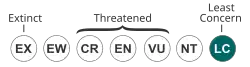
Scientists from the IUCN say this frog is not in danger of dying out. In some places, some of the frogs may be in danger when people change the places where the frogs live to cut down trees and make farms.[1]
References
- 1 2 3 4 5 IUCN SSC Amphibian Specialist Group (2023). "Peters' Dwarf Frog: Engystomops petersi". IUCN Red List of Threatened Species. 2023: e.T57270A184642858. doi:10.2305/IUCN.UK.2023-1.RLTS.T57270A184642858.en. Retrieved June 4, 2026.
- 1 2 Frost, Darrel R. "Engystomops petersi Jiménez de la Espada, 1872". Amphibian Species of the World, an Online Reference. Version 6.0. American Museum of Natural History, New York. Retrieved June 4, 2026.
- 1 2 3 4 Diego A. Ortiz; Morley Read; Santiago R. Ron (July 31, 2026). Santiago R. Ron (ed.). "Engystomops petersi Jiménez de la Espada, 1872". AmphibiaWeb (in Spanish). University of California, Berkeley. Retrieved June 4, 2026.