Dzungar–Russian conflicts
| Dzungar–Russian conflicts | |||||||||
|---|---|---|---|---|---|---|---|---|---|
| Part of the Russian conquest of Central Asia and the Russian conquest of Siberia | |||||||||
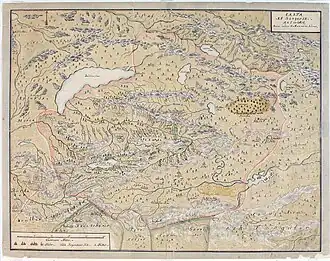 The map of Dzungaria by the Swedish prisoner of war, Johan Gustav Renat | |||||||||
| |||||||||
| Belligerents | |||||||||
| Dzungar Khanate | Tsardom of Russia | ||||||||
The Dzungar–Russian conflicts were a series of border conflicts between the Dzungar Khanate, and the Tsardom of Russia. As it started with Sengge's invasion of Yenisei down to the Expeditions by Buccholz, and Likharev.
By the 16th century, with the Russians invaded the Astrakhan Khanate, and the Khanate of Sibir to secure their trade routes and make towns for settlement.
15th century
In 1634, Erdeni Batur, who was the son of the Choros prince, Kharkhul, established the nation of the Dzungar Khanate on the upper Emil River and south of the Tarbagatai Mountains. He had established friendly with the Russians and granted them access to salt mines and to settle in his territory.[2] However the relations between the Dzungars and Russians fell, because the Khong Tayiji of the Dzungar Khanate, Sengge invaded the Yenisei river with the support of the Khakas people. The Dzungars moved towards the city of Krasnoyarsk.[3] The Dzungars killed the civilians and destroyed villages and farms.[4]
The Dzungars also defeated a Russian force, led by Rodion Koltsov. The Dzungars took Rodion Koltsov as a prisoner of war,[5] and laid siege to the city of Krasnoyarsk in 1667,[5][2] which led to death of civillians due to starvation.[6] Sengge had demanded that the Russian authorities recognize him as the Lord over the Kyrgyz people.[2] The Russians agreed to Sengge's terms and the Dzungars abandoned the siege.[7]
18th century
In 1709, The Dzungars invaded the Russians again, and destroyed a fortification between the Biya and Katun Rivers.[2] Later, with about 4,000 cavalry, the Dzungars continued their campaign, and ravaged several towns in the Area.[8]
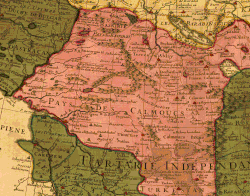
In 1714, I.D. Buchholz who was a lieutenant colonel had received commands signed by Peter I on the St. Natalia galley to arrive to Yarkent, and exploit the gold deposits in the Area.[9]
Meanwhile, Tsewang Rabtan, the Khan of the Dzungar Khanate sent Buchholz a demand to leave, which the Russian expedition force refused the demand. The Siege of Yamyshev soon occured by the Dzungar Khan's brother, Tseren Dhondup to attack the fortress with an army of 10,000 men, on February 9, 1716.[10]
End of the conflicts
In 1719, another expedition was made by I. M. Likharev. He soon reached the Lake Zaysan. But the Dzungars in leadership of Galdan Tseren attacked the Russian forces at Lake Zaysan in 1720.[11] This forced Likharev's expedition to return to Tobolsk.[12] After the battle, the Dzungar–Russian border was established on the Yenisei and Irtysh River.[13]
References
- ↑ Grousset, Rene (1970). The Empire of Steppes: A History of Central Asia. New Brunswick: RUTGERS UNIVERSITY PRESS. pp. 532.
- 1 2 3 4 Adle, Chahryar (2003). History of Civilizations of Central Asia. Vol. 5: Development in contrast: from the sixteenth to the mid-nineteenth century. UNESCO Publishing. p. 146. ISBN 92-3-103876-1.
{{cite book}}: CS1 maint: date and year (link) - ↑ (Gorod u Krasnogo Yara, p. 54).
- ↑ (Butanaev, p. 144)
- 1 2 Shamilevich, Umetbaev Timur. ДЖУНГАРЫ У СТЕН КРАСНОЯРСКА 1667 ГОД Уметбаев Тимур Шамилевич [DZUNGARS AT THE WALLS OF KRASNOYARSK 1667 Umetbaev Timur Shamilevich] (in Russian).
- ↑ Службы «на крови». Служилые люди красноярского острога и борьба с енисейскими киргизами в конце XVII столетия
- ↑ Boronin, O.V. (2002). Двоеданничество в Сибири XVII – 60-е. гг. XIX в. [Double tribute in Siberia XVII - 60s. XIX century Oleg Valerievich Boronin] (in Russian). Barnaul: Boronin, O.V., Edited by V.A. Moiseev. - Barnaul, 2002. p. 83.
- ↑ Boronin, Oleg V. "Двоеданничество в Сибири XVII - 60-е гг. XIX в." [Dual Subordination in Siberia from the 17th to the 1860s]. Двоеданничество В Сибири XVII - 60-е Гг. XIX В. (in Russian).
- ↑ Martynov, L. (1939). Крепость на Оми: Исторический очерк [The Fortress on the Om: A Historical Sketch] (in Russian). Omsk: Омскоблиздат.
- ↑ Perdue, P.C. (2005). China Marches West: The Qing Conquest of Central Eurasia. Cambridge: the Belknap press of Harvard university press, Peter C. Perdue. pp. 212. ISBN 0-674-01684-X.
- ↑ Baabar, Unknown (2000). "History of Mongolia" "From World Power to Soviet Satellite". Baabar. p. 84.
- ↑ Российско-казахские отношения в XVI–XIX вв [Russian-Kazakh Relations in the 16th–19th Centuries] (in Russian).
- ↑ Grousset, Rene (1970). The Empire of Steppes: A History of Central Asia. New Brunswick: RUTGERS UNIVERSITY PRESS. pp. 532.