Crossodactylodes septentrionalis
| Crossodactylodes septentrionalis | |
|---|---|
Scientific classification  | |
| Kingdom: | Animalia |
| Phylum: | Chordata |
| Class: | Amphibia |
| Order: | Anura |
| Family: | Leptodactylidae |
| Genus: | Crossodactylodes |
| Species: | C. septentrionalis |
| Binomial name | |
| Crossodactylodes septentrionalis Teixeira, Recoder, Amaro, Damasceno, Cassimiro, and Rodrigues, 2013 | |
Crossodactylodes septentrionalis is a frog. It lives in Brazil.[2][3][1]
Body
This frog is about 17 mm long from nose to rear end. The frog's skin is orange-brown in color with cream-white lines on the sides and a brown mark on the back shaped like the letter X. There are white spots on the back. The tops of the legs are orange in color. The belly is light in color. The iris of the eye is red in color.[4]
Name
Scientists named this frog septentrionalis because it is Latin for "of the north." C. septentrionalis lives further north than any other frog in Crossodactylodes.[4]
Home
This frog lives in trees. It lives in bromeliad plants that grow on the trees. Scientists have only seen the frog in the Vriesea dictyographa bromeliad plant. Scientists saw adult frogs, young frogs, and tadpoles living in the same plants.[1]
Scientists saw the frog in exactly one place: Peito de Moça peak, about 930 meters above sea level.[2] Scientists saw this frog in a protected park: Parque Nacional Serra das Lontras.[1]
Danger
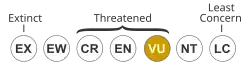
Scientists from the IUCN say this frog is in some danger of dying out. It lives in a protected park, so human beings do not change it. The biggest danger for this frog is climate change because it could change the rain and other water in the air, which the frog needs.[1]
References
- 1 2 3 4 5 IUCN SSC Amphibian Specialist Group (2023). "Crossodactylodes septentrionalis". IUCN Red List of Threatened Species. 2023: e.T78459018A86254792. doi:10.2305/IUCN.UK.2023-1.RLTS.T78459018A86254792.en. Retrieved October 24, 2025.
- 1 2 Frost, Darrel R. "Crossodactylodes septentrionalis Teixeira, Recoder, Amaro, Damasceno, Cassimiro, and Rodrigues, 2013". Amphibian Species of the World, an Online Reference. Version 6.0. American Museum of Natural History, New York. Retrieved October 24, 2025.
- ↑ "Crossodactylodes septentrionalis Teixeira, Recoder, Amaro, Damasceno, Cassimiro, & Rodrigues, 2013". AmphibiaWeb. University of California, Berkeley. Retrieved October 24, 2025.
- 1 2 Teixeira M Jr; Recoder RS; Amaro RC; Damasceno RP; Cassimiro J; Rodrigues MT (2013). "A new Crossodactylodes Cochran, 1938 (Anura: Leptodactylidae: Paratelmatobiinae) from the highlands of the Atlantic Forests of southern Bahia, Brazil". Zootaxa (Full text). 3702: 459–472. doi:10.11646/zootaxa.3702.5.5. Retrieved October 24, 2025.