Cristero War
| Cristero War | |||||||
|---|---|---|---|---|---|---|---|
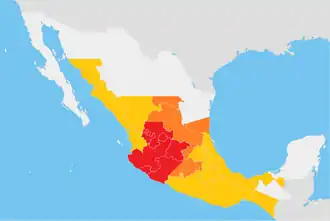 Map of Mexico showing regions in which Cristero outbreaks occurred Large-scale outbreaks Moderate outbreaks Sporadic outbreaks | |||||||
| |||||||
| Belligerents | |||||||
|
 United States |
Knights of Columbus | ||||||
| Commanders and leaders | |||||||
|
Plutarco Elías Calles Emilio Portes Gil Joaquín Amaro Domínguez Saturnino Cedillo Heliodoro Charis Marcelino García Barragán Jaime Carrillo Genovevo Rivas Guillén Álvaro Obregón † |
Enrique Gorostieta Velarde † José Reyes Vega † Alberto B. Gutiérrez Aristeo Pedroza Andrés Salazar Carlos Carranza Bouquet † Dionisio Eduardo Ochoa † Barraza Damaso Domingo Anaya † Jesús Degollado Guízar Luis Navarro Origel † Lauro Rocha Lucas Cuevas † Matías Villa Michel Miguel Márquez Anguiano Manuel Michel Victoriano Ramírez † Victorino Bárcenas † | ||||||
| Strength | |||||||
 ~100,000 men (1929) |
 ~50,000 men and women (1929) | ||||||
| Casualties and losses | |||||||
|
56,882 dead |
30,000-50,000 dead | ||||||
|
Estimated 250,000 dead 250,000 fled to the United States (mostly non-combatants) | |||||||
The Cristero War (in Spanish: Guerra Cristera or La Cristiada; [la kɾisˈtjaða]) is an Mexican conflict that occurred from 3 August 1926 to 21 June 1929, especially in the central and western parts of Mexico. The internal conflict had its background in the implementation of the Calles Law, which restricted the power of the Catholic Church and also the increaed enforcement of Articles 3, 5, 24, 27 and 130 of Constitution of 1917.
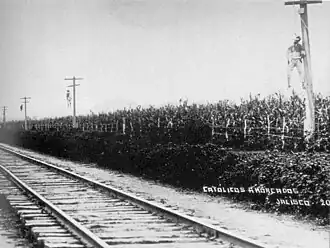
The rural population of central Mexico supported the Church and opposed the anticlerical laws. The conflict also involved US Ambassador Dwight Morrow breaking relations with the government of Mexican President Plutarco Calles. In 1929, the conflict ended by an agreement between the Mexican government and Archbishop Leopoldo Ruiz y Flóres, which ended the Church's support for the Cristero rebels and caused them to disintegrate.
The most important battles of the war occurred in the Mexican states of Zacatecas, Colima, Guanajuato, and Jalisco.
References
- Cristeros (Soldiers of Christ) – Documentary Archived 2012-03-24 at the Wayback Machine
- The Cristero Rebellion, by Jim Tuck Archived 2008-12-21 at the Wayback Machine
- AP article on the 2000 canonizations
- Biography of Miguel Pro Archived 2011-11-17 at the Wayback Machine
- Spanish article on the war
- Spanish biographies of the saints canonized in 2000
- Ferreira, Cornelia R. Blessed José Luis Sánchez del Rio: Cristero Boy Martyr, biography (2006 Canisius Books).
- Iniquis Afflictisque – encyclical of Pope Pius XI on the persecution of the Church in Mexico (November 18, 1926)
- Miss Mexico wears dress depicting Cristeros at the 2007 Miss Universe Pageant
- Catholicism.org: "Valor and Betrayal – The Historical Background and Story of the Cristeros" – article by Gary Potter.