Corinna
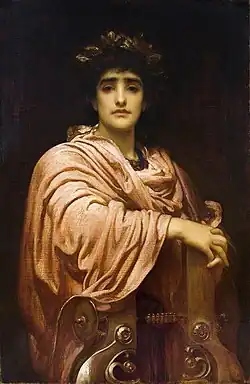
Corinna, or Korinna (Ancient Greek: Κόριννα, romanized: Korinna; c. 500–401 BCE), was an ancient Greek poet from Tanagra in Boeotia.[1] She may have been a contemporary and rival of the Greek poet Pindar.[1] Corinna's poetry survives only in pieces and focuses on local Boeotian myths.[1]
Biography
Corinna was from Tanagra in Boeotia (central Greece).[a] The Suda, a tenth-century Byzantine encyclopedia, says she was the daughter of Acheloodorus and Procratia, and was nicknamed "Myia" (Μυῖα, "the fly").[2] She was said to have lived during the fifth century BC.[4] She was maybe a contemporary of Pindar, either having taught him, or having been a fellow student of Myrtis of Anthedon with him.[b][6] Corinna was said to have defeated Pindar in either one poetry competition or five poetry competitions.[c][6][8]
Poetry
Corinna wrote five books of poetry according to the Suda.[9] But her poetry survives in roughly forty pieces.[10][8][11] Corinna uses simple and clear language in her poetry.[12] She uses basic metrical schemes,[13] and focuses on mythical stories.[14][15][16] The tone of Corinna's poetry is ironic or humorous.[17]
Corinna was respected by the people of her hometown, Tanagra. Pausanias says that there was a monument to her in the streets of the town and a painting of her in the gymnasium.[18] Tatian writes in his Address to the Greeks that Silanion had sculpted her.[19][19] Corinna's poetry was popular in the Roman Empire.[13] She is mentioned by the first-century BC Greek poet Antipater of Thessalonica who lists her as one of nine "mortal muses".[20] Ovid gives his lover the pseudonym "Corinna" in his Amores.[21] She is also named by Propertius as a model for Cynthia, and by Statius along with Callimachus, Lycophron, and Sophron.[22] Alexander Polyhistor wrote comments about her work.[23]
Gallery
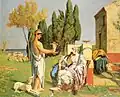 Corinna was a student of Myrtis of Anthedon, according to ancient tradition, with whom she sits in this 1897 painting by Ernst Stückelberg.
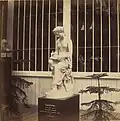 Corinna: The Lyric Muse by William Brodie (c. 1855).
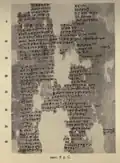 Papyrus showing Corinna's poems on the "Contest of Helicon and Cithaeron" and the "Daughters of Asopus" (P.Berol. 13284).
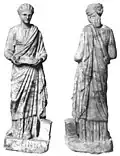 Ancient marble sculpture of Corinna, maybe a copy of Silanion's bronze mentioned by Tatian.
Notes
References
Citations
- 1 2 3 Encyclopedia Britannica (1998). "Corinna". Encyclopaedia Britannica, Inc. Retrieved 28 May 2024.
- 1 2 3 4 Suda κ 2087, "Corinna"
- 1 2 Pausanias, Description of Greece 9.22.3
- ↑ West 1990, p. 553.
- ↑ Vita Pindari Metrica, 9f.
- 1 2 Allen & Frel 1972, p. 26.
- ↑ Claudius Aelianus, Varia Historia 13.25
- 1 2 Plant 2004, p. 92.
- ↑ Campbell 1992, pp. 1–3.
- ↑ Page 1963, pp. 9–45.
- ↑ Balmer 1996, p. 33.
- ↑ Campbell 1967, p. 410.
- 1 2 Skinner 1983, p. 9.
- ↑ Larmour 2005, p. 46.
- ↑ Rayor 1993, pp. 220–221.
- ↑ Heath 2017, p. 103.
- ↑ Larmour 2005, p. 47.
- ↑ Snyder 1991, p. 42.
- 1 2 Vergados 2017, p. 244.
- ↑ Snyder 1991, p. 43.
- ↑ Heath 2013, p. 157.
- ↑ Thorsen 2020, p. 3.
- ↑ Vergados 2017, p. 245.
Sources
- Allen, Archibald; Frel, Jiri (1972). "A Date for Corinna". The Classical Journal. 68 (1): 26–30. JSTOR 3296024.
- Balmer, Josephine (1996). Classical Women Poets. Newcastle-upon-Tyne: Bloodaxe Books. ISBN 1-85224-342-2.
- Campbell, D. A. (1967). Greek Lyric Poetry: A Selection. New York: Macmillan Publishers.
- Larmour, David H.J. (2005). "Corinna's Poetic Metis and the Epinikian Tradition". In Greene, Ellen (ed.). Women Poets in Ancient Greece and Rome. Norman: University of Oklahoma Press. pp. 25–58. ISBN 0-8061-3664-2.
- Heath, John (2017). "Corinna's 'Old Wives' Tales'". Harvard Studies in Classical Philology. 109: 83–130. JSTOR 44863954.
- Heath, John (2013). "Why Corinna?". Hermes. 141 (2): 155–170. doi:10.25162/hermes-2013-0015. JSTOR 43652844. S2CID 252453257.
- Page, Denys L. (1963) [1953]. Corinna. London: The Society for the Promotion of Hellenic Studies.
- Plant, Ian M. (2004). Women Writers of Ancient Greece and Rome: An Anthology. Norman: University of Oklahoma Press. ISBN 978-0-8061-3621-9.
- Rayor, Diane (1993). "Korinna: Gender and the Narrative Tradition". Arethusa. 26 (3): 219–231. JSTOR 26309654.
- Skinner, Marilyn B. (1983). "Corinna of Tanagra and her Audience". Tulsa Studies in Women's Literature. 2 (1): 9–20. doi:10.2307/464203. JSTOR 464203.
- Snyder, Jane McIntosh (1991). The Woman and the Lyre: Women Writers in Classical Greece and Rome. Carbondale: SIU Press. ISBN 978-0-8093-1706-6.
- Thorsen, Thea S. (2020). "'Divine Corinna': Pre-Twentieth Century Receptions of an Artistic Authority" (PDF). EuGeStA. 10: 1–29. Archived from the original on 2022-01-27. Retrieved 2024-05-28.
{{cite journal}}: CS1 maint: bot: original URL status unknown (link) - Vergados, Athanassios (2017). "Corinna". In Sider, David (ed.). Hellenistic Poetry: A Selection. Ann Arbor: University of Michigan Press. pp. 243–263. ISBN 978-0-472-05313-1.
- West, Martin L. (1990). "Dating Corinna". The Classical Quarterly. 40 (2): 553–557. doi:10.1017/S0009838800043172. JSTOR 639119. S2CID 246874256.
Further reading
- Berman, Daniel W. (2010). "The Language and Landscape of Korinna". Greek, Roman, and Byzantine Studies. 50 (1): 41–62.
- Campbell, D. A. (1992). Greek Lyric Poetry IV: Bacchylides, Corinna, and Others. Cambridge: Harvard University Press. ISBN 978-0-674-99508-6.
- Collins, Derek (2006). "Corinna and Mythological Innovation". The Classical Quarterly. 56 (1): 19–32. doi:10.1017/S0009838806000036. JSTOR 4493385. S2CID 171018980.
- Debrosse, Anne (2015). "La réception des poétesses grecques, ou les affabulations de "l'imagination combleuse"". Anabases. 21 (21): 253–262. doi:10.4000/anabases.5371.
- Henderson, W. J. (1995). "Corinna of Tanagra on Poetry". Acta Classica. 38: 29–41. JSTOR 24594521.
- Klinck, Anne L. (2008). Women's Songs in Ancient Greece. Montreal & Kingston: McGill-Queen's University Press. ISBN 978-0-7735-3448-3.
- Kousoulini, Vasiliki (2016). "Panhellenic and Epichoric Elements in Corinna's Catalogues". Greek, Roman, and Byzantine Studies. 56 (1): 82–110.
- Larson, Jennifer (2002). "Corinna and the Daughters of Asopus". Syllecta Classica. 13: 47–62. doi:10.1353/syl.2002.0006. S2CID 161788185.
- Lobel, Edgar (1930). "Corinna". Hermes. 65 (3): 356–365. JSTOR 4474178.
- McPhee, Brian D. (2018). "Mythological Innovations in Corinna's Asopides Poem (fr.654.ii–iv PMG)". Greek, Roman, and Byzantine Studies. 58 (2): 198–222.
- Smyth, Herbert Weir (1963). Greek Melic Poets (4th ed.). New York: Biblo and Tannen. ISBN 978-0-8196-0120-9.
{{cite book}}: ISBN / Date incompatibility (help) - West, Martin L. (1970). "Corinna". The Classical Quarterly. 20 (2): 277–287. doi:10.1017/S0009838800036235. JSTOR 637425. S2CID 246875832.
Other websites
- "Korinna 1 (PMG 655)". Diotíma. Translated by Rayor, Diane. Retrieved 13 February 2022.