Cobalt(II) fluoride
 | |
 | |
| Names | |
|---|---|
| IUPAC name
Cobalt(II) fluoride | |
| Other names
cobalt difluoride | |
| Identifiers | |
3D model (JSmol) |
|
| ChemSpider | |
| ECHA InfoCard | 100.030.044 |
| EC Number |
|
PubChem CID |
|
| RTECS number |
|
CompTox Dashboard (EPA) |
|
SMILES
| |
| Properties | |
| CoF2 | |
| Molar mass | 96.93 g/mol |
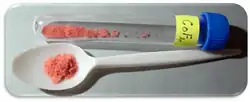
| Appearance | Red crystalline solid |
| Density | 4.46 g/cm3 (anhydrous) 2.22 g/cm3 (tetrahydrate) |
| Melting point | 1,217 °C (2,223 °F; 1,490 K) |
| Boiling point | 1,400 °C (2,550 °F; 1,670 K) |
| 1.4 g/100 mL (25 °C) | |
| Solubility | soluble in HF insoluble in alcohol, ether, benzene |
| Structure | |
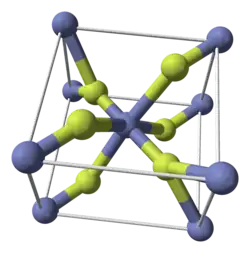
| tetragonal (a,hydrous) orthorhombic (tetrahydrate) | |
| Hazards | |
| NFPA 704 (fire diamond) | |
| Lethal dose or concentration (LD, LC): | |
LD50 (median dose) |
oral (rat): 150 mg/kg |
| Related compounds | |
Other anions |
cobalt(II) oxide, cobalt(II) chloride |
Other cations |
iron(II) fluoride, nickel(II) fluoride |
Except where otherwise noted, data are given for materials in their standard state (at 25 °C [77 °F], 100 kPa). | |
| Infobox references | |
Cobalt(II) fluoride, also known as cobaltous fluoride, is a chemical compound. Its chemical formula is CoF2. It contains cobalt in its +2 oxidation state. It also contains fluoride ions.
Properties
It is a reddish crystalline solid. It only dissolves a little in water. The hydrate (type with water molecules attached) can dissolve in water. It can dissolve in acid. It can react with hydrogen at 300 °C (572 °F) to make cobalt and hydrogen fluoride.
Preparation
It can be made by reacting anhydrous (without any water molecules attached) cobalt(II) oxide or cobalt(II) chloride with a stream of hydrogen fluoride. This reaction makes the anhydrous form. The hydrated (with water molecules attached) form is made by reacting any cobalt(II) compound with hydrofluoric acid. When fluorine is reacted with cobalt at a high temperature, it makes both cobalt(II) fluoride and cobalt(III) fluoride.
Uses
It is used as a catalyst. It can be used as a source of the fluoride ion in dentist care. It is used in lenses.