Central African Empire
Central African Empire Empire centrafricain | |||||||||
|---|---|---|---|---|---|---|---|---|---|
| 1976–1979 | |||||||||
| Motto: "Unité, Dignité, Travail" ("Unity, Dignity, Duty") | |||||||||
| Anthem: "La Renaissance" ("The Renaissance") | |||||||||
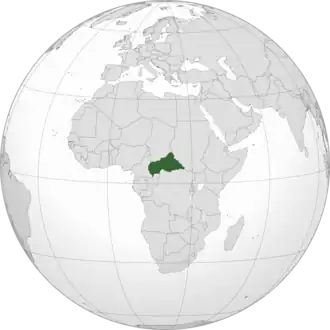 Location of the Central African Empire. | |||||||||
| Capital and largest city | Bangui | ||||||||
| Official language | French | ||||||||
National language | Sango | ||||||||
| Government | Constitutional monarchy (de jure) One-party absolute monarchy under military dictatorship (de facto) | ||||||||
| Emperor | |||||||||
• 1976–1979 | Bokassa I | ||||||||
| Prime Minister | |||||||||
• 1976–1978 | Ange-Félix Patassé | ||||||||
• 1978–1979 | Henri Maïdou | ||||||||
| Establishment | |||||||||
| 4 December 1976 | |||||||||
| 4 December 1977 | |||||||||
| 21 September 1979 | |||||||||
| Currency | Central African CFA franc | ||||||||
| |||||||||
| Today part of | Central African Republic | ||||||||
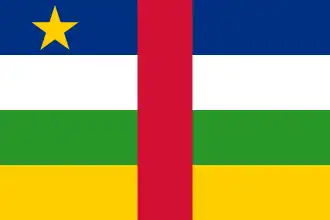
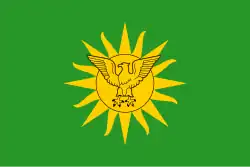
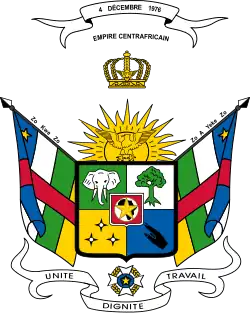

The Central African Empire (French: Empire centrafricain) was an African monarchical state that was established on 4 December 1976 when the then-President of the Central African Republic, Jean-Bédel Bokassa, declared himself Emperor of Central Africa. The empire would fall less than three years later when French and Central African forces overthrew Bokassa and re-established the Central African Republic on 21 September 1979.
History
Proclamation
In September 1976, President Jean-Bédel Bokassa dissolved the government of the Central African Republic and replaced it with the Central African Revolutionary Council. On 4 December 1976, at the ruling MESAN party congress, Bokassa instituted a new constitution, converted back to Roman Catholicism after briefly converting to Islam earlier in the year, and declared the country to be a monarchy. He then had himself crowned Emperor of Central Africa on 4 December 1977.[1]
Bokassa's full title was "Emperor of Central Africa by the Will of the Central African People, United within the National Political Party, the MESAN" and used the style "His Imperial Majesty". His regalia, lavish coronation ceremony, and regime were largely inspired by Napoleon, who had converted the French First Republic into the First French Empire. The coronation ceremony was estimated to cost his country roughly US$20,000,000 (XAF12,230,000,000,00 in modern values), one-third of the country's budget and all of France's aid for that year.
Bokassa justified his actions by claiming that creating a monarchy would help Central Africa "stand out" from the rest of the continent, and earn the world's respect. Despite invitations, no foreign leaders attended the event. Bokassa was widely ridiculed for this act, with his egotistical extravagance compared with that of Ugandan dictator Idi Amin.
Overthrow
By January 1979, French support for Bokassa had eroded after riots in Bangui led to a massacre of civilians.[2] Between 17 and 19 April, a number of high school students were arrested after they had protested against wearing the expensive, government-required school uniforms; an estimated 100 were killed in the Ngaragba Prison massacre.[3][4]
Emperor Bokassa personally participated in the massacre, where he was reported beating dozens of children to death with his own cane.[5] The massive press coverage which followed the deaths of the students opened the way for a successful coup which saw French troops in Operation Caban and subsequently Operation Barracuda restore former president David Dacko to power while Bokassa was away in Libya meeting with Muammar Gaddafi on 20 September 1979.
Bokassa's overthrow by the French government was called "France's last colonial expedition" by veteran French diplomat and regime change architect Jacques Foccart. François Mitterrand refused to have France intervene in this manner again. Operation Barracuda began the night of 20 September and ended early the next morning. An undercover commando squad from the French intelligence agency SDECE, joined by the 1st Marine Infantry Parachute Regiment led by Colonel Brancion-Rouge, landed by Transall transport aircraft, and managed to secure Bangui M'Poko International Airport. Upon arrival of two more aircraft, a message was sent to Colonel Degenne to come in with eight Puma helicopters and Transall aircraft, which took off from N'Djaména military airport in neighbouring Chad.[6]
By 12:30 p.m. on 21 September 1979, the pro-French Dacko proclaimed the fall of the Central African Empire. David Dacko remained president until he was overthrown on 1 September 1981, by General André Kolingba.
Bokassa died on 3 November 1996, in the Central African Republic. In 2009, Jean-Serge Bokassa, who was seven years old when the Emperor was overthrown, stated his father's reign was "indefensible".[7]
Notes
- ↑ The second flag was the Imperial Standard, but was also used unofficially as a secondary national flag.
References
- ↑ "Africa's Napoleon: The Coronation of Jean Bedel Bokassa". New Histories. Retrieved 2025-06-10.
- ↑ Meredith 1997, p. 230.
- ↑ "AFRICA: Papa in the Dock". Time. 11 June 1979. Archived from the original on 12 May 2019. Retrieved 12 May 2019.
- ↑ Greene, B. (12 March 2012). "5 Most Notorious African Warlords, Jean-Bédel Bokassa". U.S. News. Retrieved 12 May 2019.
- ↑ "10 LAWS OF TYRANNY: Jean-Bédel Bokassa of Central Africa". 26 December 2022.
- ↑ Bokassa 2006, p. 32.
- ↑ Thomson, M. (2 January 2009). "'Good old days' under Bokassa?". BBC News. Retrieved 12 May 2019.