Cartwheel galaxy
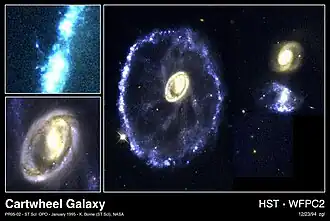
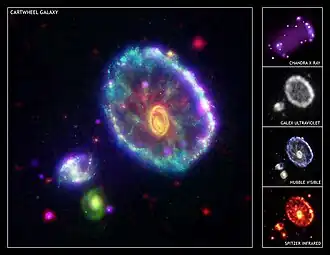
The Cartwheel galaxy (also known as ESO 350-40) is a lenticular galaxy about 500 million light-years away in the constellation Sculptor.[1]
It is about 150,000 light years across, slightly larger than the Milky Way.[2] It has a mass of about 2.9–4.8 × 10⁹ solar masses, and rotates at 217 km/s.[3]
It was discovered by Fritz Zwicky in 1941.[4] Zwicky said his discovery was "one of the most complicated structures awaiting its explanation on the basis of stellar dynamics".[4][5]
The Cartwheel galaxy shows radio and optical spokes, but they are not the same spokes.[6]
Evolution
The galaxy was a normal spiral galaxy before it had a collision with a smaller galaxy about 200 million years ago.[3][7][8] When the nearby galaxy passed through the Cartwheel Galaxy, the power of the collision sent a strong shock wave through the galaxy. Moving at high speed, the shock wave moved gas and dust. This made a starburst around the galaxy's center. This explains the blue colored ring around the center, bright section.[9] It can be seen that the galaxy is beginning to take the shape of a normal spiral galaxy again, as spiral arms (The spokes) are spreading out from a central core.[8]
There are other possible explanations of the ring-like appearance.[5]
References
- ↑ Moore, Patrick 2000. The data book of Astronomy. CRC Press, 318. ISBN 0-7503-0620-3
- ↑ "Amazing Space - fast facts: Cartwheel Galaxy". Amazing Space. 2008. Retrieved 2009-07-03.
- 1 2 Amram P.; et al. (1998). "The Hα kinematic of the Cartwheel galaxy". Astron Astrophys. 330: 881–93. Bibcode:1998A&A...330..881A.
- 1 2 Zwicky F (1941). Theodore van Karman Anniversary volume: contribution to applied mechanics and related subjects. Pasadena, California: California Institute of Technology. p. 137.
- 1 2 Griv E (2005). "Origin of the Cartwheel Galaxy: disk instability?". Astrophys Space Sci. 299 (4): 371–85. Bibcode:2005Ap&SS.299..371G. doi:10.1007/s10509-005-3423-5. S2CID 119586794.
- ↑ Mayya YD; et al. (2005). "The discovery of spiral arms in the starburst galaxy M82". Ap J. 628 (1): L33 – L36. arXiv:astro-ph/0506275. Bibcode:2005ApJ...628L..33M. doi:10.1086/432644. S2CID 17576187.
- ↑ That is, 200 million years before the image. We see the galaxy as it was 500 million years ago, and the collision took place 700 million years ago.
- 1 2 "Cartwheel Galaxy". College of Southern Nevada. Retrieved 2009-07-03.
- ↑ Platt, Jane (2006). "Cartwheel galaxy makes waves in new NASA image". NASA. Archived from the original on 2014-07-14. Retrieved 2009-05-15.
Other websites
- Galaxy evolution simulation: the Cartwheel Galaxy Archived 2011-07-19 at the Wayback Machine