COVID-19 pandemic in Europe
| COVID-19 pandemic in Europe | |
|---|---|
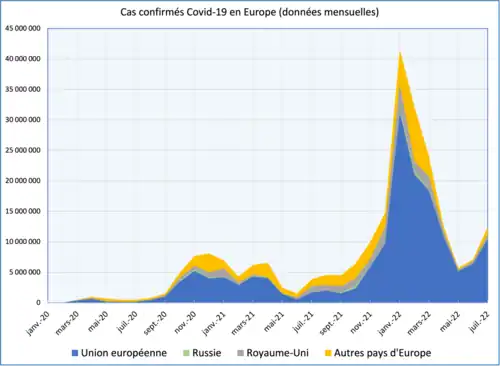 New COVID cases in Europe by month, from 2020–2022 | |
| Disease | COVID-19 |
| Virus strain | SARS-CoV-2 |
| Location | Europe |
| First outbreak | Wuhan, Hubei, China[1] |
| Index case | Bordeaux, France |
| Arrival date | 21 January 2020 (6 years, 5 months, 1 week and 1 day ago) |
| Confirmed cases | 243,000,000+[2] |
| Suspected cases‡ | >600,800,000 (>80% of Europe's population, 2021–22 estimates)[3][4] |
| Recovered | 239,000,000+[2] |
Deaths | ~2,000,000[2] |
Territories | 57 |
| ‡Suspected cases have not been confirmed by laboratory tests as being due to this strain, although some other strains may have been ruled out. | |
The global COVID-19 pandemic arrived in Europe with its first confirmed case in Bordeaux, France, on 24 January 2020. After that, the virus quickly spread across the continent. By 17 March 2020, every country in Europe had confirmed cases of COVID-19,[5] and all of them reported at least one death, with the exception of Vatican City.
Italy was the first European country to experience a major outbreak in early 2020, becoming the first country worldwide to introduce a a national lockdown.[6] By 13 March 2020, the World Health Organization (WHO) declared Europe the epicentre of the pandemic[7][8] and it remained so until the WHO announced it was overtaken by South America on 22 May.[9] By 18 March 2020, lockdowns introduced in Europe affected more than 250 million people.[10] Despite the deployment of COVID-19 vaccines, Europe became the pandemic's epicentre once again in late 2021.[11] On 11 January 2022, as the Omicron variant was rapidly exploding worldwide, Dr. Hans Kluge, the WHO Regional Director for Europe predicted that "more than 50 percent of the population in the region will be infected with Omicron in the next six to eight weeks".[12]
As the outbreak became a major crisis across Europe, national and European Union responses have led to debate over restrictions of civil liberties and the extent of European Union solidarity.
By May 2022, Europe was the most-affected continent in the world. The most-affected countries in Europe include Italy, France, Germany, the United Kingdom and Russia.
References
- ↑ "2019 Novel Coronavirus (2019-nCoV) Situation Summary". Centers for Disease Control and Prevention (CDC). 30 January 2020. Archived from the original on 26 January 2020. Retrieved 30 January 2020.
- 1 2 3 "COVID Live - Coronavirus Statistics - Worldometer".
- ↑ John P. A. Ioannidis (26 March 2022). "The end of the COVID-19 pandemic". European Journal of Clinical Investigation. 52 (2). Wiley Online Library. doi:10.1111/eci.13782. Retrieved 27 November 2025.
- ↑ "COVID in Europe: Up to 80% of the EU population has now been infected by the virus". Reuters. Euronews. 28 April 2022. Retrieved 27 November 2025.
- ↑ @MeGovernment (17 March 2020). "Two COVID-19 cases confirmed in Montenegro" (Tweet). Retrieved 17 March 2020 – via Twitter.
- ↑ Saglietto, Andrea; D'Ascenzo, Fabrizio; Zoccai, Giuseppe Biondi; Ferrari, Gaetano Maria De (4 April 2020). "COVID-19 in Europe: the Italian lesson". The Lancet. 395 (10230): 1110–1111. doi:10.1016/S0140-6736(20)30690-5. ISSN 0140-6736. PMC 7118630. PMID 32220279.
- ↑ Nebehay, Stephanie (13 March 2020). "Europe is epicenter of coronavirus pandemic: WHO". Reuters. Retrieved 8 May 2021.
- ↑ "Coronavirus: Europe now epicentre of the pandemic, says WHO". BBC. 13 March 2020. Retrieved 8 May 2021.
- ↑ Feuer, Will (22 May 2020). "South America is a 'new epicenter' of the coronavirus pandemic, WHO says".
- ↑ Henley, Jon (18 March 2020). "More than 250m in lockdown in EU as Belgium and Germany adopt measures". The Guardian. ISSN 0261-3077. Archived from the original on 1 April 2020. Retrieved 4 April 2020.
- ↑ "COVID-19's epicentre again: Europe faces fresh reckoning". www.aljazeera.com. Retrieved 19 November 2021.
- ↑ "Covid: Half of Europe to be infected with Omicron within weeks - WHO". BBC News. 11 January 2022. Retrieved 14 January 2022.