Brown-headed cowbird
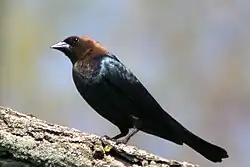
The brown-headed cowbird (Molothrus ater) is a bird in the Icteridae family.
Apearance
Male brown headed cowbirds are 7.5-8.7 inches in length with a wingspan of around 14 inches and a weight of 1.5-1.8 oz. Females are 6.3-7.9 inches in length with a wingspan of 12.6-15.0 inches and a weight of 1.3-1.6 oz. The slightly larger males have black plumage with a brown colored head. The females are light brown with lighter feathers on their heads and bellies. Females also have a faint streaking pattern on their belly. They have a clack finch-like beak that is shorter than other blackbirds and thick at the base. The juveniles are light brown with distinct streaking patterns. [1][2]
Habitat
Before the colonization of North America, the brown-headed cowbird's range was confined to the plains in the middle of the North American Continent. The birds followed the roaming bison herds, eating the insects kicked up by their hooves. Once colonization got underway, forests were cleared to create more agricultural habitats with large open grasslands and new forms of cattle for the birds to follow. This dramatic change to the landscape facilitated their spread throughout the continent. Because of this dramatic expansion to the birds' range, the brown-headed cowbird is considered a nuisance or invasive species in many parts of the US, including California.
Their current range includes the entirety of the mainland US, excluding Alaska, the majority of northern Mexico, and the majority of Alberta, as well as parts of Saskatchewan and British Columbia. They are often present in the middle and some of the southern part of their range year-round, and are present northwards during the breeding season. During the winter, they move into more southern areas, including Florida and Mexico. Within their range, they are found in rural agricultural habitats, open grasslands, forest edges, and in suburban areas where they feed on insects and seeds.[2][3][4]
Diet
The cowbird is a ground forager that feeds on various types of seeds and insects. They are known for following livestock and eating the seeds and insects that are exposed as the cows move across the landscape. They are also often seen flocking with other ground foraging birds, including other blackbirds, grackles, and starlings.[5]
Reproduction
Brown-headed cowbirds are brood parasites that lay their eggs in the nests of other birds instead of raising the eggs themselves. Often, the parasitized birds cannot tell the cowbird eggs apart from their own eggs and end up unwittingly adopting the cowbird chick as their own. The presence of the cowbird chick has a negative impact on its “siblings,” outcompeting them for food and, in the case of smaller host species, shoving them out of the nest entirely. Cowbirds often parasitize smaller bird species, so when the cowbird chick begins to grow, they often crowds out the host's biological chicks. This is made more effective by the fact that cowbird eggs have shorter incubation times than other birds, so they often hatch first, giving them a further advantage over their siblings. What's more, in about 60 to 70% of the nests, the female cowbird will remove a host egg before replacing it with her own.
This parasitic strategy allows the brown-headed cowbird to put more energy into mating and producing eggs instead of parental care. This means that a single female cowbird can lay up to 40 eggs in a single breeding season from May to July. Cowbirds are known to parasitize 220 different bird species. Cowbirds are far from monogamous, and females mate with many different males in one season, increasing the genetic diversity of their chicks. [6][5]
- ↑ "Brown-headed Cowbird Identification, All About Birds, Cornell Lab of Ornithology". www.allaboutbirds.org. Retrieved 2025-12-12.
- 1 2 "Brown-headed Cowbird | Audubon Field Guide". www.audubon.org. Retrieved 2025-12-12.
- ↑ "California's Invaders: Brown-Headed Cowbird". wildlife.ca.gov. Retrieved 2025-12-12.
- ↑ Lowther, Peter E. (2020). "Brown-headed Cowbird (Molothrus ater), version 1.0". Birds of the World. doi:10.2173/bow.bnhcow.01. ISSN 2771-3105.
- 1 2 "Brown-headed Cowbird Overview, All About Birds, Cornell Lab of Ornithology". www.allaboutbirds.org. Retrieved 2025-12-12.
- ↑ "Brown-Headed Cowbirds: From Buffalo Birds to Modern Scourge". Smithsonian's National Zoo and Conservation Biology Institute. 1996-01-01. Retrieved 2025-12-12.