British nuclear tests at Maralinga
| Maralinga Atomic Test Site in South Australia | |
|---|---|
| Near Maralinga in Australia | |
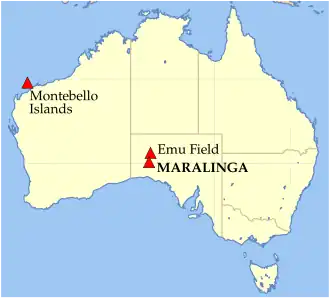 Map showing nuclear test sites in Australia | |
| Coordinates | 30°10′S 131°37′E / 30.167°S 131.617°E |
| Type | Nuclear test range |
| Site information | |
| Operator | United Kingdom |
| Status | Inactive |
| Site history | |
| In use | 1955–1963 |
| Test information | |
| Nuclear tests | 7 |
| Remediation | Completed in 2000 |
Between 1956 and 1963, the United Kingdom carried out seven nuclear tests at Maralinga in South Australia. This site is part of the Woomera Prohibited Area, about 800 km (500 mi) northwest of Adelaide, the state capital. There were two main groups of tests: Operation Buffalo in 1956 and Operation Antler in 1957. The explosions ranged from about 1 to 27 kilotons of TNT (4 to 100 TJ) of TNT.
Maralinga was also used for smaller tests that did not involve full nuclear explosions. These minor tests included:
- "Kittens": tested parts called neutron initiators.
- "Rats" and "Tims": studied how the core of a nuclear weapon was compressed.
- "Vixens": looked at how fire or small explosions affected atomic weapons.
There were about 550 minor tests, which caused more radioactive contamination than the big explosions.
Operation Buffalo
Operation Buffalo had four tests:
- One Tree (12.9 kilotons of TNT (54 TJ)) and Breakaway (10.8 kilotons of TNT (45 TJ)) were exploded on towers.
- Marcoo (1.4 kilotons of TNT (5.9 TJ)) was exploded on the ground.
- Kite (2.9 kilotons of TNT (12 TJ)) was dropped from a British Vickers Valiant bomber plane at 11,000 metres (35,000 ft). This was the first time Britain dropped a nuclear weapon from an aircraft.
Operation Antler
Operation Antler tested new, lighter nuclear weapons with three tests:
- Tadje (0.93 kilotons of TNT (3.9 TJ))
- Biak (5.67 kilotons of TNT (23.7 TJ))
- Taranaki 26.6 kilotons of TNT (111 TJ))
The first two were exploded on towers, and the last was hung from balloons. Tadje used cobalt pellets to measure the explosion, which led to rumors that Britain was making a cobalt bomb.
After the tests, the site was left contaminated with radioactive waste. A cleanup was first done in 1967. In 1985, the McClelland Royal Commission studied the site and found dangerous radiation still remained. They recommended another cleanup, which was finished in 2000 and cost AUD $108 million (about $192 million in 2022).
There has been ongoing debate about the safety of the site and the health effects on the Aboriginal people who lived there and on workers involved in the tests. In 1994, the Australian Government paid $13.5 million (about $26.6 million in 2022) to the traditional owners, the Maralinga Tjarutja people. The last part of the land in the Woomera Prohibited Area was opened for public access in 2014.
By the late 1970s, the way Australian mass media talked about the British nuclear tests changed a lot. Some journalists started to look deeper into the topic, and politicians began to pay more attention. In October 1978, journalist Brian Toohey wrote a series of articles in the Australian Financial Review, using information from a secret government paper. In June 1993, Ian Anderson, a writer for New Scientist, published an article called "Britain's dirty deeds at Maralinga" and other related stories. In 2007, Alan Parkinson wrote a book called *Maralinga: Australia's Nuclear Waste Cover-up* about the failed cleanup at Maralinga. The story of Maralinga has also inspired popular songs by Paul Kelly and the band Midnight Oil.