British fascism
British Union of Fascists | |
|---|---|
| Abbreviation | BUF |
| Leader | Oswald Mosley |
| Founded | 1 October 1932 |
| Dissolved | 23 May 1940 |
| Merger of | • New Party • British Fascists (majority) |
| Succeeded by | Union Movement |
| Headquarters | "Black House", King's Road, Chelsea, London SW3, U.K.[1] |
| Newspaper | • The Blackshirt (1933–1936) • Action (1936–1940) |
| Elite unit | "I" Squad[2] |
| Paramilitary wings | • Fascist Defence Force • Stewards |
| Autonomous wing | Ulster Fascists |
| Grassroots wing | January Club |
| Membership | 40,000 (c. 1934)[3][4] |
| Ideology | British Fascism • British nationalism • National conservatism • Social conservatism • Right-wing populism • National syndicalism[5] • Fascist corporatism • Non-interventionism[6][7] • Antisemitism[8] |
| Political position | Far-right |
| Religion | Church of England |
| Colours | Red, white and blue Black (customary) |
| Slogan | "Vote British and Save London" |
| Anthem | "Comrades the voices" |
| Party flag | |
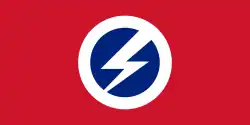 Other flags:
| |
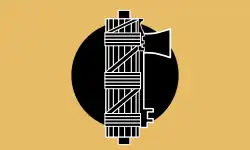
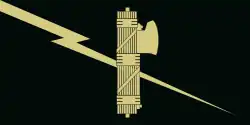
British Fascism is the form of fascism promoted by parties in the United Kingdom. [9] British fascism is based on British Nationalism. [10] Examples of British Fascist movements are British Fascists (1923-1934) and the British Union of Fascists (1932-1940). Some recent examples are National Front (1967-present) and Britain First (2011-present). [11][12][13]
Ideological origins
British Fascism is based upon Italian Fascism and British Traditions.[9]
British Fascism claims that both it Economic and Political agenda represent Tudor England.[9] It claims its centralized national authoritarian state is based upon the Tudor System.[9]
British Fascism also claims the legacy of Oliver Cromwell.[14]
English Political theorist Thomas Hobbes in his work Leviathan (1651) created the ideology of Absolutism which was highly influential in the fascist ideology.[15]
British fascism claims its corporatist economic policy is based upon the medieval guild system.[9]
Beliefs
Nationalism
British Fascism is based upon British Nationalism.
Foreign polices
British Fascism was Non-interventionism and argued war should only be used in defense of Britain or the British Empire. It believed the only threat to the British Empire was from the Soviet Union. [16]
Corporatist policies would also be spread to the empire.[17]
Totalitarianism
British Fascism is Totalitarian. The BUF declared support for a totalitarian state with Mosley describing it as "a nation emerges organised in the divine parallel of the human body as the name implies. Every organ plays a part in relation to the whole and in harmony with the whole".[18]
Corporatism economy
British Fascism is against laissez-faire and promotes a corporatist economic system.[9]
Traditionalism
British Fascism supports the British Monarchy.
References
- ↑ Linehan, Thomas P. (1996). East London for Mosley: the British Union of Fascists in East London and south-west Essex. London: Cass. p. 254. ISBN 0714645680.
- ↑ Martin Pugh, Hurrah For The Blackshirts!: Fascists and Fascism in Britain Between the Wars, pp. 133-135, Random House
- ↑ Powell, David (2004). British Politics,1910-35 - The Crisis of the Party System. Routledge. p. 181. ISBN 9780415351065.
- ↑ Webber, G. C. (1984). "Patterns of Membership and Support for the British Union of Fascists". Journal of Contemporary History. 19 (4): 575–606. doi:10.1177/002200948401900401. JSTOR 260327. S2CID 159618633.
- ↑ A Workers' Policy Through Syndicalism. Union Movement. 1953. ISBN 9781899435265.
{{cite book}}: ISBN / Date incompatibility (help) - ↑ Oswald Mosley. Fascism: 100 Questions Asked and Answered. Question 88
- ↑ Mosley, Oswald (15 November 1967). "David Frost Interviews Sir Oswald Mosley". The Frost Programme (Interview). Interviewed by David Frost.
- ↑ W F Mandle, Anti-Semitism and the British Union of Fascists
Robert Benewick The Fascist Movement in Britain, pp 132-134
Alan S Millward, "Fascism and the Economy", in Walter Laquer (ed) Fascism: A reader's Guide, p 450
Nigel Copsey, Anti-Fascism in Britain, p 38 and pp 40-41 - 1 2 3 4 5 6 Thomas P. Linehan. British fascism, 1918-39: parties, ideology and culture. Manchester, England: Manchester University Press, 2000. p. 14.
- ↑ Richard C. Thurlow. Fascism in Britain: from Oswald Mosley's Blackshirts to the National Front. 2nd edition. New York: I. B. Taurus, 2006. p. 133-134.
- ↑ Bienkov, Adam (19 June 2014). "Britain First: The violent new face of British fascism". Politics.co.uk. Retrieved 20 January 2017.
- ↑ Foxton, Willard (4 November 2014). "The loathsome Britain First are trying to hijack the poppy – don't let them". The Telegraph. Archived from the original on 9 January 2020. Retrieved 19 June 2018.
- ↑ Sabin, Lamiat (25 October 2014). "'Fascist' group Britain First to start 'direct action' on Mail and Sun journalists over Lynda Bellingham post". The Independent.
- ↑ Julie V. Gottlieb, Thomas P. Linehan. The culture of fascism: visions of the Far Right in Britain. New York: I. B. Taurus, 2004. p. 152.
- ↑ Contemporary Political Theory: New Dimensions, Basic Concepts and Major Trends. 12th Edition. New Delhi: Sterling Publishers, 2007. p. 705.
- ↑ Oswald Mosley. Fascism: 100 Questions Asked and Answered. Question 88
- ↑ Oswald Mosley. Fascism: 100 Questions Asked and Answered. Question 83
- ↑ Roger Griffin. Fascism, Totalitarianism And Political Religion. Oxon, England, UK; New York, New York, USA: Routledge, 2005. P. 110.