Boeing F/A-18E/F Super Hornet
| F/A-18E/F Super Hornet | |
|---|---|
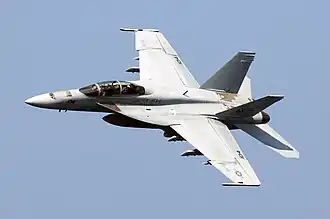 | |
| U.S. Navy F/A-18F Super Hornet | |
| Role | Carrier-based multirole fighter |
| National origin | United States |
| Manufacturer | McDonnell Douglas (1995–1997) Boeing Defense, Space & Security (1997–present) |
| First flight | 29 November 1995 |
| Introduction | 1999[1] 2001 (IOC) |
| Status | In service |
| Primary users | United States Navy Royal Australian Air Force Kuwait Air Force |
| Produced | 1995–present |
| Number built | ≥632 as of April 2020 |
| Program cost | Total procurement: US$48.09 billion (through FY2011) |
| Unit cost |
US$66.0 million (2020 flyaway cost) |
| Developed from | McDonnell Douglas F/A-18 Hornet |
| Variants | Boeing EA-18G Growler |
.
Origins
Origins of the Super Hornets were to replace the United States Navy’s aging F-14 Fleet, The F-14’s were getting old and the Classic Hornets were made to replace earlier models of the F-14.
Testing and Production
The testing and production went well for Boeing, the F/A-18’s were slowly phasing out the older F-14B’s, and from 2006 until the 2020’s the US Navy’s fleet was all Hornet variants until the F-35C Lightning II was introduced into the Navy.
Other Users
All users of the Super Hornets are;
United States - Operating 512 airframes of the Super Hornet and 155 Growlers, all for the United States Navy
Australia - Operating 24 F/A-18F Super Hornets based at No.1 Squadron - Royal Australian Air Force, and 12 E/A-18G Growlers based at No.6 Squadron - Royal Australian Airforce, all are being operated by the Royal Australian Air force, Based at RAAF Base Amberley
Kuwait - 28 F/A-18E/F Super Hornets on order, for the Kuwait Air Force
Armament
The Armament of the Super Hornets Includes;
- Guns: 1× 20 mm (0.787 in) M61A2 Vulcan, 412 rounds
- Hardpoints: 11 (2× wingtips, 6× under-wing, and 3× under-fuselage) with a capacity of Max payload: 17,750 lb (8,050 kg). Carrier bringback payload: F/A-18E: 9,900 lb (4,491 kg), F/A-18F: 9,000 lb (4,082 kg), with provisions to carry combinations of:
- Missiles:
- Air-to-air missiles
- 4× AIM-7 Sparrow
- 6× AIM-9 Sidewinder
- 12× AIM-120 AMRAAM
- 12× AIM-260 JATM (to be integrated)
- Air-to-surface missiles
- 6× AGM-65E/F Maverick
- 4× AGM-84H/K SLAM-ER
- 6× AGM-88 HARM
- 4x AGM-158 JASSM
- 4× AGM-154 Joint Standoff Weapon (JSOW) - glide bomb
- Anti-ship missiles
- 4× AGM-84 Harpoon
- 4× AGM-158C LRASM
- Joint Strike Missile (JSM) (to be integrated)
- Air-to-air missiles
- Bombs:
- JDAM bombs (up to 10× GBU-32/35/38/54 or 4× GBU-31)
- Paveway series of laser-guided bombs
- Mk 80 series unguided bombs
- CBU-78 Gator mine system[citation needed]
- Mk 20 Rockeye II cluster bomb[citation needed]
- Mk-62/63/65 Quick Strike Naval mine
- Other:
- SUU-42A/A Flares/infrared decoy dispenser pod and chaff pod
- AN/ALE-50 towed decoy system pod
- AN/ASQ-228 ATFLIR or AN/AAQ-28(V) Litening targeting pods
- up to 4× 480 US gal (1,800 L; 400 imp gal) drop tanks and 1× A/A42R-1 Aerial Refueling Store pod for aerial refueling.
- 12× ADM-141C TALD decoys
- AWW-13 Advanced data link pod
- Missiles:
Full Page
- ↑ Naval Aviation News March–April 1999, p. 30 "fleet service in January 1999"name="service1999">