Boana paranaiba
| Boana paranaiba | |
|---|---|
 | |
Scientific classification  | |
| Kingdom: | Animalia |
| Phylum: | Chordata |
| Class: | Amphibia |
| Order: | Anura |
| Family: | Hylidae |
| Genus: | Boana |
| Species: | B. paranaiba |
| Binomial name | |
| Boana paranaiba (Carvalho and Giaretta, 2010) | |
| Synonyms[2] | |
| |
Body
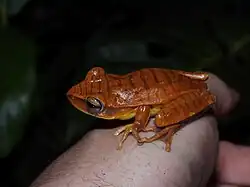
The scientists who wrote the first paper about this frog said the adult male frog was 46.3–52.3 mm long from nose to rear end and the adult female frog 46.2–51.2 mm long. The iris of the eye can be bronze in color or gray in color. It can have a blue ring in it. Sometimes there is only half a blue rung. The skin of its back is reddish or yellow in color. It has dark spots. There are wide, brown stripes down its back and all four legs. There is white color around these brown stripes. This frog has a thin white line on its mouth. It has a dark brown line from its nose to each eye. It has a dark brown line under its ear. It has dark spots near its jaw. Its belly is yellow or whitish in color. The insides of the back legs are dark brown with light spots.[4]
Name
The frog is named after the Paranaíba River. The name paranabia comes from the Tupi language. It means "large river with muddy water." The Tupi people live near where the frog lives.[4]
Home
This frog can live in a few different kinds of places. People have seen it in Caatinga, Cerrado, and Atlantic Forests, palm grove marshes, and nearby open areas. Scientists have seen it 600 m above sea level.
Scientists have seen the frog in protected places: APA da Serra das Gales e da Portaria, APA Serra da Jiboia, MONA Ponte de Pedra do Rio Correntes, and PARES do Jalapão.[1]
Young
Male frogs sing for female frogs on the ground or on plants. They can sit up to 2 m off the ground. Scientists saw that the male frogs had scars on their backs. The scars were not deep. The scientists think the male frogs might fight each other.[4]
Danger
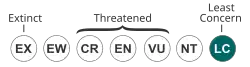
Scientists from the IUCN say this frog is not in danger of dying out. In some places, some frogs may be in danger when human beings change the places where the frogs live to make towns and places for cows to eat grass.[1]
References
- 1 2 3 4 IUCN SSC Amphibian Specialist Group; Instituto Boitatá de Etnobiologia e Conservação da Fauna (2023). "Boana paranaiba". IUCN Red List of Threatened Species. 2023: e.T83539002A86256019. doi:10.2305/IUCN.UK.2023-1.RLTS.T83539002A86256019.en. Retrieved June 3, 2026.
- 1 2 "Boana paranaiba (Carvalho and Giaretta, 2010)". Amphibian Species of the World 6.0, an Online Reference. American Museum of Natural History. Retrieved August 25, 2021.
- ↑ "Boana paranaiba". Amphibiaweb. Retrieved August 25, 2021.
- 1 2 3 THIAGO RIBEIRO DE CARVALHO; ARIOVALDO ANTONIO GIARETTA2; KÁTIA GOMES FACURE (June 29, 2010). "A new species of Hypsiboas Wagler (Anura: Hylidae) closely related to H. multifasciatus Günther from southeastern Brazil" (PDF). Zootaxa (Full text). 2521: 37–52. doi:10.11646/zootaxa.2521.1.3. Retrieved June 30, 2022.
{{cite journal}}: CS1 maint: numeric names: authors list (link)